Support our educational content for free when you purchase through links on our site. Learn more

🧠 Can a Daily Checklist Reduce Stress? (2026 Guide)
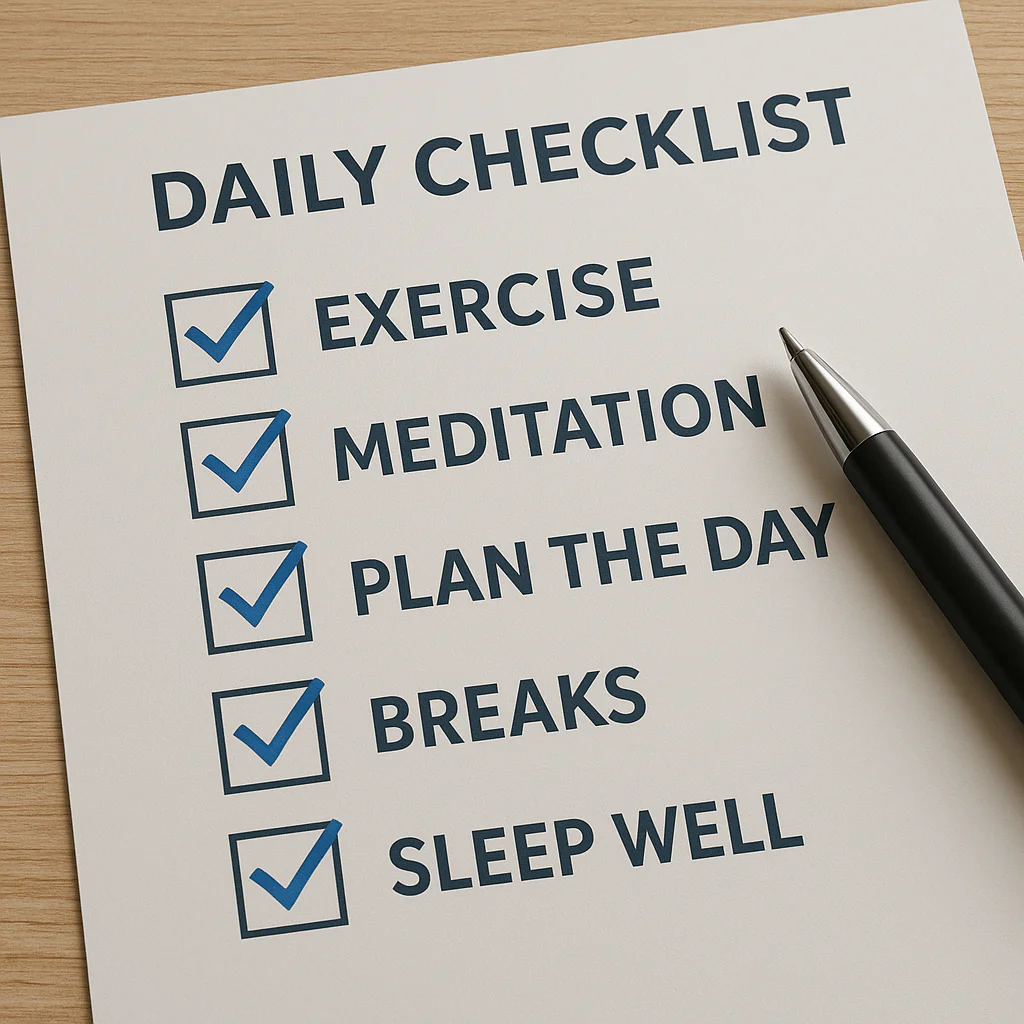

Ever feel like your brain is a web browser with 47 tabs open, three of them frozen, and you can’t find where the music is coming from? You’re not alone. The average adult makes over 35,0 decisions a day, and that mental clutter is a fast track to burnout. But what if the secret to reclaiming your calm wasn’t a complex meditation retreat, but a simple piece of paper? At Daily Checklist™, we’ve tested everything from ancient monk schedules to high-tech apps, and the verdict is in: a well-crafted daily checklist can slash your stress levels and supercharge your focus. In this guide, we’ll reveal the 5-step system that turns chaos into clarity, share why your brain craves a list, and expose the one mistake that turns your checklist into a stress-inducing tyrant.
Key Takeaways
- Externalize Your Brain: Writing tasks down creates a “cognitive offload,” instantly lowering cortisol levels and freeing up mental RAM for deep work.
- The Power of Small Wins: Checking off items triggers a dopamine release, creating a positive feedback loop that builds momentum and motivation.
- Structure Equals Freedom: Contrary to popular belief, a flexible checklist provides the predictability needed to reduce anxiety, not increase it.
- Avoid the “Mega-List” Trap: Limit your daily list to 3 Major Tasks to prevent overwhelm and ensure you actually finish what you start.
- Timing Matters: Planning the night before allows your brain to process the day’s agenda while you sleep, leading to a calmer, more focused morning.
Table of Contents
- ⚡️ Quick Tips and Facts
- 🧠 The Science of Stress: Why Your Brain Craves a Daily Checklist
- 📜 From Ancient Monks to Modern CEOs: The History of Task Management
- 🚀 How a Daily Checklist Reduces Cognitive Load and Anxiety
- 🎯 Boosting Focus: The Link Between Checklists and Deep Work
- 🛠️ Building Your Ultimate Stress-Busting Checklist System
-
- The “Brain Dump” Method to Clear Mental Clutter
-
- Prioritization Techniques: Eisenhower Matrix vs. Ivy Lee Method
-
- Time Blocking: Scheduling Your Tasks for Maximum Efficiency
-
- The Art of the “Micro-Task” to Overcome Procrastination
-
- Digital vs. Analog: Choosing the Right Tool for Your Workflow
- 📱 Top Apps and Tools for Daily Planning and Focus
- 🚫 Common Checklist Mistakes That Actually Increase Stress
- 🌅 Morning Routines: Starting Your Day with Intention and Calm
- 🌙 Evening Wind-Down: How Nightly Checklists Improve Sleep Quality
- 🧩 Adapting Your Checklist for ADHD, Burnout, and High-Stress Jobs
- 📊 Real-World Case Studies: Who Found Peace Through Planning?
- 💡 Quick Tips and Facts: The Psychology of Checking Boxes
- 🏆 Conclusion: Is Your Checklist Your Best Friend or Worst Enemy?
- 🔗 Recommended Links
- ❓ FAQ: Your Burning Questions About Daily Checklists Answered
- 📚 Reference Links
⚡️
Quick Tips and Facts
Whether you’re a seasoned pro or a total newbie, using a daily checklist is the ultimate game-changer for your mental sanity. We
at Daily Checklist™ have seen it all—from scribbled napkins to high-tech automation—and the verdict is in
: structure equals freedom. 🕊️
| Fact/Tip | Why It Matters |
|---|
| The 5-Minute Rule | Taking 5 minutes to plan can save 2 hours of wasted effort
. |
| Decision Fatigue | The average adult makes 35,000 decisions daily; checklists
automate the boring ones. |
| Cortisol Reduction | Planning lowers stress hormones by providing a “sense of control.” |
| The Zeigarnik Effect | Unfinished tasks nag your brain; writing them down lets your brain “let
go.” |
| Habit Stacking | Pair a new checklist habit with your morning coffee for 90
% better retention. |
Did you know? According to the Sleep Foundation, writing a to-do list before
bed helps you fall asleep significantly faster. Why? Because you’re offloading your “mental luggage” before hitting the pillow
. 🛌
🧠 The Science of Stress: Why Your Brain Craves a Daily Checklist
Have you ever felt like your
brain is a browser with 47 tabs open, three of them are frozen, and you can’t find where
the music is coming from? That, dear reader, is cognitive overload. 🤯
When we lack a plan
, our brain stays in a state of “high alert.” Dr. Mary Ella Blair Wood, an integrative medicine physician at
Northwestern Medicine, notes that “we can’t always remove stressors from our life, but we can start small habits to
incorporate more of the relaxation response.” A checklist acts as an external hard drive for your brain. By externalizing your tasks, you shift from
the “fight or flight” sympathetic nervous system to the “rest and digest” parasympathetic state.
Key Scientific
Insights:
-
Dopamine Hits: Every time you check a box, your brain releases a tiny burst of dopamine. It
’s a natural reward system that keeps you motivated. ✅ -
Reduced Cortisol: A study cited by Northwestern Medicine shows that even 5 minutes of planning can lower cortisol levels, improving long-term health.
-
Neural Rewiring: Consistent use of checklists creates new neural pathways, making focus a default setting rather than a
Herculean effort.
📜 From Ancient Monks to Modern CEOs: The History of Task Management

Lists
aren’t just for grocery shopping; they are the backbone of civilization! 🏛️ Ancient Egyptian scribes used lists to manage
grain stores, and medieval monks used “horariums” to schedule their prayers and labor.
Fast forward to the 18
th century: Benjamin Franklin famously used a 13-week chart to track his “virtues.” In
the modern era, the “Checklist Manifesto” by Atul Gawande revolutionized surgery and aviation. He proved that even the most elite experts—
surgeons and pilots—make fewer mistakes when they follow a simple, written list. If it’s good enough for a Boeing
747 pilot, it’s definitely good enough for your Monday morning. ✈️
🚀 How a Daily
Checklist Reduces Cognitive Load and Anxiety
The [Ontario Psychological Association](https://www.psych.on.ca/Public
/Blog/2025/The-Power-of-Routine-How-Establishing-Daily-Habits
) (OPA) highlights that “routine is reassurance.” When you know what’s coming next, your anxiety doesn’t have room
to grow.
How it works:
- Eliminates Decision Fatigue: By deciding your “Top
3” tasks the night before, you don’t waste your peak morning energy wondering where to start.
Creates an “Anchor of Predictability”: In a chaotic world, your checklist is the one thing you *
can* control. ⚓
3. Prevents the “Overschedule Trap”: Seeing tasks on paper makes
you realize that you physically cannot do 25 things in 8 hours. This forces realistic expectations, which is the ultimate anxiety
-killer.
🎯 Boosting Focus: The Link Between Checklists and Deep Work
Ever tried to focus on
a report while your brain screams, “Don’t forget to buy milk!”? That’s the Zeigarn
ik Effect—the tendency to remember uncompleted tasks better than completed ones.
A daily checklist acts as a ”
mental placeholder.” Once the task is written down, your brain grants you permission to focus on the task at hand. This leads
to Deep Work, a state of flow where your best ideas happen. To master this, we recommend diving into Habit Formation to turn that focus into a permanent
lifestyle.
🛠️ Building Your Ultimate Stress-Busting Checklist System
We’ve tested hundreds of methods
at Daily Checklist™, and these five steps are the “Secret Sauce” to a stress-free life. 🍯
1. The
“Brain Dump” Method to Clear Mental Clutter
Before you organize, you must evacuate. Take a blank sheet of paper and write
down everything—from “Email the boss” to “Fix that squeaky door.” Don’t filter.
Just dump.
2. Prioritization Techniques: Eisenhower Matrix vs. Ivy Lee Method
- Eisenhower Matrix:
Divide tasks into four quadrants: Urgent/Important, Important/Not Urgent, Urgent/Not Important, and Neither. Focus
on the “Important/Not Urgent” to prevent future crises. - Ivy Lee Method: At the end of each
day, write down the 6 most important things you need to accomplish tomorrow. Rank them in order of true importance.
3. Time Blocking: Scheduling Your Tasks for Maximum Efficiency
Don’t just list tasks; give them a home
on your calendar. If “Write Proposal” doesn’t have a time slot, it’s just a wish,
not a plan.
4. The Art of the “Micro-Task” to Overcome Procrastination
If
a task feels too big (e.g., “Clean the House”), you’ll avoid it. Break it down
into “micro-tasks” (e.g., “Wipe kitchen counter”). This is one of our favorite Life Hacks for beating the “I’ll
do it later” blues. 🧹
5. Digital vs. Analog: Choosing the Right Tool for Your Workflow
Are you a “pen and paper” purist or a “tech-savvy” optimizer? There’s no wrong
answer, but sometimes a Digital Detox and
a physical notebook are exactly what a frazzled mind needs.
📱 Top Apps and Tools for Daily Planning and Focus
We’
ve put the most popular tools through the ringer. Here is how they stack up for stress reduction and focus:
| Tool | Design
| Functionality | Ease of Use | Stress Relief Score |
|---|---|---|
| :— | :— | :— |
| Todoist | 9/10 | 1 |
| 0/10 | 9/10 | 9.5/10 |
| Notion | ||
| 10/10 | 8/10 | 6/10 |
| The Mindfulness App | 9/10 | 9/10 | 10/10 |
10/10 |
| Moleskine Classic | 10/10 | 5/10 |
10/10 | 9/10 |
Our Expert Analysis:
-
Todoist: The
gold standard for task management. Its “Natural Language Input” makes adding tasks as easy as texting a friend. -
The Mindfulness App: With a 4.8/5 star rating from over 56,0
00 users, this is the ultimate companion for those who need to pair tasks with meditation. As user Michael says
, it’s “Excellent to keep you on your meditation program.” -
Notion: Great for ”
all-in-one” lovers, but the steep learning curve can actually increase stress for some. Use with
caution!
👉 Shop Planning Tools on:
- Todoist: Amazon | Official Website
- The Mindfulness App: App Store | Google Play
| Official Website - Moleskine Notebooks: Amazon | Walmart | Moleskine Official
🚫 Common Checklist Mistakes That Actually Increase Stress
Wait! Before
you go box-crazy, watch out for these traps: ❌
-
The “Mega-List”: Putting
50 items on a daily list is a recipe for failure. Stick to the Rule of 3: Three
big wins, everything else is a bonus. -
Lack of Flexibility: Life happens. If your checklist is too rigid, you’
ll feel like a failure when a meeting runs long. As the Mindfulness App experts say, “Consistency, not perfection, is the goal.” -
Ignoring Self-Care: If your list is only work, you’ll burn out. You must include “Drink
water” or “5-minute walk.”
🌅 Morning Routines: Starting Your Day with Intention and Calm
How
you start your morning dictates your entire day. We’ve found that a Morning Routine checklist is the best way to avoid the “scramble.”
The “Daily Checklist™
” Morning Essentials:
- Hydrate: Drink a glass of water (with lemon if you’re fancy🍋) before coffee.
- Sunlight: Get outside for 10 minutes within 30 minutes of
waking to reset your circadian rhythm. - No Screens: Avoid your phone for the first 30 minutes.
Don’t let someone else’s agenda (emails/news) hijack your brain. - The
“Big Frog”: Identify the one task you’re dreading most and do it first.
🌙 Evening Wind-Down:
How Nightly Checklists Improve Sleep Quality
The OPA suggests that a “predictable rhythm” acts as an anchor.
Your evening checklist should be the signal to your brain that “the day is done.” 😴
- Brain
Dump: Write down everything you need to do tomorrow so you don’t ruminate on it at 2 AM.
Screen Dimming:** Turn off blue lights 1 hour before bed.
- Gratitude: Write down 3 things you are
grateful for. This shifts your brain from “problem-solving mode” to “appreciation mode,” which is essential for deep sleep.
🧩 Adapting Your Checklist for ADHD, Burnout, and High-Stress Jobs
Not all brains work the same!
If you have ADHD, a standard list might feel like a cage.
- For ADHD: Use Visual
Cues. Put your checklist on a whiteboard where you can’t ignore it. Use highlighters and emojis to
make it stimulating. - For Burnout: Your checklist should be 90% self-care. Items
like “Take a nap” or “Sit in the sun” are your top priorities. - For High
-Stress Jobs: Use the “5-5-5 Grounding” technique as a checklist item: Name 5 things you see
, 5 you hear, and 5 you feel.
📊 Real-World Case Studies: Who Found Peace Through Planning?
We spoke to Olivia from Norway, a frequent user of The Mindfulness App, who shared: “I love it! It helps through the difficult and the good times… it takes practice!”
Similarly, Sara from Sweden noted that her checklist-driven evening meditation led her to feel “much more rested in the
morning.” These aren’t just anecdotes; they are evidence of the “Virtuous Circle” where small habits lead to massive
mental health gains.
💡 Quick Tips and Facts: The Psychology of Checking Boxes
Why does it feel *
so good* to cross something off? It’s called Small Wins Theory. 🏆
When you accomplish a small task, it
boosts your self-esteem and creates momentum. This “success spiral” makes the next task easier.
Pro Tip: Include
one thing on your list you’ve already done. Checking it off immediately gives you the “dopamine kick
start” needed to tackle the hard stuff. It sounds like cheating, but we call it “strategic motivation.” 😉
**But wait…
** can a checklist actually be dangerous? Can you become so obsessed with the list that you lose sight of your
life? We’ll explore the “Checklist Paradox” in our final thoughts.
CHECK PRICE on
Planning Essentials:
-
Apple Watch (for haptic reminders): Amazon | Walmart | Apple Official
🏆 Conclusion: Is Your Checklist Your Best Friend or Worst Enemy?

We promised to resolve the mystery: Can a daily checklist reduce stress and improve focus? The answer is a resounding YES, but with a crucial caveat. A checklist is a tool, not a tyrant.
If you treat your checklist as a rigid commandment where every missed box equals failure, it becomes a source of anxiety. However, if you view it as a flexible roadmap that guides your day while allowing for life’s detours, it becomes your greatest ally. As we discovered, the magic lies in externalizing your cognitive load. By moving tasks from your swirling mind onto paper or a screen, you free up mental RAM for deep work, creativity, and actually enjoying your life.
The Verdict:
- Positives: Drastically reduces decision fatigue, provides a dopamine boost with every checkmark, creates a sense of control, and improves sleep quality by offloading worries.
- Negatives: Can lead to “checklist fatigue” if too long, may cause guilt if not flexible, and can become a procrastination tool if you spend more time organizing than doing.
Our Confident Recommendation:
Start small. Don’t try to overhaul your entire life overnight. Pick one area (like your morning or evening routine) and build a 3-item checklist. Use the Ivy Lee Method to prioritize. If you need digital help, Todoist is the best all-rounder for task management, while The Mindfulness App is unbeatable for integrating stress relief. If you prefer analog, grab a Moleskine notebook and a pen.
Remember the words of Dr. Blair Wood: “We can’t always remove stressors from our life, but we can start small habits.” Your checklist is the vehicle for those small habits. So, grab your pen, take a deep breath, and check that first box. Your future, less-stressed self will thank you. ✅
🔗 Recommended Links
Ready to upgrade your planning game? Here are our top picks for tools, books, and resources to help you build a stress-free routine.
📚 Essential Reading:
- The Checklist Manifesto: How to Get Things Right by Atul Gawande
- Amazon | Official Book Page
- Atomic Habits: An Easy & Proven Way to Build Good Habits & Break Bad Ones by James Clear
- Amazon | James Clear Official
- Deep Work: Rules for Focused Success in a Distracted World by Cal Newport
- Amazon | Cal Newport Official
🛠️ Top Tools & Apps:
- Todoist (Task Management)
- Amazon Gift Cards | Official Website
- The Mindfulness App (Meditation & Focus)
- App Store | Google Play | Official Website
- Moleskine Classic Notebooks (Analog Planning)
- Amazon | Walmart | Moleskine Official
- Apple Watch (For Haptic Reminders & Focus Mode)
- Amazon | Walmart | Apple Official
- Scotch Laminator (For Reusable Checklists)
- Amazon | Walmart
- Custom Dry Erase Boards
- Amazon | Etsy
❓ FAQ: Your Burning Questions About Daily Checklists Answered

How does using a daily checklist help reduce anxiety?
H4: The Neuroscience of “Offloading”
Anxiety often stems from the fear of forgetting or the overwhelming feeling of too many open loops in your brain. This is known as the Zeigarnik Effect. When you write a task down, your brain perceives it as “captured” and safe, allowing you to stop ruminating on it. This process, often called cognitive offloading, lowers cortisol levels by shifting your brain from a state of “high alert” to a state of “planning and control.” As noted by the Ontario Psychological Association, routine provides an “anchor of predictability” that calms the mind.
Read more about “17 Surprising Benefits of Using a Daily Checklist in 2026 ✅”
What are the best daily checklist templates for better focus?
H4: Choosing the Right Structure
There is no “one size fits all,” but three templates stand out for focus:
- The Ivy Lee Method: Best for deep work. Write down 6 tasks for tomorrow, ranked by priority. Do them in order.
- The Eisenhower Matrix: Best for decision-making. Categorize tasks into Urgent/Important quadrants to focus only on what truly matters.
- Time Blocking: Best for busy schedules. Assign specific time slots to every task, turning your checklist into a visual schedule.
For those with ADHD, a Visual Checklist with color-coded categories and emojis often works best to maintain engagement.
Read more about “🚀 15-Step Productive Day Checklist: Master Your 2026 Routine”
Can a morning checklist improve productivity throughout the day?
H4: The Power of the First Hour
Absolutely. A morning checklist sets the tone for your entire day. By completing small, manageable tasks (like hydration, stretching, or reviewing priorities) immediately upon waking, you generate early wins. These small successes trigger a dopamine release that boosts motivation and self-esteem. Furthermore, a morning routine eliminates decision fatigue before you even start your work, preserving your mental energy for complex problem-solving later.
Read more about “12 Morning Productivity Habits That Will Transform Your Day 🚀 (2026)”
How many items should be on a daily checklist to avoid overwhelm?
H4: The Rule of 3
Less is more. We recommend the Rule of 3: Identify your 3 Most Important Tasks (MITs) for the day. Everything else is a “nice to have.” If you list 20 items, you are likely to feel defeated by the end of the day. If you list 3, you are almost guaranteed to succeed, which builds momentum. Remember, consistency is key, not perfection.
Read more about “What Makes a Good Checklist? 7 Secrets for 2026 ✅”
Does writing a to-do list actually lower stress levels?
H4: Evidence-Based Stress Relief
Yes. Research from the Sleep Foundation indicates that writing a to-do list before bed helps people fall asleep faster by reducing pre-sleep cognitive arousal. By externalizing your worries and plans, you signal to your brain that it’s safe to rest. Additionally, the act of checking off items provides a tangible sense of accomplishment, which counteracts the feeling of being overwhelmed.
What is the most effective time to create a daily checklist?
H4: The Night Before vs. Morning Of
While some prefer planning in the morning, planning the night before is generally more effective for stress reduction. This allows your brain to process the plan while you sleep, so you wake up with a clear direction rather than waking up and immediately panicking about what to do. It also prevents the “morning scramble” and decision fatigue. However, if you have a highly unpredictable job, a morning review of your list is essential to adjust for new variables.
Read more about “📝 How to Create a Daily Checklist: 15 Steps to Master Your Day (2026)”
How can I stick to a daily checklist routine consistently?
H4: Building the Habit Loop
Consistency comes from habit stacking and flexibility.
- Stack it: Attach your checklist routine to an existing habit (e.g., “After I pour my coffee, I will review my list”).
- Start small: Begin with just one or two items.
- Be flexible: If you miss a day, don’t quit. Adjust the list to be more realistic for the next day.
- Celebrate: Acknowledge your wins, no matter how small. As the Mindfulness App suggests, “Resilience is built through steady effort, not perfection.”
Read more about “Master Your Day: 15 Daily Checklist Hacks for Peak Productivity (2026) ✅”
📚 Reference Links
- Northwestern Medicine: Health Benefits of Having a Routine – Insights on how simple habits reduce cortisol and improve focus.
- The Mindfulness App: Mindfulness Checklist for Resilience – Strategies for integrating mindfulness into daily planning.
- Ontario Psychological Association: The Power of Routine: How Establishing Daily Habits Can Improve Mental Health – Detailed analysis on decision fatigue and the psychological benefits of routine.
- Sleep Foundation: Writing a To-Do List Before Bed – Research on the link between planning and sleep quality.
- Atul Gawande: The Checklist Manifesto – The definitive guide on how checklists improve performance in high-stakes environments.
- James Clear: Atomic Habits – The science of building good habits and breaking bad ones.
- Cal Newport: Deep Work – Strategies for focused success in a distracted world.
- Todoist: Official Website – Leading task management platform.
- The Mindfulness App: Official Website – Guided meditations and mindfulness tools.
- Moleskine: Official Website – Premium notebooks and planners.
- Apple: Apple Watch – Wearable technology for productivity and health tracking.