Support our educational content for free when you purchase through links on our site. Learn more

15 Morning Productivity Habits to Start Your Day Strong ☀️
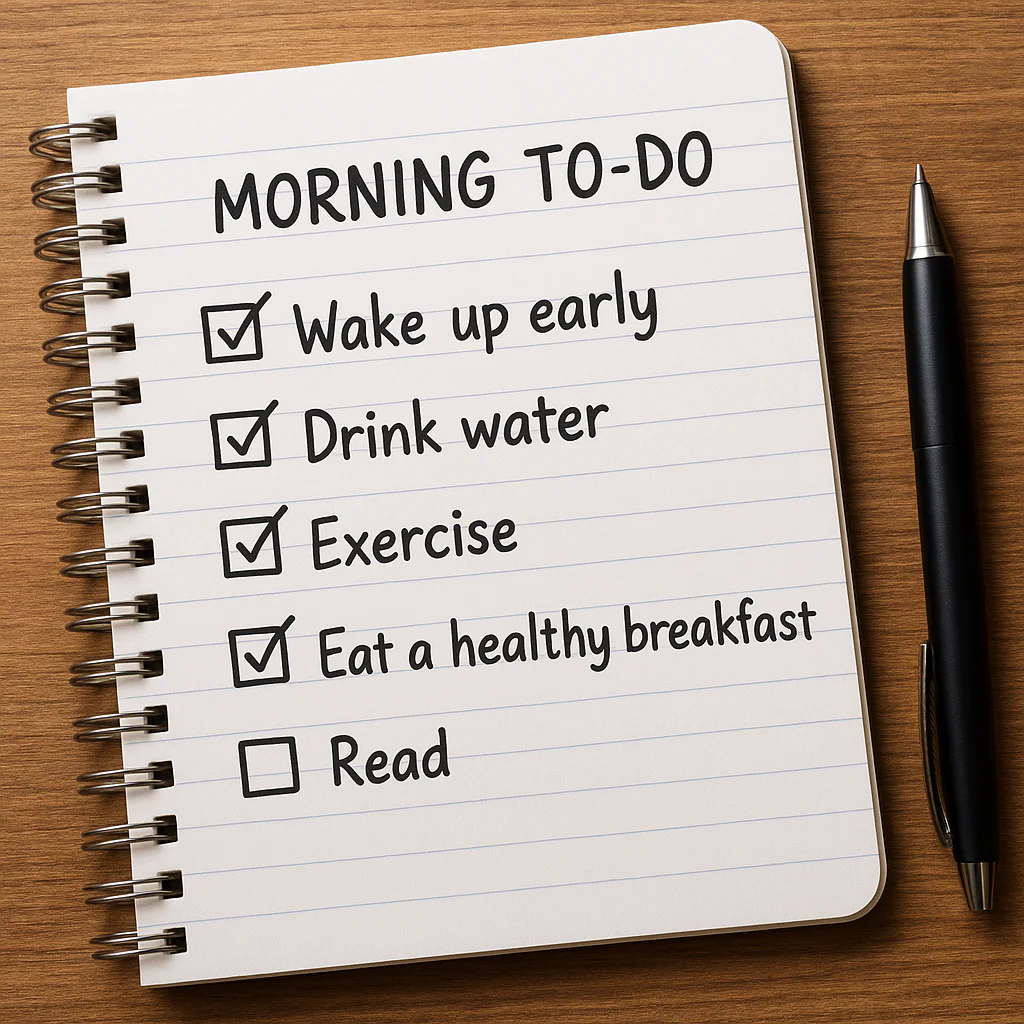

The best Morning Productivity Habits aren’t about waking up at an heroic hour or cramming your morning with wellness rituals. They’re small, repeatable actions that help you get enough rest, reduce avoidable decisions, and begin the day knowing what matters.
At Daily Checklist™, we’ve learned that a five-minute plan made the night before can beat a flawless morning routine that requires perfect weather, a quiet house, and an unusually cooperative alarm clock. Start with one or two habits, then build a routine around your real schedule.
Sleep comes first: the CDC recommends that adults get at least seven hours a night. So before you set a brutally early alarm, make sure your routine gives you enough time to rest.
Key Takeaways
- Protect your sleep first. A productive morning starts the night before; don’t trade rest for an earlier alarm.
- Make mornings easier with a little preparation. Set out essentials and write down your top priorities before bed.
- Choose habits that fit your life. Water, daylight, movement, breakfast, or quiet time can help, but you don’t need to do everything.
- Keep your checklist short and actionable. Identify your most important task and the next step to begin.
- Reduce distractions where you can. Set phone boundaries and protect focused work time when your responsibilities allow.
- Build gradually. A routine you can repeat beats an elaborate plan you abandon by Thursday.
Table of Contents
- ⚡ Quick Tips and Facts
- 🌅 The Science and Benefits of Morning Productivity
- How sleep, chronotypes, and circadian rhythms shape your mornings
- Why a productive morning looks different for everyone
- ✅ 15 Morning Productivity Habits to Build a Better Day
- 1. Protect your sleep and wake up consistently
- 2. Prepare for the morning the night before
- 3. Put your alarm across the room and skip snoze
- 4. Allow enough time for a calm commute or workday start
- 5. Drink water before reaching for caffeine
- 6. Enjoy coffee or tea strategically
- 7. Eat a nourishing breakfast—or plan for one
- 8. Get natural light early
- 9. Move your body with a quick workout or walk
- 10. Make time for personal care
- 11. Meditate, breathe, or journal to clear your mind
- 12. Choose a positive intention for the day
- 13. Review your schedule before opening your inbox
- 14. Prioritize your most important tasks
- 15. Start with focused work before distractions take over
- 🧩 Build a Morning Routine That Fits Your Life
- A 10-minute routine for busy mornings
- A 30-minute routine for a balanced start
- A 60-minute routine for deeper focus and exercise
- Morning routines for parents, students, and remote workers
- How to adapt your routine for early shifts or changing schedules
- 📱 Reduce Morning Distractions and Decision Fatigue
- Set phone boundaries and avoid email overload
- Use a simple checklist, planner, or calendar
- Make your workspace easier to start using
- 🔁 How to Make Your Morning Productivity Routine Stick
- Start small with habit stacking and realistic cues
- Track consistency without chasing perfection
- Troubleshoot low-energy mornings and missed days
- 🌱 A More Productive Morning Starts with a Sustainable Routine
- 🏁 Conclusion
- 🔗 Recommended Links
- ❓ FAQ
- What is the best morning routine for productivity?
- How early should I wake up to be more productive?
- How long should a morning routine take?
- Is it better to exercise or eat breakfast first?
- Should I check my phone first thing in the morning?
- What should I do if I am not a morning person?
- How can I have a productive morning with little sleep?
- Do morning affirmations or meditation improve productivity?
- 📚 Reference Links
⚡ Quick Tips and Facts
A productive morning isn’t a contest to see who can wake up earliest or fit the most self-improvement into one sunrise. The aim is to lower friction, protect your attention, and begin the day with enough energy to do what matters. At Daily Checklist™, we’ve found that a short routine you can repeat beats an elaborate one you abandon by Thursday.
For a practical way to simplify your day, start with a daily checklist that names the next action instead of trying to script every minute.
| Quick fact | What it means for your morning |
|---|---|
| Adults generally need at least seven hours of sleep | Don’t trade sleep for a longer routine. The CDC’s sleep guidance is a better starting point than an arbitrary 5 a.m. alarm. |
| Consistent sleep and wake times support healthy sleep habits | Aim for a schedule that fits your life, including weekends where practical. See the CDC’s sleep-hygiene recommendations. |
| Light, movement, and a clear plan can ease the transition into the day | Try daylight, a short walk, and one defined task rather than a dozen alarms and a motivational speech. |
| A morning routine is personal | Parents, shift workers, students, and night owls may need very different routines. Asana’s morning-routine guide also stresses that there is no single best routine for everyone. |
| Preparation reduces morning decisions | Write tomorrow’s top priorities and set out essentials before bed. A tiny bit of evening admin can save a surprising amount of morning faffing. |
Our 3-step starter routine:
- Get up at a time that leaves room for your real-life obligations.
- Drink water, get some light, or move gently—choose one or two, not all the wellness habits on the internet.
- Check your priorities and start one meaningful task before opening the inbox, if your work allows.
✅ Keep: repeatable cues, realistic timing, and a short priority list.
❌ Skip: sacrificing sleep, copying someone else’s dawn routine, and treating one missed morning as a full routine collapse.
For more ideas on building repeatable habits, browse our habit formation guides.
🌅 The Science and Benefits of Morning Productivity
Morning productivity is less about a magic hour and more about matching your routine to your sleep, energy, responsibilities, and work demands. A calmer start can make it easier to choose what deserves your attention before messages, meetings, and household logistics begin competing for it.
That doesn’t mean everyone does their best thinking before breakfast. Some people feel sharp early; others hit their stride later. We recommend treating your first few weeks as an experiment: notice when you feel alert, what derails you, and which small actions make the day easier.
How sleep, chronotypes, and circadian rhythms shape your mornings
Your body’s internal clock helps regulate sleep and wakefulness. Light exposure, daily schedules, and other cues affect that rhythm, so a routine that fits your normal sleep pattern is more sustainable than one built around an impressive alarm time. The National Institute of General Medical Sciences explains circadian rhythms, while the CDC recommends consistent sleep habits.
A few useful distinctions:
- Sleep duration matters: Most adults need at least seven hours, though individual needs vary. Check the CDC’s adult sleep recommendations.
- Wake time is not a virtue score: A 7:30 a.m. routine that works beats a 5 a.m. routine that leaves you chronically tired.
- Shift work changes the equation: If your schedule rotates, anchor your routine to your wake-up time rather than the clock.
- Morning light can be a helpful cue: Step outside or sit near a bright window when feasible. The National Institute for Occupational Safety and Health discusses light and shift-work schedules.
There’s also a common source of confusion: advice often says to wake earlier, while sleep experts emphasize getting enough sleep. Trust the sleep requirement first. If you want more morning time, move bedtime earlier gradually instead of borrowing hours from your body.
Why a productive morning looks different for everyone
A freelance designer with no commute can protect a quiet work block. A parent may be managing breakfast, backpacks, and a missing shoe that has apparently joined a witness-protection program. A nurse finishing a night shift may need a wind-down routine, not a sunrise workout.
Build around your actual constraints:
| Your situation | A useful adjustment |
|---|---|
| You commute | Pack essentials and choose clothes the night before; include a realistic travel buffer. |
| You work from home | Create a clear “start work” cue, such as opening your planner and setting a focus timer. |
| You have caregiving duties | Use a compact routine with one personal habit and one family-preparation checklist. |
| You work shifts | Keep the order of your routine consistent even when the clock time changes. |
| You’re not hungry early | Plan a balanced snack or breakfast for later rather than forcing a meal. |
| Your mornings are unpredictable | Use a minimum version: water, check today’s priority, begin the next action. |
Our planners’ rule: make the routine fit the day you have, not the fantasy day with no traffic, no children, and a perfectly charged phone. For more practical ways to reduce everyday friction, see our life hacks.
✅ 15 Morning Productivity Habits to Build a Better Day
You don’t need all 15. Choose a couple that solve your biggest morning problems, then build from there. The list moves from foundations to focused work because it’s hard to prioritize brilliantly when you’re running on four hours of sleep and coffee fumes.
1. Protect your sleep and wake up consistently
Start with sleep, not the alarm. The CDC recommends at least seven hours for adults, and sleep needs vary by age and person. Set a wake time that supports enough rest and works with your responsibilities.
Try this:
- Pick a realistic wake time for most workdays.
- Count backward to set a bedtime that gives you enough opportunity to sleep.
- Keep the timing reasonably consistent where your schedule allows.
- If you need to shift earlier, adjust gradually rather than suddenly moving your alarm by an hour.
If you’re regularly exhausted despite enough time in bed, or have persistent sleep problems, consider discussing them with a healthcare professional. A productivity routine can’t fix an untreated sleep issue.
2. Prepare for the morning the night before
Our most reliable morning hack often happens the evening before. Spend five minutes making tomorrow easier:
- Check your calendar for appointments, deadlines, and commute needs.
- Write down one to three priorities.
- Lay out clothing and gather keys, bags, chargers, or work materials.
- Set up breakfast ingredients or lunch supplies if that helps.
- Clear the spot where you’ll begin work.
The goal isn’t to plan every detail. It’s to remove decisions that don’t need to happen while you’re half awake. As TrackingTime’s morning-routine guide puts it, “Night-before preparation is where your morning is actually built.”
3. Put your alarm across the room and skip the snoze button
If snozing routinely turns a planned start into a hurried one, place your alarm far enough away that you need to stand up. Then make the first action obvious: open the curtains, put on slippers, or go straight to the bathroom.
A practical caveat: the snoze button is not the real villain if you’re consistently sleep-deprived. Moving the alarm helps with the habit; getting enough sleep addresses the cause. If you’re still struggling to wake, revisit bedtime and your sleep schedule rather than adding more alarms.
4. Allow enough time for a calm commute or workday start
Estimate the time your actual morning takes, not the time it takes in an optimistic spreadsheet.
Write down the steps—getting dressed, breakfast, family responsibilities, commuting, opening your workspace—and add a modest buffer. For a remote workday, decide when personal time ends and work begins. For an in-person job, check your route and leave room for ordinary delays.
A useful test: If one small hicup makes you late, your schedule has no buffer. Add time where you can; remove unnecessary tasks where you can’t.
5. Drink water before reaching for caffeine
A glass of water can be a convenient first habit, especially if it helps you remember to drink throughout the day. Keep it by the bed or kitchen sink if that makes the routine easier.
But let’s retire the dramatic claims: water is useful for hydration, not a special “detox” or guaranteed metabolism switch. The National Academies’ hydration guidance explains that fluid needs vary and include water from beverages and food.
Make it simple: Drink when you’re thirsty, keep water accessible, and follow medical guidance if you have a condition that affects fluid intake.
6. Enjoy coffee or tea strategically
Coffee or tea can be an enjoyable cue that your day has begun. Keep the ritual if you like it; just avoid using caffeine to mask chronic sleep loss.
Caffeine affects people differently, and timing matters. The FDA’s caffeine guidance notes that sensitivity varies and that too much can cause unwanted effects such as jiters or sleep disruption. If caffeine affects your sleep, try reducing the amount or having it earlier.
A cup can also become a small pause: make the drink, take a few slow breaths, then look at your top priority. No elaborate ceremony required. The mug is not a productivity system, but it can be a pleasant starting signal.
7. Eat a nourishing breakfast—or plan for one
Breakfast needs are individual. Some people feel better eating soon after waking; others prefer to eat later. If you do eat, aim for a satisfying mix that works for you—such as protein, fiber-rich foods, and fruit or vegetables.
Quick options include:
- Oatmeal with fruit, nuts, or yogurt.
- Eggs with whole-grain toast.
- Yogurt with berries and oats.
- A smoothie made with ingredients that keep you satisfied.
- A prepared snack to eat at work if appetite comes later.
The popular “30 grams of protein within 30 minutes” formula is not a universal requirement. Choose a pattern that supports your energy and health, and follow advice from your clinician or registered dietitian if you have specific dietary needs. For general nutrition guidance, see MyPlate from the U.S. Department of Agriculture.
8. Get natural light early
Open the curtains, step outside briefly, or take a short walk if your schedule and weather cooperate. Daylight can serve as a cue for your body clock; the National Institute of General Medical Sciences explains how light helps regulate circadian rhythms.
No need to stare at the sun—please don’t. Just make ordinary daylight part of the morning when practical. If you work nights or have a condition affected by light exposure, get tailored advice before changing your light routine.
9. Move your body with a quick workout or walk
Morning movement can be as modest as five minutes of stretching or a walk around the block. The CDC’s physical-activity guidance emphasizes regular activity across the week; it doesn’t require every session to be an intense dawn workout.
Pick a version you can repeat:
- Low effort: gentle mobility or a short walk.
- Moderate: a brisk walk, yoga session, or easy bike ride.
- Higher intensity: a workout you already tolerate and enjoy, with a warm-up and appropriate recovery.
If you have an injury, health condition, or concerns about exercising, seek advice from a qualified professional. The best routine is not the one that makes you miserable before 7 a.m.; it’s the one you can keep doing safely.
10. Make time for personal care
Personal care can help mark the transition from sleep to work, but it doesn’t need to be an expensive or elaborate ritual. A shower, skincare, reading a page or two, or sitting quietly with a pet may be enough.
Choose what feels restorative rather than adding self-care as another item to fail. A five-minute activity you enjoy is often more practical than a 45-minute routine that requires three products, a playlist, and a clear bathroom.
11. Meditate, breathe, or journal to clear your mind
A short pause can give your attention a landing place before the day starts. Try one of these:
- Breathing: Sit comfortably and follow a few natural breaths. If focusing on breathing feels uncomfortable, use another grounding cue.
- Journaling: Write what’s on your mind, then note the next action you can control.
- Mindfulness: Notice sounds, sensations, or your surroundings without trying to force your mind blank.
The National Center for Complementary and Integrative Health’s meditation overview describes mindfulness practices and the evidence around them. Meditation is optional, not a productivity prerequisite. If it helps you, keep it; if not, a quiet walk counts as a perfectly respectable alternative.
12. Choose a positive intention for the day
Affirmations work best when they feel believable and action-oriented. Instead of “Today will be flawless,” try:
- “I can begin with one task.”
- “I’ll focus on what I can control.”
- “I can take a pause before responding.”
- “I’m going to make steady progress on the important thing.”
You can write one in your planner or say it while getting ready. Gratitude journaling may suit some people, too, but it’s not a test of optimism. You don’t need to manufacture cheerfulness on a hard morning; choosing a helpful next step is enough.
13. Review your schedule before opening your inbox
Check your calendar for meetings and constraints, then decide where focused work can fit. If you start with email, you may inherit other people’s priorities before remembering your own.
A simple review:
- Look at appointments and deadlines.
- Identify your available work blocks.
- Choose one priority that fits the first useful block.
- Decide when you’ll check messages.
This won’t suit every role. If you handle urgent customer, safety, or operational messages, schedule an initial check—but keep it deliberate rather than letting the inbox become an endless scavenger hunt.
14. Prioritize your most important tasks
Try the Top Three method: name three meaningful tasks, then mark the one that matters most. If the list feels too ambitious, reduce it. A checklist is supposed to clarify the day, not quietly accuse you.
You can also sort tasks by urgency and importance. The Eisenhower Matrix is a popular framework: handle urgent and important work, schedule important non-urgent work, delegate what’s appropriate, and question low-value tasks. Use judgment; a matrix is a tool, not a substitute for context.
| Priority question | If yes… | If no… |
|---|---|---|
| Is there a genuine deadline or urgent consequence? | Address or schedule it promptly. | Check whether it can wait. |
| Does it meaningfully advance an important goal? | Protect time for it. | Consider delegating, deferring, or dropping it. |
| Can I identify the next physical action? | Write that action on the list. | Define the task more clearly first. |
15. Start with focused work before distractions take over
If your job allows it, protect a focused first work block for a high-value task. Start with a clear deliverable—not “work on project,” but “draft the first section” or “review the three key figures.”
A simple sequence:
- Put the task and its next action where you can see them.
- Silence nonessential notifications or enable Do Not Disturb.
- Set a reasonable focus interval.
- Work one task until the interval ends or you reach a useful stopping point.
- Record where to resume before switching tasks.
Some roles require immediate availability, and that’s a real constraint, not a failure of discipline. Protect a smaller focus window later instead. For a broader look at managing phone interruptions, visit our digital detox guides.
The first YouTube video, “This morning routine is scientifically proven to make you limitless” by SpoonFedStudy, offers another take on designing a morning for focus. Treat its routine as inspiration, not medical advice or a universal formula; the useful part is noticing which ideas fit your real schedule.
🧩 Build a Morning Routine That Fits Your Life
A routine is a sequence of helpful cues, not a contract to complete every wellness habit before touching your laptop. Start with the bottleneck: Are you rushing? Losing time to your phone? Unsure what to work on? Choose a routine that addresses that problem.
A 10-minute routine for busy mornings
| Time | Action |
|---|---|
| 1 minute | Get up, open curtains, and have water if you want it. |
| 2 minutes | Review today’s calendar and top priority. |
| 3 minutes | Wash up, get dressed, or complete another essential. |
| 2 minutes | Stretch, step outside, or move around. |
| 2 minutes | Check what you need for the next obligation and begin. |
This is a minimum viable routine, not a rushed version of a perfect morning. If mornings are especially hectic, reduce it to: get ready, identify the next important task, and go.
A 30-minute routine for a balanced start
Try a flexible mix:
- 5 minutes: get light, drink water, and wake up.
- 5 minutes: gentle movement or a short walk.
- 5 minutes: wash and get dressed.
- 5 minutes: eat or prepare something to take with you.
- 5 minutes: review the day and choose priorities.
- 5 minutes: transition to your commute, family needs, or first work block.
Adjust the order. If movement helps you feel awake, do it first; if breakfast is the practical anchor, start there. The clock is a guide, not a tiny supervisor.
A 60-minute routine for deeper focus and exercise
If you have an hour and enough sleep, you might structure it like this:
- 10 minutes: wake, wash, and get natural light.
- 15 minutes: walk, mobility work, or a planned workout.
- 10 minutes: shower and get ready.
- 10 minutes: breakfast or food preparation.
- 5 minutes: review the calendar and top priorities.
- 10 minutes: set up your workspace and begin your first task.
This leaves little slack, so avoid filling every minute if your household or commute is unpredictable. A routine with no buffer can break the first time a kettle boils slowly.
Morning routines for parents, students, and remote workers
Parents and caregivers: Prepare bags, clothes, and breakfast supplies at night. Use a family checklist with a few concrete prompts rather than repeatedly calling “shoes!” from another room.
Students: Put the first study task on paper before bed, such as “review lecture notes for 20 minutes.” Start with the material you need, not an open-ended scroll through course messages.
Remote workers: Create a transition cue—make tea, change clothes, open your planner, or take a short walk. A commute-free morning still benefits from a boundary between home and work.
Hybrid or office workers: Keep a portable version of the routine: keys, badge, charger, snack, and the day’s key task. A checklist can help you avoid the classic “I came all the way back upstairs for my laptop” episode.
How to adapt your routine for early shifts or changing schedules
When the clock time changes, keep the order of your routine steady where possible:
- Wake and use the bathroom.
- Get light appropriate to your schedule.
- Hydrate or eat according to your needs.
- Check essentials and the day’s plan.
- Begin work or commute.
For rotating shifts, prioritize sleep opportunity, a predictable wind-down routine, and a safe commute. The CDC’s NIOSH shift-work resources discuss the challenges of long and irregular work hours. If fatigue makes driving or safety-sensitive work risky, take it seriously and seek workplace or clinical support.
📱 Reduce Morning Distractions and Decision Fatigue
Your phone can be an alarm, calendar, newstand, chat room, and tiny slot machine in one rectangle. Make it useful by deciding what it’s for before you pick it up.
Set phone boundaries and avoid email overload
Try one boundary for a week:
- Keep the phone outside the bedroom or out of arm’s reach.
- Use Focus or Do Not Disturb settings for a planned work block.
- Turn off nonessential notifications.
- Choose a specific time to check email and messaging tools.
- Allow exceptions for urgent family, safety, or job needs.
A strict phone-free morning is not practical for everyone. If you need your phone for caregiving, work, or accessibility, use the smallest boundary that still protects attention—perhaps blocking social apps while allowing calls from key contacts.
Use a simple checklist, planner, or calendar
The best planning system is the one you’ll actually use. A paper list can be fast and calming; a calendar is better for time-specific commitments; a digital task manager can help when work is shared or changing.
Keep a morning checklist short:
- Wake and get ready.
- Check today’s calendar.
- Confirm the top priority.
- Gather essentials.
- Start the next action.
Write tasks as actions—“send draft to Maya” is clearer than “project.” For more on keeping habits manageable, see our habit formation resources.
Make your workspace easier to start using
Before bed, reset the first few things you’ll need: clear one working surface, open the relevant document, charge your laptop, or place your notebook nearby. You don’t need a full desk makeover; you need an obvious starting point.
At the end of your workday, leave a short restart note:
- What you finished.
- What remains.
- The next action.
- Any detail you’ll otherwise have to reconstruct.
That note can save you from spending the first part of tomorrow asking, “Wait, where was I?”
🔁 How to Make Your Morning Productivity Routine Stick
Habit consistency grows more easily when the routine is small, cued by something you already do, and forgiving when life gets messy. The National Institutes of Health’s habit-formation overview is a useful primer on building healthy habits over time.
Start small with habit stacking and realistic cues
Attach one new action to an existing one:
- After I turn off my alarm, I open the curtains.
- After I make coffee, I review my top priority.
- After I sit at my desk, I silence nonessential notifications and start the task.
Then make the action easy enough to repeat. If you want to exercise, lay out comfortable clothes; if you want to plan, keep the checklist where you’ll see it. This is the practical side of habit design: make the helpful action obvious and reduce the steps between intention and action.
Start with one or two changes. Several competing new habits can make your morning feel like a training montage you never signed up for.
Track consistency without chasing perfection
Mark whether you completed your chosen habit, not whether your whole morning was flawless. A weekly review can answer:
- Did this habit make the morning easier?
- Was the timing realistic?
- What interrupted it?
- Should I keep it, change it, or drop it?
A checklist is a record and a prompt, not a courtroom. Missed a day? Resume at the next opportunity instead of waiting for Monday, the first of the month, or a favorable alignment of planets.
Troubleshoot low-energy mornings and missed days
Use the problem to choose the fix:
| What’s happening | Try this |
|---|---|
| You’re tired most mornings | Revisit sleep duration, bedtime, and schedule consistency before adding habits. |
| You keep running late | Time the routine once, remove low-value steps, and add a buffer. |
| You lose time on your phone | Move the phone, reduce notifications, or set an app limit. |
| You don’t know what to do first | Write tomorrow’s first action the night before. |
| The routine feels burdensome | Cut it down to one health-supporting habit and one planning action. |
| Your schedule changes daily | Keep the same sequence but use a shorter or longer version as needed. |
If ongoing tiredness, poor sleep, or anxiety is affecting daily functioning, a checklist may help with logistics but cannot replace professional support.
🌱 A More Productive Morning Starts with a Sustainable Routine
The strongest morning routine is not the longest one. It’s the one that helps you arrive at the day rested enough, clear about what matters, and ready to begin.
Our Daily Checklist™ recommendation is to build your routine in this order:
- Protect sleep before trying to wake earlier.
- Prepare one or two essentials the night before.
- Choose a small physical or mental reset that genuinely helps.
- Write a short priority list and identify the next action.
- Protect a focused work block when your role and responsibilities allow.
- Review and adjust rather than blaming yourself when the plan meets real life.
If you want to experiment with a fuller routine, the featured SpoonFedStudy video explores one ambitious approach. Borrow the elements that feel useful, ignore what doesn’t fit, and remember: the most productive morning may be the one that lets you sleep enough.