Support our educational content for free when you purchase through links on our site. Learn more

30 Life-Changing Benefits of Daily Checklists (2026) 🚀
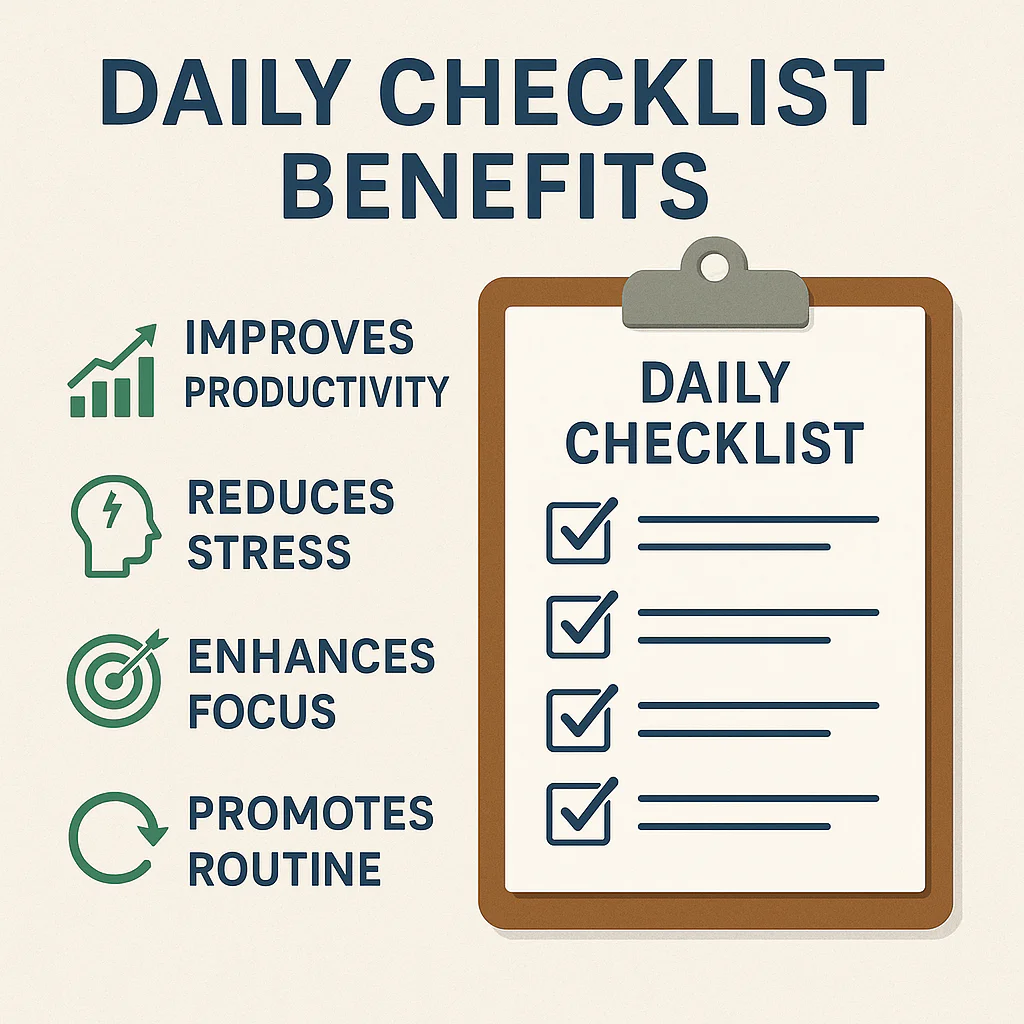
Forget the sterile, bureaucratic rigidity of “Form 1100, Daily Building and Grounds Checklist.” While that document ensures a building is safe, it doesn’t ensure your life is thriving. What if the secret to unlocking your brain’s full potential, slashing anxiety, and finally crushing procrastination was as simple as a checkmark? 🤔
At Daily Checklist™, we’ve seen everything from chaotic entrepreneurs to burnt-out executives transform their days by adopting this humble tool. The science is clear: the act of writing a task and checking it off triggers a dopamine release that literally rewires your brain for success. In this comprehensive guide, we’re breaking down 30 specific, life-changing benefits of daily checklists, comparing the top digital giants (Evernote vs. Notion), and revealing how to build a system that works for your unique brain. Whether you’re managing a construction site or your own mental health, the right checklist is the difference between surviving the day and mastering it.
Key Takeaways
- 🧠 Rewire Your Brain: Daily checklists trigger dopamine releases upon completion, creating a positive feedback loop that boosts motivation and reduces procrastination.
- 📉 Slash Anxiety & Fatigue: Offloading tasks to a list reduces cognitive load, freeing up mental energy for deep work and eliminating the stress of forgotten items.
- 🛠️ Master Your Tools: Whether you prefer the OCR search power of Evernote or the infinite customization of Notion, the best system is the one you’ll actually use consistently.
- 🚀 30 Proven Benefits: From improving sleep quality to managing ADHD symptoms, discover the full spectrum of advantages that go far beyond simple task management.
Ready to build your ultimate system?
- 👉 Shop Top Productivity Apps: Evernote | Notion
- Get Our Free Template: Download Daily Checklist Starter Kit
Table of Contents
- ⚡️ Quick Tips and Facts
- 📜 The Evolution of Order: A Brief History of the Humble Checklist
- 🧠 The Psychology of Productivity: Why Our Brains Crave Checklists
- 🚀 30 Life-Changing Benefits of Daily Checklists
- 1. Slaying the Procrastination Dragon
- 2. Reducing Cognitive Load and Mental Fatigue
- 3. The Sweet Dopamine Hit of Crossing Items Off
- 4. Mastering Time Management and Task Prioritization
- 5. Boosting Accountability and Personal Consistency
- 6. Enhancing Focus in a World of Digital Distractions
- 7. Eliminating Decision Fatigue Before It Starts
- 8. Improving Short-Term Memory and Information Retention
- 9. Streamlining Complex Workflows into Manageable Steps
- 10. Building Unshakeable Self-Confidence through Completion
- 11. Creating a Sense of Structure in Chaotic Schedules
- 12. Facilitating Easier Delegation for Team Success
- 13. Tracking Long-Term Progress Toward Major Goals
- 14. Reducing Anxiety and the Stress of Forgotten Tasks
- 15. Improving Sleep Quality by Clearing Your Mind
- 16. Sparking Creativity through Structured Constraints
- 17. Providing a Tangible Record of Daily Achievements
- 18. Cementing Positive Habits through Daily Tracking
- 19. Minimizing Costly Errors and Oversight Omissions
- 20. Increasing Overall Efficiency and Output Velocity
- 21. Promoting a Healthier Work-Life Balance
- 22. Clarifying Daily Intentions and Core Values
- 23. Managing Executive Dysfunction and ADHD Symptoms
- 24. Visualizing Success Before the Work Begins
- 25. Strengthening Self-Discipline and Grit
- 26. Optimizing Daily Energy Levels and Peak Performance
- 27. Preventing “Shiny Object Syndrome” Distractions
- 28. Encouraging Mindfulness and Present-Moment Awareness
- 29. Improving Team Communication and Transparency
- 30. Celebrating Small Wins to Fuel Motivation
- 📓 Mastering the Craft: Daily Checklist Journaling Benefits
- What Does a High-Performance Daily Checklist Look Like?
- The Endless Possibilities of Daily Checklist Journaling
- ⚔️ The Digital Showdown: Evernote vs. Notion for Task Management
- Evernote: The Trusted Digital Filing Cabinet
- Evernote Pros: Why It Still Reigns Supreme
- Evernote Cons: Where the Elephant Stumbles
- Notion: The Customizable Productivity Playground
- Notion Pros: The Power of Infinite Flexibility
- Notion Cons: The Steep Climb to Mastery
- 🔮 The Next Frontier: Daily Checklist Journaling in the Future
- 🛠️ Get Expert Insights into Your Digital Foundations
- 🏁 Conclusion
- 🔗 Recommended Links
- ❓ FAQ: Everything You Need to Know About Checklist Success
- 📚 Reference Links
⚡️ Quick Tips and Facts
Before we dive into the deep end of productivity, let’s hit the fast lane with some game-changing facts that might just rewrite your morning routine. Did you know that the simple act of checking a box can literally rewire your brain? 🧠✨
- The Dopamine Effect: According to neuroscience, completing a task triggers a release of dopamine, the “action hormone.” This isn’t just about feeling good; it’s a biological command to keep going. As one expert puts it, “A little bit of dopamine begets a lot of bit of dopamine.” Read more about the neuroscience of habits here.
- Memory Boost: Writing things down by hand engages the reticular activating system (RAS), filtering out distractions and helping your brain prioritize what actually matters.
- The “Pruning” Power: A study on productivity suggests that reviewing and “pruning” (strikethrough) incomplete tasks can reduce anxiety more than trying to force completion. It’s about strategic abandonment of low-value tasks.
- Digital vs. Analog: While apps are convenient, the physical act of writing and checking off items provides a significantly larger neurological reward than tapping a screen.
Pro Tip: If you feel overwhelmed, try the “2-Minute Rule.” If a task takes less than two minutes, do it immediately and check it off. The momentum is instant!
For a deeper dive into how these small actions compound over time, check out our guide on Daily Checklists and why they are the backbone of a structured life.
📜 The Evolution of Order: A Brief History of the Humble Checklist

You might think checklists are a modern invention born from the sterile whiteboards of Silicon Valley, but order has always been humanity’s best friend against chaos. 🏛️
The concept dates back to ancient times. The Romans used wax tablets to track debts and duties, but the modern checklist as we know it? That’s a relatively recent hero. It gained massive traction during the Industrial Revolution, where complex machinery required strict safety protocols.
However, the checklist truly became a life-saver in the aviation industry. In 1935, the Boeing Model 299 (the precursor to the B-17 Flying Fortress) crashed during a test flight because the pilots forgot to unlock a crucial control. The solution wasn’t “try harder”; it was a checklist. This simple innovation allowed the plane to fly thousands of hours without a single crash, proving that human error is inevitable, but systems are not.
Fast forward to today, and we see checklists in everything from surgical operating rooms (thanks to Dr. Atul Gawande’s The Checklist Manifesto) to your morning coffee routine. The evolution has moved from paper scraps to digital databases, but the core principle remains: Structure creates freedom.
🧠 The Psychology of Productivity: Why Our Brains Crave Checklists
Why does checking a box feel so satisfying? It’s not just because you’re organized; it’s because your brain is addicted to closure.
The Dopamine Loop
When you write a task on a list, your brain registers it as a “threat” or an “open loop” (a concept known as the Zeigarnik Effect). This creates low-level stress. The moment you check it off, that loop closes, and your brain rewards you with a hit of dopamine. It’s a biological high that motivates you to tackle the next item.
“Dopamine is in fact what we call the action hormone.” — Featured Video Perspective
Reducing Cognitive Load
Imagine your brain is a computer with 16GB of RAM. Every open tab (unfinished task) eats up memory. A daily checklist acts as external hard drive storage, offloading tasks so your brain can focus on execution rather than retention.
The Illusion of Control
In a world of constant uncertainty, a checklist provides a tangible sense of control. It transforms abstract anxieties into concrete, manageable steps. As we’ll see later, this is particularly crucial for those managing executive dysfunction or ADHD.
🚀 30 Life-Changing Benefits of Daily Checklists
We asked the planners at Daily Checklist™ to break down exactly why this simple tool is a powerhouse. Here are 30 distinct benefits that go far beyond just “getting things done.”
1. Slaying the Procrastination Dragon
Procrastination often stems from the sheer size of a task. A checklist breaks a mountain into pebbles. By listing “Write report” as “1. Open document, 2. Outline intro, 3. Write first paragraph,” you make the task non-threatening.
2. Reducing Cognitive Load and Mental Fatigue
Your working memory is limited. By offloading tasks to a list, you free up mental energy for creative problem-solving and deep work.
3. The Sweet Dopamine Hit of Crossing Items Off
Every checkmark is a micro-celebration. This positive reinforcement loop keeps you motivated even when the day gets tough.
4. Mastering Time Management and Task Prioritization
A checklist forces you to decide what matters. It separates the urgent from the important, ensuring you don’t spend your day putting out fires while the house burns down.
5. Boosting Accountability and Personal Consistency
When you write it down, you make a promise to yourself. Reviewing the list at the end of the day provides honest feedback on your consistency.
6. Enhancing Focus in a World of Digital Distractions
A physical or digital list acts as a guardrail, keeping you on track when social media or emails try to pull you off course.
7. Eliminating Decision Fatigue Before It Starts
By deciding what to do the night before, you eliminate the need to make decisions in the morning. You just execute.
8. Improving Short-Term Memory and Information Retention
The act of writing engages the brain more deeply than typing, leading to better memory retention of the tasks themselves.
9. Streamlining Complex Workflows into Manageable Steps
Complex projects become less daunting when broken into a sequential checklist. It’s the difference between climbing a cliff and walking up a staircase.
10. Building Unshakeable Self-Confidence through Completion
A stack of completed checklists is proof of progress. It builds a track record of success that boosts your self-efficacy.
11. Creating a Sense of Structure in Chaotic Schedules
For those with unpredictable lives, a checklist provides a stable anchor, a routine that remains constant regardless of external chaos.
12. Facilitating Easier Delegation for Team Success
In a team setting, checklists clarify who does what, reducing miscommunication and ensuring nothing falls through the cracks.
13. Tracking Long-Term Progress Toward Major Goals
Daily checklists are the bricks that build the castle. They allow you to see how small daily actions contribute to macro goals.
14. Reducing Anxiety and the Stress of Forgotten Tasks
The fear of forgetting something is a major anxiety trigger. A checklist acts as a safety net, allowing you to relax.
15. Improving Sleep Quality by Clearing Your Mind
Writing down tomorrow’s tasks before bed “closes the loops” in your brain, preventing racing thoughts that keep you awake.
16. Sparking Creativity through Structured Constraints
Paradoxically, constraints breed creativity. Knowing exactly what needs to be done frees your mind to find innovative ways to do it.
17. Providing a Tangible Record of Daily Achievements
Unlike a to-do list that disappears, a checklist journal becomes a historical record of your productivity and growth.
18. Cementing Positive Habits through Daily Tracking
Checklists are the ultimate habit trackers. They turn abstract goals like “get fit” into concrete actions like “do 10 pushups.”
19. Minimizing Costly Errors and Oversight Omissions
From missing a flight to skipping a medication dose, checklists prevent human error in critical situations.
20. Increasing Overall Efficiency and Output Velocity
By reducing the time spent deciding what to do next, you increase the time spent doing the work.
21. Promoting a Healthier Work-Life Balance
A checklist helps you define the end of the workday, ensuring you don’t carry work stress into your personal time.
22. Clarifying Daily Intentions and Core Values
When you align your tasks with your values, your checklist becomes a mission statement for the day.
23. Managing Executive Dysfunction and ADHD Symptoms
For neurodivergent individuals, checklists are not just helpful; they are essential tools for navigating daily life.
24. Visualizing Success Before the Work Begins
Reviewing a checklist allows you to mentally rehearse the day, priming your brain for success.
25. Strengthening Self-Discipline and Grit
Consistently completing a checklist builds the muscle of discipline, making it easier to tackle harder challenges.
26. Optimizing Daily Energy Levels and Peak Performance
By scheduling high-energy tasks during your peak hours, a checklist helps you work with your biology, not against it.
27. Preventing “Shiny Object Syndrome” Distractions
A checklist keeps you focused on your primary objectives, preventing you from chasing every new idea that pops up.
28. Encouraging Mindfulness and Present-Moment Awareness
Checking off a task requires you to be present in the moment, fostering a state of mindfulness.
29. Improving Team Communication and Transparency
Shared checklists create a single source of truth, ensuring everyone is on the same page.
30. Celebrating Small Wins to Fuel Motivation
The cumulative effect of small wins creates a momentum that can carry you through even the toughest days.
📓 Mastering the Craft: Daily Checklist Journaling Benefits
While a standard to-do list is great, checklist journaling takes it to the next level. It combines the structure of a checklist with the reflection of a journal.
What Does a High-Performance Daily Checklist Look Like?
A high-performance checklist isn’t just a random list of chores. It’s a strategic blueprint.
- Categorization: Group tasks by context (e.g., “Deep Work,” “Admin,” “Health”).
- Prioritization: Use symbols like
*for high-priority items. - Time Blocking: Assign specific time slots to tasks.
- Reflection Prompts: Include a section for “What went well?” and “What could be improved?”
The Endless Possibilities of Daily Checklist Journaling
The beauty of checklist journaling is its adaptability.
- Morning Routines: Track hydration, meditation, and exercise. Explore more on Morning Routines.
- Habit Stacking: Link new habits to existing ones (e.g., “After I brush my teeth, I will write 3 things I’m grateful for”).
- Project Management: Break down a large project into daily actionable steps.
- Mood Tracking: Correlate task completion with your emotional state.
Insight: As noted in our research, “Whereas the minimalism and empty space of a journal creates a canvas for expression, the structure and satisfaction of a checkbox completed creates a sense of accomplishment.” This hybrid approach gives you the best of both worlds.
⚔️ The Digital Showdown: Evernote vs. Notion for Task Management
So, you’re convinced you need a checklist. But paper or digital? And if digital, which app reigns supreme? Let’s dive into the two titans: Evernote and Notion.
Rating the Contenders
| Feature | Evernote | Notion |
|---|---|---|
| Design & Aesthetics | 7/10 (Functional, classic) | 9/10 (Modern, customizable) |
| Functionality | 8/10 (Great for notes, OCR) | 9/10 (Database powerhouse) |
| Ease of Use | 8/10 (Intuitive) | 6/10 (Steep learning curve) |
| Offline Access | 7/10 (Limited on free plan) | 5/10 (Requires internet mostly) |
| Search Capabilities | 10/10 (OCR for images is killer) | 7/10 (Good text search, no OCR) |
| Flexibility | 6/10 (Rigid structure) | 10/10 (Infinite possibilities) |
Evernote: The Trusted Digital Filing Cabinet
Evernote has been around the block. It’s the reliable workhorse of the note-taking world.
Evernote: The Trusted Digital Filing Cabinet
Evernote excels at capturing everything. Whether it’s a screenshot, a scanned document, or a voice memo, it stores it all in one place. Its OCR (Optical Character Recognition) is legendary—you can search for text inside an image, a feature that is still unmatched.
Evernote Pros: Why It Still Reigns Supreme
- OCR Search: Find text inside photos and PDFs instantly.
- Web Clipper: The best browser extension for saving articles.
- Simplicity: It just works. No complex setups required.
- Cross-Platform: Syncs seamlessly across all devices.
Evernote Cons: Where the Elephant Stumbles
- Rigid Structure: It’s hard to create complex databases or relational data.
- Performance: Can feel sluggish on older Macs.
- Pricing: The free plan is quite restrictive.
- No Markdown: Lacks native Markdown support for formatting.
👉 Shop Evernote on:
- Evernote: Evernote Official Website | Amazon Search
Notion: The Customizable Productivity Playground
Notion is the chameleon of productivity apps. It’s not just a checklist; it’s a wiki, a database, a project manager, and a journal all in one.
Notion: The Customizable Productivity Playground
With Notion, you build your own system. You can create a daily checklist that links to your project database, which links to your habit tracker. It’s infinitely flexible.
Notion Pros: The Power of Infinite Flexibility
- Databases: Create relational databases to track tasks, projects, and habits.
- Customization: Design your dashboard exactly how you want it.
- Collaboration: Excellent for team projects and shared workspaces.
- Templates: Thousands of community-made templates to get started.
Notion Cons: The Steep Climb to Mastery
- Learning Curve: It can be overwhelming for beginners.
- No OCR: You cannot search text inside images.
- Offline Mode: Very limited offline functionality.
- Speed: Can be slow to load on large databases.
👉 Shop Notion on:
- Notion: Notion Official Website | Amazon Search
🔮 The Next Frontier: Daily Checklist Journaling in the Future
Where is this all heading? The future of checklists is smart, predictive, and integrated.
Imagine an app that:
- Learns your habits: It knows you always skip “Exercise” on Tuesdays and suggests a shorter workout.
- Automates actions: Checking off “Order groceries” automatically adds items to your Instacart cart.
- Integrates with IoT: Your smart lights turn green when you finish your morning checklist.
As technology evolves, the line between planning and doing will blur. We might see checklists that adjust in real-time based on your energy levels, tracked by wearables. The future isn’t just about checking boxes; it’s about optimizing human potential.
🛠️ Get Expert Insights into Your Digital Foundations
Ready to build your ultimate system? Don’t go it alone. At Daily Checklist™, we specialize in helping you simplify your day and build digital foundations that last.
Whether you need a custom Notion template or a paper-based system tailored to your ADHD brain, the right foundation makes all the difference.
Question: Are you still using a sticky note for your life’s most important tasks? It’s time to upgrade.
Check out our Life Hacks section for more tips on optimizing your digital and physical workspace. And if you’re feeling overwhelmed by screens, our Digital Detox guide might be just what you need to find balance.
Ready to transform your productivity?
- Download our Free Daily Checklist Template: Get Started Here
- Join our Community: Connect with thousands of others on the same journey.
🏁 Conclusion

We started this journey by asking a simple question: Why does checking a box feel so good? Now, we know the answer. It’s not just about organization; it’s about rewiring your brain for success, reducing the cognitive load that weighs you down, and turning the abstract chaos of life into a tangible, manageable roadmap.
Whether you are a seasoned productivity guru or someone just trying to remember to take your vitamins, the benefits of daily checklists are undeniable. From the dopamine hits that fuel your motivation to the anxiety reduction that comes from knowing nothing is forgotten, a checklist is the ultimate tool for reclaiming your day.
The Verdict: Paper vs. Digital
We’ve weighed the pros and cons of the digital giants.
- Evernote remains the undisputed king of capture and search, especially if you rely on scanning documents or need to find text inside images. It’s the reliable, no-nonsense filing cabinet for your life.
- Notion is the champion of customization, perfect for those who want to build a database-driven ecosystem where tasks, projects, and habits interconnect.
Our Confident Recommendation:
If you are new to checklists or value simplicity and OCR capabilities, start with Evernote. If you crave flexibility, love building systems, and want to track complex relationships between tasks, Notion is your future. However, never underestimate the power of pen and paper for the initial planning phase to maximize memory retention. The best system is the one you will actually use consistently.
Final Thought: Don’t let the perfect be the enemy of the good. Whether you use a $2 notebook or a $0 free-tier app, the act of writing it down and checking it off is the magic. Start today, prune the low-value tasks tomorrow, and watch your life transform.
🔗 Recommended Links
Ready to upgrade your toolkit? Here are our top picks for physical and digital tools to get you started on your checklist journey.
📚 Essential Books on Productivity & Checklists
- The Checklist Manifesto: How to Get Things Right by Atul Gawande
- Why read it: The definitive guide on why checklists save lives and improve performance in high-stakes environments.
- 👉 Shop on Amazon: The Checklist Manifesto on Amazon
- Atomic Habits by James Clear
- Why read it: Learn how to build the habits that make your daily checklists stick.
- 👉 Shop on Amazon: Atomic Habits on Amazon
- Deep Work by Cal Newport
- Why read it: Master the art of focused work, a key component of an effective daily checklist.
- 👉 Shop on Amazon: Deep Work on Amazon
🛠️ Top Digital Tools
- Evernote
- Best for: Note-taking, OCR search, and document scanning.
- Get it here: Evernote Official Website | Search on Amazon
- Notion
- Best for: All-in-one workspace, databases, and custom project management.
- Get it here: Notion Official Website | Search on Amazon
- Moleskine Cahier Journals
- Best for: The tactile experience of analog checklists.
- 👉 Shop on Amazon: Moleskine Cahier Journals on Amazon
🏢 Professional & Regulatory Resources
- Form 1100: Daily Building and Grounds Checklist
- Context: A real-world example of a mandatory daily checklist used in Texas Health and Human Services facilities to ensure safety and compliance.
- View the Form: Texas HHS Form 1100
❓ FAQ: Everything You Need to Know About Checklist Success

How do daily checklists improve mental clarity?
Daily checklists act as an external hard drive for your brain. By offloading tasks from your working memory to a written list, you free up cognitive resources. This process, often called cognitive offloading, reduces the “noise” of open loops in your mind, allowing you to focus entirely on the task at hand rather than worrying about what you might forget.
Read more about “📝 10 Ultimate Daily Checklist Templates to Master Your Day (2026)”
What are the psychological benefits of using a daily checklist?
The psychological benefits are profound:
- Dopamine Release: Completing a task triggers a reward response, reinforcing positive behavior.
- Reduced Anxiety: Knowing everything is accounted for lowers the stress of the unknown.
- Sense of Control: In chaotic environments, a checklist provides a structured anchor, fostering a feeling of mastery.
- Improved Self-Efficacy: Consistently checking off items builds confidence in your ability to execute plans.
Read more about “🚀 Why Your Daily Checklist is a Life-Changer (2026)”
Can daily checklists help reduce anxiety and stress?
Absolutely. Anxiety often stems from the fear of forgetting something important or the overwhelm of a large, undefined task. A checklist breaks large problems into manageable steps and serves as a safety net. When you write a task down, your brain perceives it as “handled,” which significantly lowers cortisol levels and promotes a state of calm.
Read more about “📱 How to Make a Daily Checklist on Your Phone (2026 Guide)”
How do daily checklists increase productivity at work?
Checklists increase productivity by:
- Eliminating Decision Fatigue: You decide what to do the night before, so you can execute immediately in the morning.
- Prioritization: They force you to distinguish between urgent and important tasks.
- Flow State: By removing the friction of “what’s next,” you enter a state of deep work faster.
- Error Reduction: They ensure critical steps aren’t skipped, preventing costly rework.
Read more about “7 Ways Daily Checklists Master Time (2026) 🕒”
What is the best way to create an effective daily checklist?
An effective checklist follows these principles:
- Be Specific: Instead of “Work on project,” write “Draft introduction for Q3 report.”
- Prioritize: Use numbering or symbols (e.g.,
*) to highlight the top 3 critical tasks. - Keep it Realistic: Don’t list 20 tasks if you can only do 5. Quality over quantity.
- Review and Prune: At the end of the day, review what wasn’t done. Decide if it’s still relevant or if it should be pruned (deleted) to reduce clutter.
- Time-Block: Assign estimated times to tasks to manage your day’s energy.
Read more about “🚀 15-Step Productive Day Checklist: Master Your 2026 Routine”
Do daily checklists help with time management skills?
Yes, they are a cornerstone of time management. By visualizing your day, you become more aware of how long tasks actually take versus how long you think they take. This reality check helps you plan more accurately, avoid overcommitting, and allocate time for breaks, leading to a more balanced and efficient schedule.
Read more about “🚀 10 Best Time Management Tools for 2026: Stop Drowning in Chaos”
How long does it take to see benefits from using a daily checklists?
The benefits are often immediate. You may feel a sense of relief and clarity the very first day you start using one. However, the deeper benefits—such as habit formation, significant anxiety reduction, and long-term productivity gains—typically solidify after 21 to 66 days of consistent use, which is the average time it takes to form a new habit.
Additional Insights
- For ADHD Brains: Checklists are not just helpful; they are often essential for managing executive dysfunction. Breaking tasks into micro-steps can make the difference between paralysis and action.
- The “Pruning” Technique: Don’t be afraid to cross out tasks you consistently fail to complete. It might mean the task isn’t a priority, and removing it can actually boost your overall productivity by focusing on what truly matters.
Read more about “What Makes a Good Checklist? 7 Secrets for 2026 ✅”
📚 Reference Links
- Atul Gawande: The Checklist Manifesto: How to Get Things Right. Publisher Page
- American Psychological Association: Stress and Anxiety Management. APA Stress Resources
- Harvard Business Review: Why Checklists Are So Effective. HBR Article
- Texas Health and Human Services: Form 1100, Daily Building and Grounds Checklist. Official Form Page
- Evernote: Product Features and OCR Technology. Evernote Blog
- Notion: Productivity Templates and Databases. Notion Blog
- National Institute of Mental Health: Understanding Anxiety and Stress. NIMH Resources