Support our educational content for free when you purchase through links on our site. Learn more

📊 How Do I Measure a Productive Day? 10 Metrics That Actually Matter (2026)
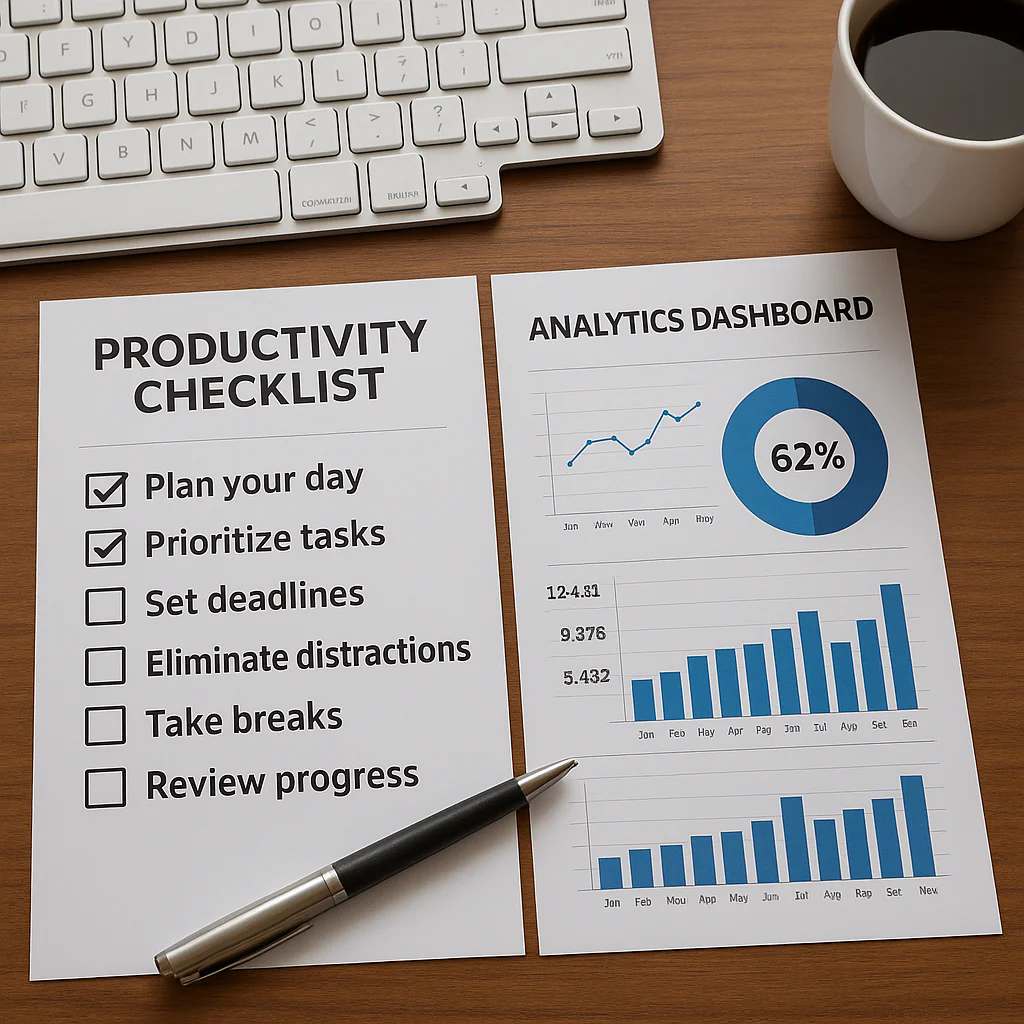
A truly productive day isn’t about how many hours you grind or how many boxes you check; it’s about the quality of your focus and the alignment of your output with your deepest goals. If you are wondering, “How do I measure a productive day?”, the answer lies in tracking energy levels, deep work hours, and meaningful outcomes rather than just raw activity.
Most of us fall into the trap of confusing “busy” with “effective,” a mistake that costs us hours of potential creativity every single week. Did you know that it takes an average of 23 minutes to regain deep focus after just one interruption? That means a single Slack notification can derail your entire morning’s worth of high-value work.
I once spent an entire Tuesday frantically clearing my inbox and attending back-to-back meetings, feeling exhausted by 5 PM. When I reviewed my day, I realized I hadn’t touched a single project that actually moved my career forward. It was a classic case of motion without progress.
That’s why we’ve compiled a comprehensive guide to help you stop guessing and start measuring what truly counts. Whether you are a software engineer, a healthcare professional, or a creative freelancer, these metrics will help you reclaim your time and your sanity.
Key Takeaways
- Focus on Outcomes, Not Outputs: A productive day is defined by meaningful results and goal alignment, not just the number of tasks completed.
- Track Energy, Not Just Time: Managing your ultradian rhythms and scheduling deep work during peak energy windows is more effective than rigid time-blocking.
- Limit Context Switching: Reducing interruptions to fewer than 5 per day can drastically improve your cognitive performance and output quality.
- Use the “One Big Thing” Rule: Ensure you complete your Most Important Task (MIT) before tackling any other administrative duties.
- Review and Adjust: Conduct a weekly review to analyze your data, identify bottlenecks, and refine your personal productivity baseline.
Table of Contents
- ⚡️ Quick Tips and Facts
- 📜 The Evolution of Efficiency: A Brief History of Measuring Productivity
- 🧠 Defining Your Personal Productivity Baseline
- 📊 10 Essential Metrics to Track Your Daily Output
- 🕒 7 Proven Time-Blocking Strategies for Maximum Focus
- 🚫 5 Common Pitfalls That Sabotage Your Daily Progress
- 🛠️ Top Tools and Apps for Real-Time Productivity Monitoring
- 🧘 The Role of Energy Management in Sustaining High Performance
- 📈 How to Analyze Your Data and Adjust Your Routine
- 🌟 Real-World Case Studies: From Chaos to Clarity
- 🔮 Future-Proofing Your Workflow: AI and Automation
- 🏁 Conclusion
- 🔗 Recommended Links
- ❓ FAQ: Your Burning Questions Answered
- 📚 Reference Links
⚡️ Quick Tips and Facts
Before we dive into the nitty-gritty of tracking your day, let’s cut through the noise with some hard truths and actionable hacks that the team at Daily Checklist™ has learned the hard way (usually after burning out a few times).
- The “Busy” Trap: Being busy is not the same as being productive. You can spend 10 hours answering emails and feel exhausted, yet have made zero progress on your actual goals. Quality of focus beats quantity of hours every single time.
- The 80/20 Rule: Often, 80% of your results come from just 20% of your efforts. Identifying that critical 20% is the secret sauce to a productive day.
- Context Switching is Expensive: It takes an average of 23 minutes to get back on track after a single interruption. If you get pinged every 10 minutes, you are effectively working in a state of permanent “reboot.”
- Energy > Time: Managing your energy levels is more crucial than managing your time. A 1-hour sprint when you are well-rested is worth four hours of zombie-scrolling.
- The “Done” List: Don’t just track what you did; track what you finished. A checklist of “attended meetings” is less satisfying than “shipped the project proposal.”
If you are looking for a concrete starting point, check out our guide on How do you have a productive day checklist? to get your feet wet immediately.
📜 The Evolution of Efficiency: A Brief History of Measuring Productivity

You might think measuring productivity is a modern obsession born from the era of Slack notifications and Zoom fatigue. But the human desire to quantify “work” goes back much further than the industrial revolution.
From Sun Dial to Stopwatch
In the agrarian era, a “productive day” was simple: Did the sun set with the fields harvested? It was a binary outcome. But as society shifted to factories, Frederick Winslow Taylor introduced “Scientific Management” in the late 19th century. Taylorism was all about breaking tasks into tiny, measurable units. It was efficient, sure, but it treated humans like cogs in a machine.
The Knowledge Worker Shift
Fast forward to the 20th century, and we entered the age of the knowledge worker. Suddenly, you couldn’t measure productivity by the number of widgets produced. How do you measure the output of a writer, a coder, or a strategist?
- The Old Way: Count the hours at the desk.
- The New Way: Measure the value created.
This shift is where many of us get stuck. We are trying to measure a software engineer’s day by lines of code (a metric that, as we’ll see later, is often counterproductive) or a writer’s day by word count.
Did you know? The concept of “work Relative Value Units” (wRVUs) used in healthcare to measure productivity is a direct descendant of these early industrial metrics, yet it often fails to capture the nuance of complex, human-centric care.
🧠 Defining Your Personal Productivity Baseline
Here is the million-dollar question: What does a “productive day” actually look like for you?
If you ask a software engineer, a palliative care nurse, and a freelance graphic designer, you’ll get three completely different answers. A productive day for a nurse might involve 12 wRVUs and deep empathy; for a coder, it might mean solving one complex bug that saves the company thousands; for a designer, it might be the “flow state” where they lose track of time.
The Three Pillars of Your Baseline
To measure your day effectively, you need to define your baseline across three dimensions:
- Output: What tangible things did you create? (e.g., a report, a code commit, a meal).
- Outcome: Did that output move the needle on your long-term goals?
- Well-being: Did you end the day feeling drained or energized?
The Daily Checklist™ Insight:
We’ve found that most people fail because they measure Output but ignore Outcome. You can check off 50 items on a to-do list, but if none of them aligned with your quarterly goals, was it a productive day? Probably not.
Pro Tip: Before you start your day, ask yourself: “If I only accomplish one thing today, what would make me feel successful?” This is your North Star metric.
📊 10 Essential Metrics to Track Your Daily Output
Stop guessing and start measuring. But be careful—what gets measured gets managed, and if you measure the wrong thing, you’ll manage the wrong behavior. Here are 10 metrics that actually matter, drawn from the experiences of high-performers across various industries.
1. Deep Work Hours
This is the holy grail. How many hours did you spend in a state of undistracted, focused concentration?
- Why it matters: Complex problem-solving requires sustained attention.
- How to track: Use a timer or an app like RescueTime to block out distractions.
2. Context Switches Count
How many times did you switch tasks?
- Why it matters: Every switch costs you cognitive energy.
- Target: Aim for fewer than 5 major switches per day.
3. The “One Big Thing” Completion Rate
Did you complete your single most important task (MIT)?
- Why it matters: This ensures you are prioritizing impact over activity.
4. Energy Level Fluctuations
Rate your energy on a scale of 1-10 at the start, middle, and end of the day.
- Why it matters: Identifies your ultradian rhythms and helps you schedule hard tasks when you are freshest.
5. Meeting-to-Work Ratio
What percentage of your day was spent in meetings vs. doing actual work?
- Why it matters: Excessive meetings are the silent killer of productivity.
6. Learning & Growth Minutes
How much time did you spend learning a new skill or reflecting?
- Why it matters: As noted in the software engineering perspective, learning compounds over time.
7. Team Impact Score
Did you help a colleague? Did you unblock someone?
- Why it matters: Productivity isn’t just individual; it’s collective.
8. Error/Re-work Rate
How much time did you spend fixing mistakes made earlier?
- Why it matters: High re-work rates indicate poor planning or rushing.
9. Digital Detox Success
How many times did you successfully resist the urge to check social media or email?
- Why it matters: Protects your attention span.
10. Satisfaction Score
At the end of the day, how satisfied do you feel?
- Why it matters: If you are productive but miserable, you will burn out.
| Metric | Ideal Target | Why It Matters |
|---|---|---|
| Deep Work | 2-4 hours | Drives high-value output |
| Context Switches | < 5/day | Preserves cognitive load |
| MIT Completion | 1/1 (10%) | Ensures strategic alignment |
| Meeting Ratio | < 30% of day | Maximizes execution time |
| Energy Score | Consistent 7+ | Prevents burnout |
🕒 7 Proven Time-Blocking Strategies for Maximum Focus
Now that you know what to measure, let’s talk about how to structure your day to maximize those metrics. Time blocking is not just about scheduling; it’s about defending your attention.
1. The Monastic Method
- What it is: Eliminate all distractions for a set period (e.g., 4 hours). No email, no phone, no internet unless essential.
- Best for: Deep work, writing, coding, complex problem solving.
- Daily Checklist™ Tip: This is hard to sustain all day. Try it for just your first 90 minutes.
2. The Bimodal Method
- What it is: Split your day into two distinct modes: “Deep Work” and “Shallow Work.”
- Example: 8 AM – 12 PM is for deep work; 1 PM – 5 PM is for emails, calls, and admin.
- Why it works: It respects the brain’s need to switch contexts without doing it constantly.
3. The Hourly Sprint (The “First Video” Approach)
- What it is: Work in focused 1-hour intervals, followed by a 5-minute break.
- Source: As highlighted in the perspective of the “first video” on this topic, this method aligns with natural attention spans.
- The Break: Stand up, stretch, look away from the screen. Do not check your phone.
4. The Pomodoro Technique
- What it is: 25 minutes of work, 5 minutes of rest. After four cycles, take a longer break.
- Best for: People who struggle with procrastination or have ADHD.
- Tool: Try the Pomodoro Timer or the Forest App.
5. Task Batching
- What it is: Group similar tasks together (e.g., answer all emails at once, make all phone calls at once).
- Why it works: Reduces the “setup time” for your brain to switch gears.
6. The “Eat the Frog” Method
- What it is: Do your hardest, most dreaded task first thing in the morning.
- Why it works: You get the dopamine hit of completion early, and you avoid the anxiety of looming tasks.
7. Time Boxing with Buffers
- What it is: Assign a specific time slot to every task, but add a 15-minute buffer between blocks.
- Why it works: Life happens. Buffers prevent one delay from ruining your entire schedule.
Question for you: Which of these methods feels like it would fit your current workflow? Or do you need to mix and match? We’ll explore how to customize these in the next section.
🚫 5 Common Pitfalls That Sabotage Your Daily Progress
Even with the best plans, we all fall into traps. Here are the top 5 reasons your productivity measurement fails, and how to fix them.
1. The “Lines of Code” Fallacy
- The Trap: Measuring success by volume (number of tasks, lines of code, emails sent).
- The Reality: As the Stack Overflow blog points out, a line of code that doesn’t solve a problem is worse than no code. In palliative care, a “productive” day isn’t about seeing 20 patients; it’s about the quality of care for the 10 you saw.
- The Fix: Measure outcomes, not outputs.
2. Ignoring the “Hidden Work”
- The Trap: Only counting billable hours or visible tasks.
- The Reality: In many fields (like healthcare or engineering), the most valuable work is collaboration, mentoring, and planning. These are often invisible in traditional metrics.
- The Fix: Log “invisible work” explicitly in your tracker.
3. The Surveillance Trap
- The Trap: Using spyware to track mouse movements or screenshots.
- The Reality: This destroys trust and creativity. It encourages “looking busy” rather than “being productive.”
- The Fix: Focus on results-based accountability. If the work is done, it doesn’t matter how long you sat there.
4. Burnout as a Badge of Honor
- The Trap: Thinking that working 12 hours a day is the definition of productivity.
- The Reality: Research shows that working long hours often leads to negative work (errors that must be fixed later). A tired brain writes buggy code and misses edge cases.
- The Fix: Prioritize rest as a productivity tool.
5. One-Size-Fits-All Metrics
- The Trap: Using the same metrics for everyone on the team.
- The Reality: A junior developer needs different metrics than a senior architect. A nurse needs different metrics than a doctor.
- The Fix: Customize your baseline for each role and individual.
🛠️ Top Tools and Apps for Real-Time Productivity Monitoring
You can’t measure what you don’t track. Here are the tools we recommend, ranging from simple checklists to advanced analytics.
1. Notion
- Best for: All-in-one workspace (notes, tasks, databases).
- Why we love it: Highly customizable. You can build your own productivity dashboard.
- Link: Notion Official Site
2. Togl Track
- Best for: Time tracking and reporting.
- Why we love it: Simple one-click timer. Great for seeing where your time actually goes.
- Link: Togl Track
3. RescueTime
- Best for: Automatic tracking of digital habits.
- Why we love it: Runs in the background and gives you a “productivity score” based on the apps you use.
- Link: RescueTime
4. Todoist
- Best for: Task management and checklist creation.
- Why we love it: Clean interface, natural language input, and great for the “Eat the Frog” method.
- Link: Todoist
5. Clockify
- Best for: Free time tracking for teams.
- Why we love it: Unlimited users and projects. Great for small businesses.
- Link: Clockify
👉 CHECK PRICE on:
- Notion: Amazon | Notion Official
- Togl Track: Amazon | Togl Official
- Todoist: Amazon | Todoist Official
🧘 The Role of Energy Management in Sustaining High Performance
We’ve talked about time, but we haven’t talked about fuel. You can have the perfect schedule, but if your battery is dead, you won’t get anything done.
The Ultradian Rhythm
Your body operates on 90-minute cycles of high energy followed by low energy.
- The Myth: “I can power through for 8 hours straight.”
- The Truth: After 90 minutes, your prefrontal cortex (the logic center) starts to degrade. You start making mistakes, rereading the same sentence, or staring blankly at the screen.
The Power of the Break
Rest is not the opposite of productivity; it is the mechanism behind it.
- Active Recovery: Stand up, walk, stretch, look at something 20 feet away.
- Passive Recovery: Do nothing. No phone, no podcast. Just let your mind wander.
Daily Checklist™ Anecdote: One of our planners tried to power through a 4-hour coding session without a break. By hour 3, they had introduced a bug that took 2 hours to fix. The next day, they used the 90-minute rule and finished the task in 2 hours with zero bugs. Rest wins.
📈 How to Analyze Your Data and Adjust Your Routine
Collecting data is useless if you don’t act on it. Here is how to turn your daily logs into a productivity superpower.
Step 1: The Weekly Review
Every Friday, spend 30 minutes reviewing your data.
- Look for patterns: When was your energy highest? What tasks took longer than expected?
- Identify bottlenecks: Did you get interrupted 10 times on Tuesday? Why?
Step 2: The “Stop Doing” List
Just as important as what you start doing is what you stop doing.
- If a meeting consistently yields no results, cancel it.
- If a task takes 2 hours but adds no value, delegate or delete it.
Step 3: Iterate and Adapt
Your routine is not set in stone. If a time-blocking strategy isn’t working, tweak it.
- Experiment: Try the Monastic method for a week, then switch to Bimodal.
- Measure the change: Did your “Deep Work Hours” increase?
Step 4: Celebrate Wins
Don’t just focus on what went wrong. Celebrate the wins, no matter how small. This builds the habit loop and keeps you motivated.
🌟 Real-World Case Studies: From Chaos to Clarity
Let’s look at how real people (and teams) transformed their days by changing how they measured productivity.
Case Study 1: The Overworked Software Engineer
- The Problem: A senior engineer was measuring success by “hours at the desk” and “number of PRs reviewed.” He was working 12-hour days but felt like he was making no progress on the core architecture.
- The Shift: He switched to measuring Deep Work Hours and Problem Solving. He blocked out 8 AM – 1 AM for architecture work, turning off Slack and email.
- The Result: In one week, he solved a critical bug that had been plaguing the team for months. His “hours worked” dropped to 8, but his impact skyrocketed.
Case Study 2: The Palliative Care Team
- The Problem: A hospital team was pressured to hit a 12 wRVU daily target. They were rushing through patient visits, leading to burnout and complaints from families.
- The Shift: They adopted a hybrid metric: 10 wRVUs + 1 “Quality of Care” check-in per day (e.g., a meaningful family meeting).
- The Result: Patient satisfaction scores rose, and the team reported feeling more fulfilled. They realized that sustainability was more important than squeezing in one extra visit.
Case Study 3: The Freelance Writer
- The Problem: A writer was tracking “word count.” She would write 2,0 words of fluff just to hit her target, then spend the next day editing it.
- The Shift: She started tracking “Finished Drafts” and “Client Feedback”. She focused on writing one solid 50-word section per day.
- The Result: Her editing time dropped by 50%, and her clients were happier with the quality.
🔮 Future-Proofing Your Workflow: AI and Automation
The future of productivity measurement is here, and it’s powered by AI.
How AI is Changing the Game
- Automatic Tracking: AI tools can now analyze your calendar, emails, and documents to suggest how you spent your time, removing the need for manual logging.
- Predictive Analytics: AI can predict when you are likely to burn out based on your work patterns and suggest breaks.
- Smart Scheduling: Tools like Motion use AI to automatically rearrange your calendar based on your priorities and energy levels.
The Human Element
However, AI cannot measure empathy, creativity, or intuition.
- The Risk: Over-reliance on AI metrics can lead to a “gaming the system” mentality.
- The Balance: Use AI to handle the data, but use human judgment to interpret it.
Final Thought: As we move forward, the most productive people will be those who can leverage AI to handle the mundane, freeing them up to do the deeply human work that machines can’t replicate.
🏁 Conclusion

So, how do you measure a productive day? The answer, as we’ve discovered, is not a single number, a specific wRVU target, or a count of lines of code.
A productive day is one where you:
- Aligned your actions with your most important goals.
- Protected your attention from unnecessary distractions.
- Managed your energy to avoid burnout.
- Created value that matters to you and others.
The journey from chaos to clarity isn’t about finding the perfect metric; it’s about finding the right balance for your life. Whether you are a software engineer, a healthcare professional, or a creative, the principles remain the same: Focus on quality, respect your limits, and measure what truly matters.
We started this article by asking if you could measure a productive day. Now, we ask you: What is the one metric you will start tracking tomorrow to make your next day your best one yet?
🔗 Recommended Links
Ready to take action? Here are the tools and resources we recommend to help you build your productive day.
👉 Shop Productivity Tools on:
- Notion Planner: Amazon | Notion Official
- Togl Track Timer: Amazon | Togl Official
- RescueTime Subscription: RescueTime Official
- Todoist Premium: Amazon | Todoist Official
Recommended Books:
- “Deep Work” by Cal Newport: Amazon – The definitive guide to focused work.
- “The 5 AM Club” by Robin Sharma: Amazon – For mastering your morning routine.
- “Atomic Habits” by James Clear: Amazon – Essential for building the habits that sustain productivity.
❓ FAQ: Your Burning Questions Answered

How do you measure time to productivity?
Measuring “time to productivity” usually refers to how long it takes for a new employee or a new system to reach full efficiency.
- For Employees: Track the time from hire to the first independent, high-quality output.
- For Systems: Measure the time from implementation to the point where the system consistently delivers value.
- Key Insight: Don’t rush this. As the software engineering perspective notes, “Fast ramp, shallow roots” can lead to long-term issues.
Read more about “🚀 How Do You Have a Productive Workday? 15 Steps to Master Your Time (2026)”
How to determine level of productivity?
Determing your level of productivity requires a mix of quantitative and qualitative metrics.
- Quantitative: Hours of deep work, tasks completed, revenue generated.
- Qualitative: Satisfaction, quality of work, team feedback.
- Method: Use a weekly review to weigh these factors against your personal organizational goals.
Read more about “15 Essential Tasks for Your Daily Checklist (2026) 📝”
What measures time in productivity?
Time itself is not the measure; attention is.
- Attention-Hours: A more accurate metric than “person-hours.” One hour of undivided attention is worth four hours of fragmented work.
- Tools: Use time-tracking apps to measure how you spend your time, but analyze it through the lens of focus and value.
Read more about “5 Reasons Daily Checklists Transform Business Success 🚀”
What is an example of productivity measurement?
- Example 1 (Healthcare): A palliative care team tracks wRVUs (work Relative Value Units) alongside patient satisfaction scores.
- Example 2 (Tech): A developer tracks complex problems solved rather than lines of code.
- Example 3 (Creative): A writer tracks finished drafts and editor feedback rather than word count.
How do you measure productivity scale?
Productivity scales vary by industry.
- Individual Scale: 1-10 rating of daily output and energy.
- Team Scale: Velocity (in Agile) or OKRs (Objectives and Key Results).
- Organizational Scale: ROI, revenue per employee, or customer satisfaction.
- Tip: Always calibrate your scale to your specific context. A scale that works for a factory won’t work for a design studio.
How do you calculate productive days?
A “productive day” is calculated by checking if you met your North Star metric.
- Formula: (Tasks Completed / Tasks Planned) x (Quality Score) x (Energy Score).
- Simplified: Did you do the one thing that mattered most? If yes, it was a productive day.
What are the best daily checklist templates for productivity?
- The “MIT” Template: Focuses on the 1-3 Most Important Tasks.
- The “Time Block” Template: Schedules every hour of the day.
- The “Energy” Template: Groups tasks by energy level required (High, Medium, Low).
- Resource: Check out our How do you have a productive day checklist? for a ready-to-use template.
Read more about “How to Make a Really Good Checklist: 7 Steps to Mastery (2026) 🚀”
How can I track my daily tasks effectively?
- Automate: Use apps like RescueTime or Togl to track time automatically.
- Manual: Keep a simple notebook or use a digital tool like Todoist.
- Review: Do a daily and weekly review to adjust your tracking method.
- Tip: Don’t over-complicate it. If tracking takes more time than the task, you’re doing it wrong.
Read more about “12 Time Management Strategies to Master Your Day (2026) 🚀”
What defines a successful day for busy professionals?
For busy professionals, a successful day is defined by alignment and balance.
- Alignment: Did you move the needle on your long-term goals?
- Balance: Did you maintain your health and relationships?
- Outcome: Did you finish the day feeling accomplished rather than drained?
How do I create a morning routine that boosts productivity?
- Wake Up Early: Give yourself time before the chaos starts.
- Hydrate and Move: Drink water and do some light exercise.
- Plan: Review your MITs and time-block your day.
- No Phone: Avoid checking email or social media for the first hour.
- Consistency: Stick to the routine for at least 21 days to build the habit.
Read more about “✅ What is a Daily Checklist? The 12-Step Productivity Hack (2026)”
📚 Reference Links
- CAPC: Productivity Benchmarking in Palliative Care – CAPC – Blog – Insights on measuring productivity in healthcare.
- Stack Overflow: Measuring Developer Productivity – A deep dive into why traditional metrics fail in software engineering.
- LinkedIn: Measuring a Productive Day: Key Insights from Software Engineering Perspectives – Perspectives on context switching and deep work.
- Harvard Business Review: Research on Long Hours and Burnout – Studies on the impact of working long hours.
- Google: Google Codebase Statistics – Data on the scale of software development.
- Microsoft: Windows Team Activity – Insights into high-frequency code pushes.
- American Association of Hospice and Palliative Medicine (AAHPM): 2010 Survey Data – Historical data on palliative care productivity.
- MGMA: 2021 Report on Physician Productivity – Industry benchmarks for healthcare.
- American Journal of Hospice and Palliative Medicine: Productivity Studies – Academic research on care metrics.
- Daily Checklist™: Habit Formation – Resources on building lasting habits.
- Daily Checklist™: Life Hacks – Tips for optimizing your daily routine.
- Daily Checklist™: Digital Detox – Strategies for reducing screen time.