Support our educational content for free when you purchase through links on our site. Learn more

Micro-Habit Tracking for Beginners: Start Small 🌱
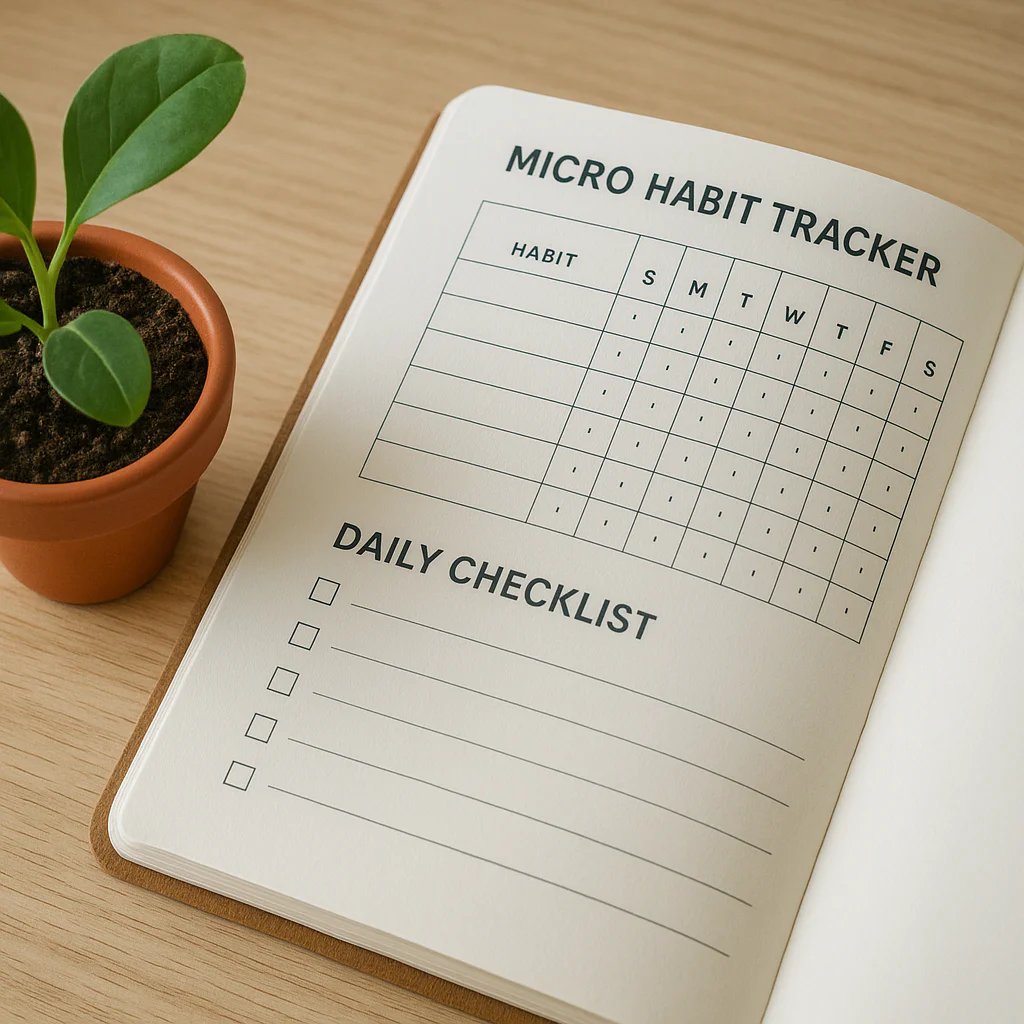
Micro-habit tracking for beginners works best when you choose one tiny, specific action, attach it to a routine you already have, and record it with a simple check mark. You don’t need a perfect streak or a fancy app—just a habit small enough to repeat on an ordinary day.
Try “read one page after lunch” instead of “read more.” In habit-formation research, the time it took for a behavior to reach near-maximum automaticity varied widely, with a median of 66 days—so consistency matters more than a magic deadline (Lally et al.).
We’ve seen checklists work best when they make the next step obvious, not when they demand a whole new personality by Monday. Start with one habit, notice what helps you remember it, and adjust when life gets in the way. A missed day is information—not a reason to throw out the tracker.
Key Takeaways
- Start with one micro-habit that is specific, meaningful, and easy to do on a busy day.
- Attach it to an existing cue, such as breakfast, brushing your teeth, or closing your laptop.
- Keep tracking simple: a paper checklist, spreadsheet, reminder, or habit app can all work.
- Review progress weekly to spot patterns and make the habit easier to maintain.
- Don’t chase perfect streaks. If you miss a day, restart at the next opportunity and adjust your plan if needed.
- Check app privacy details before tracking personal routines digitally.
Table of Contents
- ⚡️ Quick Tips and Facts
- 🌱 What Is Micro-Habit Tracking?
- 📚 The Science and Background Behind Tiny Habits
- 🎯 Why Track Micro-Habits? Benefits and Limitations
- 🧭 How to Choose a Micro-Habit That Fits Your Life
- Start Smaller Than You Think
- Connect a New Habit to an Existing Routine
- Set a Clear, Measurable Minimum
- ✅ 15 Beginner-Friendly Micro-Habits to Track
- Health and Movement
- Mindfulness and Mental Well-Being
- Learning, Home, and Productivity
- 🛠️ Build a Simple Micro-Habit Tracking System
- Choose a Paper, Spreadsheet, or Habit-Tracking App
- Create a Minimal Daily Habit Tracker
- What to Record: Completion, Frequency, and Notes
- 📱 Best Micro-Habit Tracking Apps and Tools
- Digital Habit Trackers for Beginners
- Paper Habit Trackers and Bullet Journals
- How to Pick a Tool You’ll Actually Use
- ⏰ Reminders, Habit Stacking, and Automation
- Use Cues Without Creating Notification Fatigue
- Automate Your Tracking Where It Helps
- 📊 Review Your Progress and Find Useful Patterns
- A Two-Minute Weekly Habit Review
- Measure Consistency Without Chasing Perfect Streaks
- 🔁 What to Do When You Miss a Day
- Restart Without Guilt
- Adjust a Habit That’s Too Difficult to Maintain
- ⚠️ Common Micro-Habit Tracking Mistakes
- 🔒 Privacy and Data Considerations for Habit-Tracking Apps
- 🧩 Micro-Habit Tracking Examples and Sample Routines
- A Beginner’s Seven-Day Micro-Habit Plan
- A Simple Morning and Evening Routine
- 🏁 Conclusion
- 🔗 Recommended Links
- ❓ FAQ
- How small should a micro-habit be?
- How many micro-habits should beginners track?
- How long does it take for a micro-habit to become automatic?
- Should I track habits every day?
- What’s the best free micro-habit tracker?
- Do habit streaks help or hurt motivation?
- 📖 Reference Links
Quick Tips and Facts
If you’re looking for a practical starting point, our Daily Checklist guide shows how a simple checklist can turn vague intentions into visible next steps. Micro-habit tracking uses the same principle, only the steps are delightfully small. 🌱
| Quick fact | What it means for you |
|---|---|
| A micro-habit is a deliberately tiny action | Make the first step easy enough to do on an ordinary, slightly chaotic day. |
| A tracker records behavior, not your worth | A blank box is information, not a verdict. |
| One or two habits is plenty to start | Add habits only after your first routine feels manageable. |
| A cue makes tracking easier | Attach the habit to something you already do, such as brushing your teeth or making coffee. |
| Streaks are optional | Weekly consistency and useful reflection matter more than a perfect chain of check marks. |
A beginner-friendly formula: Choose one tiny action, attach it to a reliable cue, record it in the simplest tool you’ll use, and review it once a week. Research on habit formation suggests that repetition in a stable context supports automaticity, but the timeline varies from person to person; there is no magic “21 days” guarantee (European Journal of Social Psychology).
We’ll build a system that can survive busy mornings, forgotten reminders, and the occasional “where did this week go?” moment. First, let’s make sure we mean the same thing by micro-habit.
What Is Micro-Habit Tracking?
Micro-habit tracking is the practice of recording very small, repeatable actions that support a larger goal. Think “open the book and read one page,” not “become a person who reads 50 books a year by Thursday.”
A micro-habit usually has three qualities:
- Small: It takes little time or effort to begin.
- Specific: You can tell whether you did it.
- Repeatable: You can fit it into a regular part of your day.
| Bigger aim | Micro-habit to track | Simple record |
|---|---|---|
| Read more | Read one page after lunch | ✓ / — |
| Move regularly | Walk for five minutes after work | ✓ / — |
| Learn a language | Review three flashcards after breakfast | ✓ / — |
| Keep a calmer home | Put away one item before bed | ✓ / — |
| Practice mindfulness | Take three slow breaths before opening email | ✓ / — |
The point is not to shrink an important goal until it becomes meaningless. It’s to make the starting action so approachable that you can repeat it, then build from there if you choose. A tiny habit can be the full habit on a low-energy day and a starting ramp on a higher-energy one.
For more ideas on designing routines, explore our Habit Formation articles. The tracking part can be as modest as a check mark on paper; the behavior itself is the star.
The Science and Background Behind Tiny Habits
Habit tracking is a practical aid, not a brain hack with guaranteed results. Research on habit formation points to repetition in a consistent context as one factor that helps behavior become more automatic. How long that takes varies: in one study, the time participants took to reach near-maximum automaticity ranged widely, with a median of 66 days (Lally et al., 2010).
That finding helps resolve a common disagreement. Some guides promote fixed timelines; others say habit formation is highly individual. The evidence supports the second view: timelines differ, and missing one opportunity does not automatically erase your progress. In the study, a single missed opportunity did not materially affect the habit-formation process.
Why tiny actions can help
A small action can reduce the friction involved in getting started. If your goal is to write, “open the document and write one sentence” has fewer hurdles than “finish a chapter.” Once you begin, you may naturally continue—but the minimum still counts if you stop.
Behavioral researchers also distinguish between intention and action. A cue-based plan—often phrased as “After I do X, I will do Y”—can make the action easier to remember. This is related to implementation intentions, which have been studied as a way to help people translate goals into behavior (National Institutes of Health / PubMed).
What tracking can and cannot do
| Tracking can help you… | Tracking cannot guarantee… |
|---|---|
| Notice patterns in when and where you follow through | Instant motivation |
| See whether a goal is realistic in your actual schedule | A perfect streak |
| Remember to acknowledge small wins | That every habit is right for you |
| Make progress visible | Medical, mental-health, or fitness outcomes |
A tracker is more like a small dashboard than a steering wheel: it can show what’s happening, but you still decide what to adjust. That distinction matters when an app’s streak counter starts acting like a tiny, judgmental coach.
Why Track Micro-Habits? Benefits and Limitations
A good habit tracker makes an invisible behavior visible. You may feel as if you “never read,” then notice you opened a book four evenings this week. That is useful feedback—and a much fairer assessment than relying on memory.
Potential benefits
- Clearer awareness: You can see how often the behavior actually happens.
- A lighter start: Small actions may feel less intimidating than ambitious all-or-nothing plans.
- Better troubleshooting: A pattern of missed evenings may suggest your cue or timing needs to change.
- A sense of progress: A check mark provides immediate evidence of follow-through.
- More deliberate routines: A checklist can remind you what matters before the day gets noisy.
A 2023 meta-analysis found that progress monitoring can improve goal attainment, with effects varying by how monitoring is carried out and reported (Psychological Bulletin / PubMed). That does not mean every tracker works for every person. The best tool is the one that supports reflection without turning ordinary life into a spreadsheet audition.
Limitations worth knowing
Tracking can become counterproductive if you:
- Add too many habits at once.
- Treat missed days as failure instead of feedback.
- Track actions that don’t matter to you.
- Spend more time decorating the tracker than doing the habit.
- Feel pressured by streaks, badges, or notifications.
A personal account about the Bear Mindful tracker makes a useful point: the author found that taking on too many habits could become overwhelming, and recommended “progress over perfection” (Raynalo: Habit Tracking with Bear Mindful). Her particular tracker has six monthly habit slots, but that is a design choice—not a scientifically established ideal.
Our recommendation: Start with one habit. If tracking feels easy and useful after a couple of weeks, consider adding another. If it feels like homework, simplify the habit, the tracker, or both.
How to Choose a Micro-Habit That Fits Your Life
Choose an action that supports something you genuinely want—not something that merely looks impressive in a planner. “Read one page because I enjoy stories” has a better chance of sticking than “read every day because apparently successful people do.”
Start Smaller Than You Think
The first version should be almost laughably easy to begin.
| Ambitious version | Smaller starting version |
|---|---|
| Exercise for 45 minutes | Put on walking shoes or walk for five minutes |
| Meditate for 20 minutes | Take three slow breaths |
| Write every morning | Open your document and write one sentence |
| Tidy the whole kitchen | Put away one item |
| Study for an hour | Review one flashcard |
Ask: Could I do this on a busy, low-energy day? If the honest answer is no, shrink the first step. Tiny does not mean pointless; it means repeatable.
Connect a New Habit to an Existing Routine
Use a dependable event as a cue:
After I [existing routine], I will [micro-habit].
Examples:
- After I make coffee, I’ll read one page.
- After I brush my teeth at night, I’ll set out my walking shoes.
- After I sit down for lunch, I’ll review three vocabulary cards.
- After I close my laptop, I’ll write one line in my journal.
This approach borows the stability of a routine you already have. For more cue-and-routine ideas, browse Habit Formation.
Set a Clear, Measurable Minimum
A habit should have a finish line you can recognize. “Be healthier” is a worthy aspiration but a lousy checkbox. “Eat one serving of vegetables with lunch” is trackable.
Use this quick test:
- Clear: Is the action specific?
- Small: Is the minimum easy to start?
- Observable: Will I know whether I did it?
- Relevant: Does it connect to something I care about?
If you’re tracking health-related behavior, choose safe, appropriate actions for your circumstances. A habit tracker is not a substitute for professional medical advice.
15 Beginner-Friendly Micro-Habits to Track
Here are small actions we’ve found easy to fit into real-life checklists. Pick one, not all 15—this is a menu, not a dare. 🥗
Health and Movement
| Micro-habit | Beginner-sized action | Possible cue |
|---|---|---|
| 1. Take a short walk | Walk for five minutes | After work or lunch |
| 2. Stretch briefly | Stretch for one minute | After getting out of bed |
| 3. Add a vegetable | Include one serving with a meal | While preparing lunch |
| 4. Drink water intentionally | Drink a glass of water with breakfast | When you sit down to eat |
| 5. Prepare for movement | Put walking shoes or exercise clothes where you can see them | Before bed |
The first video featured in the article suggests daily walks as a wellness micro-habit and offers other tiny routine ideas (watch the featured video). Walking can be a low-barier way to add movement, but the right amount depends on your health, ability, environment, and advice from your clinician.
Mindfulness and Mental Well-Being
| Micro-habit | Beginner-sized action | Possible cue |
|---|---|---|
| 6. Pause and breathe | Take three comfortable, slow breaths | Before opening email |
| 7. Notice one good thing | Write one sentence about something you appreciated | After dinner |
| 8. Take a screen pause | Put your phone down for five minutes | During a break |
| 9. Sit quietly | Spend one minute without a screen or task | After lunch |
| 10. Offer a small kindness | Give a sincere compliment or helpful gesture | When an opportunity appears |
The video also recommends breathing and occasional boredom as prompts for slowing down. Treat these as general lifestyle suggestions, not medical claims: breathing exercises may help some people feel calmer, but they are not a replacement for mental-health care. If taking slow breaths feels uncomfortable, stop and return to your normal breathing.
For screen-bound routines, our Digital Detox section has ideas for creating phone-free pauses without declaring war on every device you own.
Learning, Home, and Productivity
| Micro-habit | Beginner-sized action | Possible cue |
|---|---|---|
| 11. Read for pleasure | Read one page or for five minutes | Before bed |
| 12. Practice a skill | Spend two minutes drawing, playing, or practicing | After breakfast |
| 13. Learn a language | Review three flashcards | While waiting for coffee |
| 14. Reset one surface | Put away one item on a desk or counter | Before leaving the room |
| 15. Plan tomorrow | Write down the first task for the next day | When closing your laptop |
These examples echo advice in the Bear Mindful article, including reading for five minutes, doodling, writing a few sentences, and setting aside time to plan (Raynalo). The useful principle is not the exact duration. It’s choosing a small action with a clear link to your larger aim.
Build a Simple Micro-Habit Tracking System
Your system should answer three questions quickly: What am I doing? When will I do it? How will I record it? If the setup takes longer than the habit, it needs a trim.
Choose a Paper, Spreadsheet, or Habit-Tracking App
| Tool | Best for | Advantages | Possible drawbacks |
|---|---|---|---|
| Paper checklist | People who like pen-and-paper routines | Visible, simple, works without a device | Easy to misplace; manual review |
| Spreadsheet | People who enjoy flexible tracking | Customizable and easy to summarize | Setup can become a project |
| Notion template | People already using Notion | Habit lists and progress views in one workspace | Can invite over-customization |
| Habit-tracking app | People who want reminders and quick logging | Convenient check-ins, charts, and notifications | Screen time, privacy, or paid features may matter |
The Notion Micro Progress (Quick Habit Tracker) template is designed for customizable habit categories and daily, weekly, or monthly progress views. It may suit someone who already plans in Notion. If you prefer a notebook, a plain row of dates and check boxes can do the same basic job.
Create a Minimal Daily Habit Tracker
Set it up in five steps:
- Write one habit in plain language.
- Add a cue, such as “after breakfast.”
- Define the minimum, such as “read one page.”
- Choose a mark, such as ✓ for done and — for not done.
- Set a weekly review, not a daily performance evaluation.
| Habit | Cue | Minimum | Mon | Tue | Wed | Thu | Fri | Sat | Sun |
|---|---|---|---|---|---|---|---|---|---|
| Read | After lunch | One page | ✓ | ✓ | — | ✓ |
This sample is intentionally plain. You can add color later if it helps, but decorative lettering is not a required step in the habit-formation process. (The pens are welcome; the pressure isn’t.)
What to Record: Completion, Frequency, and Notes
For a beginner, completion plus a short weekly note is usually enough.
Track:
- Completion: Did the minimum action happen?
- Frequency: How often did it happen this week?
- Context, if useful: What helped or got in the way?
Avoid collecting details you won’t use. If a sleep or exercise tracker makes you anxious, or if it encourages unhealthy monitoring, simplify or stop tracking that data and seek professional guidance where appropriate.
Best Micro-Habit Tracking Apps and Tools
An app can make check-ins convenient, especially if your phone is already in your hand when the habit happens. It can also add another notification to the day. Choose based on your preferences, not on how many shiny charts appear in the screenshots.
Digital Habit Trackers for Beginners
| Tool | Notable features | Good fit for | Consider |
|---|---|---|---|
| Notion Micro Progress | Customizable categories and progress views | People already planning in Notion | More flexible than some beginners need |
| Micro Habit Watch Tracker | iPhone and Apple Watch check-ins, widgets, reminders, progress rings, streaks, and trends, according to its App Store listing | Apple users who want quick wearable check-ins | Read the current privacy disclosures and compatibility details |
| Apple Reminders | Lists, reminders, and scheduled tasks | People who want a built-in checklist | Not a dedicated habit analytics app |
| Google Sheets | Flexible rows, columns, and formulas | People who prefer a custom tracker | Manual setup and data entry |
The App Store listing for Micro Habit Watch Tracker describes one-tap check-ins, reminders, widgets, Apple Watch support, and progress displays. It also states that the app has not received enough ratings or reviews to display an overview, so there is no established App Store rating to rely on. The listing’s privacy section reports that identifiers may be used to track users across other companies’ apps and websites, despite the description’s emphasis on local habit data. Privacy labels are developer-provided disclosures, so check the current listing and the app’s privacy policy before deciding (Apple App Store listing; Apple privacy information).
Pros: The listed features aim to make check-ins quick, and Apple Watch access may help people who dislike opening a phone app.
Drawbacks: The current listing has insufficient ratings for an overview, requires compatible Apple operating systems, and raises a privacy detail worth reading carefully. It is not automatically the best choice just because it has rings and streaks.
Paper Habit Trackers and Bullet Journals
A printed tracker or notebook is a strong choice if you want low-tech visibility. A simple monthly grid can show progress without asking you to unlock your phone first.
Paper works especially well when you:
- Keep a planner or notebook in a place you already use.
- Prefer marking a box with a pen.
- Want to avoid app notifications.
- Don’t need automatic charts or device syncing.
A commercial tracker such as the Bear Mindful Habit Tracker may appeal if you like a predesigned monthly layout. Check the product listing for the current format and details; the author’s article describes a circular tracker with six monthly habit slots but does not provide extensive specifications (Raynalo).
How to Pick a Tool You’ll Actually Use
Use this short checklist:
- ✅ Can I record the habit in a few seconds?
- ✅ Will I notice the tracker at the right time?
- ✅ Does it work with my privacy and accessibility preferences?
- ✅ Can I ignore streaks or reminders that don’t help?
- ❌ Does maintaining it feel harder than doing the habit?
- ❌ Am I choosing it because of features I’m unlikely to use?
If the answer to the last question is yes, keep shopping—or just make a table on paper. A beautifully designed system is helpful only if it meets you where your day actually happens.
Reminders, Habit Stacking, and Automation
A reminder is a cue, not a command. The aim is to help your future self remember—not to let your phone nag you like a tiny office manager.
Use Cues Without Creating Notification Fatigue
Try one cue at a time:
- Routine cue: “After I brush my teeth…”
- Place cue: Keep your book beside your bed.
- Time cue: Set one reminder at a realistic time.
- People cue: Pair a walk with a friend, if that feels supportive.
If you use reminders, make them specific and adjustable. “Read one page after dinner” is more actionable than “be better.” If you begin swiping the notification away automatically, change the timing or use a non-digital cue instead.
Automate Your Tracking Where It Helps
Automation can reduce effort, but don’t automate a habit you need to consciously notice. A wearable may record activity automatically, for example, while reading or journaling usually requires a manual check-in.
The video’s “Automatic Focus Mode” suggestion uses phone settings to reduce distractions at chosen times or locations (featured video). Similar options are available through Apple Focus and Android Digital Wellbeing. These tools can support a micro-habit like “read for five minutes before bed,” but test settings carefully so you don’t silence essential calls or alerts.
Review Your Progress and Find Useful Patterns
The most valuable question is not “Did I get a perfect streak?” It’s “What made this action easier or harder?”
A Two-Minute Weekly Habit Review
Once a week, answer:
- How many times did I do the minimum?
- What cue or time worked best?
- What got in the way?
- Is the habit still meaningful?
- Should I keep it, shrink it, or change the cue?
| Pattern you notice | Possible adjustment |
|---|---|
| You remember on weekdays but forget on weekends | Add a weekend-specific cue or make the habit flexible |
| The habit is often skipped when you’re tired | Shrink the minimum |
| Reminders arrive during meetings | Change the time or use a physical cue |
| You check the box but feel no benefit | Reconsider whether this habit supports your goal |
| You enjoy doing more after starting | Keep the tiny minimum; let extra effort remain optional |
A Notion template can show progress across daily, weekly, or monthly views, according to its template listing. A paper tracker can reveal the same broad pattern if you pause to look at it. The format matters less than the reflection.
Measure Consistency Without Chasing Perfect Streaks
Count repetitions in a way that suits the behavior. “Four days out of seven” may be a more useful measure for a habit that doesn’t need to happen daily than an unbroken streak.
Try these alternatives:
- Weekly count: How many times did I practice?
- Minimum met: Did I complete the smallest version?
- Trend: Is the behavior becoming easier to remember?
- Recovery: After a missed day, did I return?
Streaks can feel motivating for some people, but they can also make one missed day seem disproportionately important. If a streak counter helps, use it lightly. If it creates pressure, turn it off. There’s no prize for allowing a chart to boss you around.
What to Do When You Miss a Day
First: nothing dramatic has happened. A missed check-in is a data point, not proof that you lack discipline. Research on habit formation found that missing one opportunity did not materially disrupt the overall process in the study described earlier (Lally et al.).
Restart Without Guilt
Use a simple reset:
- Notice what happened without blaming yourself.
- Identify the friction: Was the cue unclear, the habit too big, or the timing unrealistic?
- Choose the next opportunity rather than waiting for Monday, a new month, or a dramatic montage.
- Do the minimum version and mark it honestly.
If you missed a walk, the restart might be five minutes tomorrow. If you forgot to log your reading, don’t invent a check mark from memory. Mark only what you know, then continue.
The Bear Mindful author’s “progress over perfection” advice is particularly useful here (Raynalo). The tracker should help you return to the routine, not punish you for being a person.
Adjust a Habit That’s Too Difficult to Maintain
If a habit repeatedly feels hard to start, change one part at a time:
- Shrink the action: One sentence instead of a full page.
- Change the cue: Try after lunch instead of before bed.
- Change the environment: Put the book where you sit.
- Reduce the tracking load: Use a simple check mark instead of detailed notes.
- Pause intentionally: If the habit no longer fits, remove it and choose another.
A tracker showing “missed” again and again may be telling you something useful: the plan needs redesigning. It is not evidence that you need a more elaborate dashboard.
Common Micro-Habit Tracking Mistakes
| Mistake | Why it can backfire | Better approach |
|---|---|---|
| Starting with a long habit list | More items mean more decisions and more recording | Start with one habit |
| Choosing a vague action | You may not know what counts as complete | Define a clear minimum |
| Setting a habit that is too ambitious | The starting friction can be discouraging | Make the first step smaller |
| Treating a streak as the goal | Missing once may feel like losing all progress | Track weekly practice or return-to-routine |
| Switching apps constantly | Setup replaces action | Use one simple tool for a few weeks |
| Tracking for someone else’s approval | Motivation may not match your own priorities | Choose a personally meaningful behavior |
| Adding reminders without reviewing them | Notifications become background noise | Keep only cues that help |
| Counting every detail | Recording can become burdensome | Track the smallest useful amount |
A personal account of habit tracking with Bear Mindful describes learning that too many habits can feel overwhelming, especially during a difficult period (Raynalo). That experience is not a universal rule about exactly how many habits you can track; it is a useful reminder to fit the system to your capacity.
Privacy and Data Considerations for Habit-Tracking Apps
Habits can reveal personal routines—when you sleep, exercise, study, or take medication. Before trusting an app, check what information it collects and how it handles it.
A practical privacy checklist
- Read the app’s current privacy policy and store listing.
- Check whether an account is required.
- Look for data-sharing and tracking disclosures.
- Consider whether the app stores data locally or in a cloud account.
- Review permissions such as location, health, and notifications.
- Delete data or uninstall the app if it no longer serves you.
For Apple users, the Micro Habit Watch Tracker App Store listing says its description emphasizes local storage and no account requirement, while the privacy section also reports identifiers may be used to track users across other companies’ apps and websites. Those details deserve a careful read rather than a quick skim. Apple explains its privacy labels and app privacy information here.
If you’d rather keep the data offline, paper is a perfectly good privacy-first tracker. A checklist does not need Wi-Fi to know you read a page.
Micro-Habit Tracking Examples and Sample Routines
The easiest routine is the one that fits the shape of your day. Here are two examples you can borrow and customize.
A Beginner’s Seven-Day Micro-Habit Plan
This plan is a trial, not a challenge. Choose one habit and record what happens for a week.
| Day | Action | Check-in question |
|---|---|---|
| 1 | Pick one meaningful micro-habit | Is the action specific and small? |
| 2 | Attach it to an existing cue | Did I remember when the cue occurred? |
| 3 | Complete the minimum | Was the minimum genuinely manageable? |
| 4 | Repeat without increasing the target | Did the routine feel simpler today? |
| 5 | Notice what helped | What made starting easier? |
| 6 | Use a flexible version if needed | Can I keep the habit small on a busy day? |
| 7 | Review and adjust | Keep, shrink, change the cue, or stop? |
For example, your first week might be “read one page after lunch.” Do not increase it to a full chapter just because Tuesday went well. Let the routine prove it fits first.
A Simple Morning and Evening Routine
| Moment | Micro-habit | Tracker entry |
|---|---|---|
| After breakfast | Read one page or review three flashcards | One check mark |
| Before starting work | Take three comfortable breaths | One check mark |
| After work | Walk for five minutes or stretch briefly | One check mark |
| Before bed | Put away one item or plan tomorrow’s first task | One check mark |
You don’t need all four. Choose whichever action matters most, then test its cue. The first video’s examples also include daily walks, small acts of kindness, and taking a brief break from constant stimulation (featured video). Those ideas can be adapted into trackable actions, but the presenter’s claims about health effects should not replace reliable medical guidance.
A small personal-planner lesson
When we at Daily Checklist™ build a checklist, we try to make the next action obvious. A list that says “get organized” can sit there looking meaningful for weeks; “put one notebook in the drawer” is much easier to start. That difference is the whole charm of a micro-habit: small enough to begin, clear enough to track, and flexible enough to survive a real day.