Support our educational content for free when you purchase through links on our site. Learn more

15+ Habit Stacking Hacks for Busy Pros (2026) 🚀
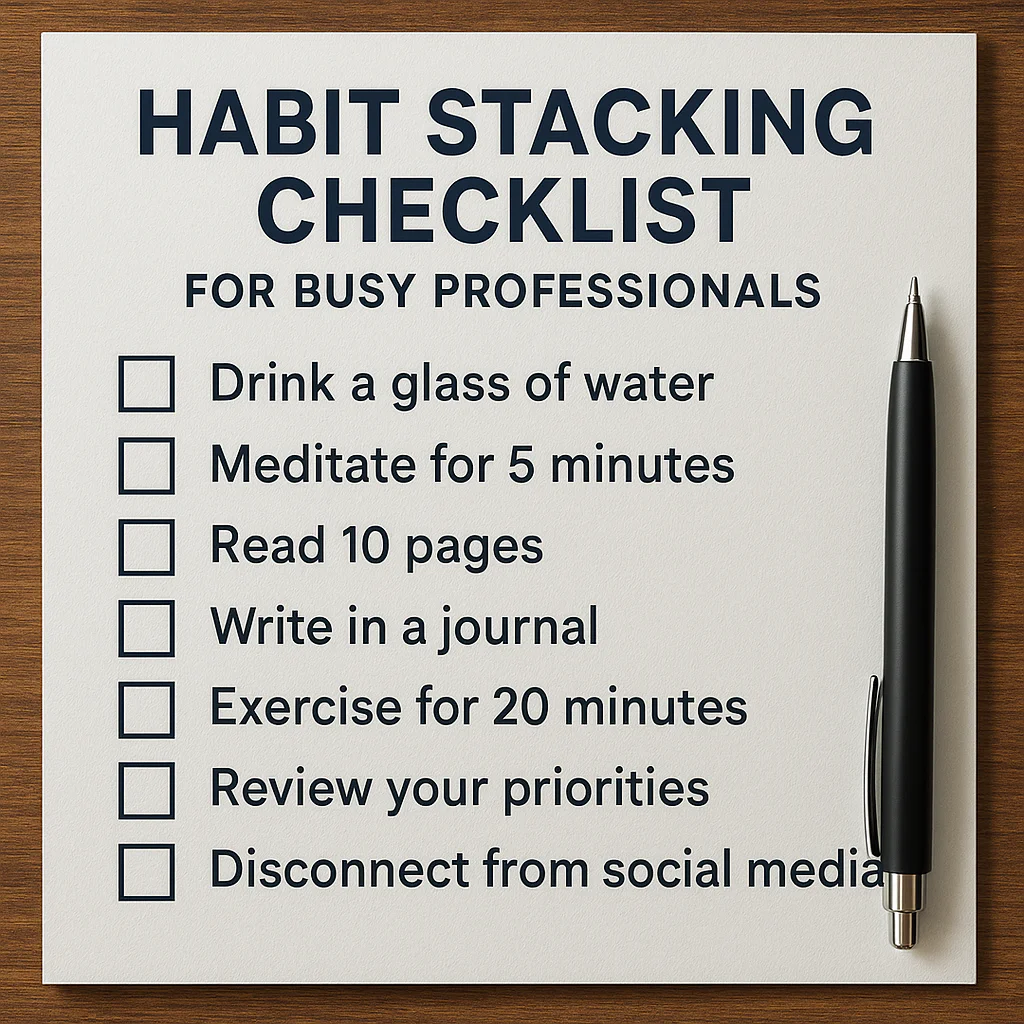
Ever feel like your to-do list is a runaway train while your productivity is stuck in neutral? You’re not alone. At Daily Checklist™, we’ve seen brilliant professionals burn out trying to force massive lifestyle overhauls, only to abandon them by week two. The secret isn’t working harder; it’s working smarter by hacking your brain’s autopilot. Enter habit stacking, the game-changing strategy that lets you build new, powerful routines by pigybacking on the habits you already do without thinking.
Imagine turning your morning coffee ritual into a launchpad for meditation, or transforming your commute into a masterclass in leadership—all without adding a single minute to your day. In this guide, we’re diving deep into the science, the “how-to,” and the 15+ proven habit stacking methods specifically engineered for the chaotic lives of working professionals. We’ll even reveal why your current “willpower” approach is failing and how a simple formula can make new behaviors stick up to 64% faster. Ready to stop chasing time and start mastering it? Let’s stack up.
Key Takeaways
- Master the Formula: The secret to success is the simple equation: “After [CURRENT HABIT], I will [NEW HABIT].” This leverages your brain’s natural Cue–Routine–Reward loop to make new behaviors automatic.
- Start Micro: Forget hour-long gym sessions. The most effective stacks use micro-habits (2–3 minutes max) to lower activation energy and ensure consistency, even on your busiest days.
- Choose Rock-Solid Anchors: Your new habit is only as strong as the existing routine it attaches to. Select daily, unshakeable anchors (like brushing teeth or logging off) rather than time-based triggers.
- Celebrate to Cement: Don’t skip the celebration! A quick mental “Yes!” or fist pump immediately after the new habit releases dopamine, wiring the behavior into your brain faster than repetition alone.
- Avoid Stacking Fatigue: Limit yourself to one new habit per anchor. Trying to build too many stacks at once leads to cognitive overload and eventual failure.
Table of Contents
- ⚡️ Quick Tips and Facts
- 📜 The Origins of Habit Stacking: From Ancient Rituals to Modern Productivity
- 🧠 The Science Behind the Stack: Understanding the Cue–Routine–Reward Loop
- 🚀 Why Small Changes Work Better Than Giant Leaps for Busy Executives
- 🎯 Mastering the Art of Choosing Strong Anchor Habits
- 🔍 Spoting Daily Triggers: How to Identify the Perfect Launchpads
- 📋 The Ultimate List: 15+ Proven Habit Stacking Methods for Working Professionals
- 1. The Morning Power-Up Stack: Kickstart Your Day with Intention
- 2. The Commute Transformation: Turning Travel Time into Growth Time
- 3. The Pre-Meting Reset: Calm Nerves and Boost Focus Instantly
- 4. The Deep Work Trigger: Switching from Reactive to Proactive Mode
- 5. The Lunch Break Recharge: Fueling Body and Mind Simultaneously
- 6. The Afternoon Slump Buster: Beating the 3 PM Energy Crash
- 7. The Email Triage Stack: Managing Inbox Zero Without the Stress
- 8. The Learning Loop: Micro-Habits for Continuous Skill Acquisition
- 9. The Networking Nudge: Building Relationships While You Work
- 10. The Boundary Setter: Protecting Your Time and Mental Space
- 1. The End-of-Day Shutdown: Ritualizing the Transition to Personal Time
- 12. The Weekend Wind-Down: Preparing for a Fresh Start
- 13. The Travel Stack: Maintaining Routines on the Road
- 14. The Crisis Management Stack: Staying Grounded During Chaos
- 15. The Reflection Stack: Daily Reviews for Continuous Improvement
- 🛠️ Setting Up Your First Habit Stack: A Step-by-Step Blueprint
- 🔄 Keeping Your Habit Stacks Going: Overcoming Plateaus and Unpredictable Schedules
- 📱 Tools for Tracking Habits and Learning: Apps, Journals, and Tech
- 💡 Common Pitfalls: Why Your Stacks Might Be Failing (And How to Fix Them)
- 🌟 Real-World Case Studies: How Top Executives Use Habit Stacking
- ❓ Frequently Asked Questions About Habit Stacking for Professionals
- 🔗 Recommended Links and Resources
- 📚 Reference Links and Scientific Studies
- 🏁 Conclusion: Using Habit Stacking for Professional Success
⚡️ Quick Tips and Facts
Ever feel like you’re constantly chasing your tail, trying to squeeze more productivity out of an already packed day? Welcome to the club, fellow busy professional! We
at Daily Checklist™ understand the struggle. That’s why we’re obsessed with finding smart, sustainable ways to simplify your day with daily checklists and boost your output without burning out. And let us tell you, habit stacking is a
game-changer!
So, what exactly is this magical method? Think of habit stacking as attaching a new, desired behavior to an existing, well-established routine, like a tiny, powerful
caboose on a bullet train. It’s a brilliant strategy that leverages your brain’s natural wiring, making new habits stick without relying on sheer willpower alone.
Here are some rapid-
fire facts to get your brain buzzing:
- Definition: Habit stacking is a method to build new habits by linking small, intentional actions to existing routines rather than overhauling your entire schedule.
Brain Power: It taps into your brain’s natural Cue–Routine–Reward loop, turning automatic behaviors into launchpads for growth.
- Efficiency Master: It requires **
no extra time or effort** because you’re piggybacking on actions you already do daily. - Success Rate Booster: New behaviors attached to existing habits are up to 50% more
likely to stick compared to trying them in isolation. A 2025 study in the Journal of Applied Psychology even found a 64% higher success rate with habit stacking! Talk about an unfair advantage! - Micro-Magic: Focusing on micro-habits (taking less than 10 minutes, often 2-3 minutes max) significantly improves consistency.
- Consistency is King: While British adults often quit new habits after 7 weeks, research suggests it takes about 14 weeks for behaviors to truly stick. Small
, consistent actions add up over time – it’s about consistency, not perfection. - Memory Hack: The hardest part of any habit often isn’t doing it, it’s **
remembering to start**. Habit stacking solves this by providing an automatic trigger. - System Over Willpower: Success relies on intelligent design and systems, not just discipline or motivation.
Ready to transform your daily grind into a growth engine? Let’s dive deeper into this fascinating world of habit formation and discover how you can master your days with strategic habit stacking. If you’re looking for more ways to optimize your routine, check
out our insights on Habit Formation and how a well-crafted Daily Checklist can be your
secret weapon!
📜 The Origins of Habit Stacking: From Ancient Rituals to
Modern Productivity
You might think “habit stacking” sounds like a trendy new buzzword, but the core concept – linking behaviors together – is as old as, well, habits themselves! Humans have intuitively chained actions for millennia, from ancient rituals performed
in a specific sequence to the simple act of preparing a meal. However, the formal articulation and popularization of “habit stacking” as a deliberate productivity strategy is a much more recent phenomenon.
The term itself was notably introduced by S
.J. Scott in his 2014 book, Habit Stacking: 97 Small Life Changes That Take Five Minutes or Less. Scott laid the groundwork, emphasizing the power of small
, incremental changes. But the concept truly gained mainstream traction and widespread recognition thanks to behavioral change expert James Clear, author of the phenomenal bestseller Atomic Habits. Clear brilliantly distilled the science and practical application of habit
stacking, making it accessible and actionable for millions.
It’s worth noting that Clear himself credits Dr. BJ Fogg of the Stanford Behavioral Lab (and author of Tiny Habits) with the foundational concept. Dr. Fogg’s work extensively explores how tiny, manageable changes, paired with existing routines and followed by immediate positive reinforcement (what he calls “celebration”), can rewire our brains for lasting change. So, while James Clear popularized the term
and its application, the scientific roots stretch back to pioneers like Dr. Fogg, who understood the profound impact of behavioral design.
From these brilliant minds, we’ve learned that you don’t need a brand-new routine;
you just need a better design. It’s about working with your brain, not against it, to build the life you want, one tiny, stacked habit at a time.
🧠 The Science Behind the Stack: Understanding the Cue–Routine–Reward Loop
Ever wonder why some actions feel almost automatic, like you
‘re on autopilot? That’s your brain’s incredible habit-forming machinery at work! Habit stacking isn’t just a clever trick; it’s deeply rooted in neuroscience, leveraging how your brain naturally creates and reinforces behaviors.
At the
heart of it all is the Cue–Routine–Reward loop, a concept popularized by Charles Duhigg in The Power of Habit and central to understanding why habit stacking is so effective.
Cue: This is the trigger, the signal that tells your brain to go into automatic mode and perform a particular behavior. In habit stacking, your existing, rock-solid habit becomes the powerful cue for your new desired action. Think of it
: “After I pour my morning coffee…”
- Routine: This is the behavior itself – the new habit you want to build. It should be small, specific, and easy to
perform immediately after the cue. “I will meditate for one minute.” - Reward: This is the positive outcome or feeling your brain gets from completing the routine. It reinforces the loop, making it more
likely you’ll repeat the behavior next time the cue appears. This could be a feeling of accomplishment, a burst of dopamine, or even a deliberate “celebration” (more on that later!).
So, where does this all happen in your brain? Habits primarily form in the striatum, a part of the basal ganglia. When you first try a new behavior, your conscious prefrontal
cortex (the part responsible for planning and decision-making) is heavily involved. But with repetition, control gradually shifts to the more automatic striatum. It’s like moving from manual driving to cruise control!
MIT Research has even shown that striatum neurons create “boundary markers” at the start and end of routines, helping the brain package behaviors into automatic units. This means your brain literally carves out a
mental pathway for your stacked habits, making them seamless.
And let’s not forget our friend dopamine! This neurotransmitter plays a crucial role in strengthening the connections between the prefrontal cortex and the striatum during rewarding
behaviors. When you experience a positive feeling after completing a new habit (even a tiny one!), dopamine floods your system, reinforcing that neural pathway and making you crave that reward again. This is why immediate, even
small, rewards or “celebrations” are so powerful in habit formation.
By understanding this fascinating loop, we can design our habit stacks to work with our brain’s natural tendencies, making the path to lasting change not just easier, but
almost inevitable.
🚀 Why Small Changes Work Better Than Giant Leaps for Busy Executives
As ambitious professionals, we’re often wired to think big. We want to overhaul our entire routine, launch into massive new projects, and see immediate, dramatic results. While admirable, this “go big or go home” mentality often leads
to burnout, frustration, and ultimately, failure when it comes to habit formation. Why? Because our brains, especially when already juggling a million tasks, prefer tiny, manageable changes over giant leaps.
Think about it: when you’re already
swamped with deadlines, meetings, and personal commitments, the idea of adding a huge new habit – say, an hour-long gym session every morning – feels utterly overwhelming. Your brain immediately throws up a “nope” flag, and suddenly
, that new habit is dead before it even began. This is where the magic of micro-habits and the wisdom of habit stacking truly shine.
- Lowering the Activation Energy: Most habits fail because the “activation energy”
– the initial effort required to start – is too high. If a new habit feels like a mountain to climb, you’ll find every excuse to put it off. But what if that mountain was just a mole
hill? A 2-minute meditation, 10 squats, or reading one page of a book feels infinitely more achievable. - Building Momentum, Not Resistance: Small wins build momentum because they’re easy to remember and complete
. Each successful micro-habit creates a positive feedback loop, making you feel capable and eager for the next step. “Small, consistent actions add up over time… The key is consistency – not perfection.” - Avoiding “Stacking Fatigue”: Trying to stack too many complex habits at once creates cognitive overload, leading to “stacking fatigue.” Our working memory, especially for neurodivergent
brains, can be unreliable if the anchor is shaky or the stack is too long. By focusing on one new, tiny habit per anchor, you prevent overwhelm and increase your chances of success. - The
Power of Repetition: It takes time for habits to become automatic – anywhere from 18 to 20 days for simple ones, and often much longer (around 14 weeks) for them to truly stick. Small habits make it easier to maintain the consistent repetition needed for neural pathways to solidify. - Energy Dependency: As neuroscientist Dr. Galina Bobriakova wisely points out, habit stacking fails if overall energy is low;
the anchor habit itself may be skipped. This is why radically lowering the entry bar during low-energy periods (e.g., doing one bend or one conscious inhale-exhale instead of a full minute of stretching) is
crucial. Energy is primary; without it, the “car” won’t move.
The trick is keeping the habit so straightforward and consistent that skipping it feels harder than doing it. Sometimes, the biggest transformations come not from sweeping changes but from small, steady steps that fit seamlessly into your everyday life. So, let’s embrace the power of the tiny, because in the world of habits
, small is truly mighty!
🎯 Mastering the Art of Choosing Strong Anchor Habits
Alright, you’re
convinced that habit stacking is the way to go. But where do you even start? The secret sauce lies in selecting the perfect anchor habit. This isn’t just any old routine; it’s the solid, unshakeable foundation upon
which you’ll build your new desired behaviors. Choose wisely, and your stack will stand strong. Choose poorly, and it might crumble faster than a stale cookie.
So, what makes an anchor habit truly strong? We’ve identified
a few key criteria, drawing from the wisdom of behavioral experts:
- Rock-Solid Consistency: Your anchor habit must be something you do daily without fail. No exceptions. Think about those behaviors so ingrained they
‘re almost unconscious. Brushing your teeth? Checking your email? Pouring your morning coffee? These are prime candidates. If you only do it “sometimes” or “when you remember,” it’s not a strong enough anchor.
- ❌ Avoid: “When I have time,” “After my big project is done,” or “On Tuesdays.”
- ✅ Embrace: “After I turn off my alarm,” “When
I sit down at my desk,” “After I finish dinner.”
- Specific and Unambiguous: Vague anchors lead to vague habits. Your anchor needs to be a clear, defined action with a distinct beginning
and end. This helps your brain create those “boundary markers” we talked about earlier.
- ❌ Avoid: “After work,” “Before bed.” (Too broad!)
- ✅ **
Embrace:** “After I log off my computer for the day,” “After I change into my pajamas.”
- Portable and Easy: Your anchor should be manageable even on your most exhausting, chaotic days. It shouldn’t require
special equipment or a specific mood. The easier it is to perform the anchor, the more reliable it will be as a trigger.
- ❌ Avoid: “After my intense gym session” (What if you skip the gym?).
- ✅ Embrace: “After I use the restroom,” “While my tea is steeping.”
-
Routine-Based Cues are Superior: Research from MIT and other
studies indicate that routine-based cues (e.g., “after brushing teeth”) are far more effective than time-based cues (e.g., “at 8:00 AM”) for forming automaticity.
Life happens, schedules shift, but your established routines often remain. -
Location or Technology Specificity: Anchors tied to specific locations or technology can be incredibly powerful. Sitting at your desk,
plugging in your phone, or starting your car are all strong, consistent environmental cues.
A Personal Anecdote from Daily Checklist™:
“I used to struggle with remembering to take my daily supplements
. I’d leave them on the counter, but in the morning rush, I’d often forget. Then, I tried anchoring it: ‘After I pour my first glass of water in the morning, I will take my supplements
.’ Simple! The act of getting water is so ingrained, it became an automatic trigger. Now, I rarely miss a day. It’s truly about finding those unbreakable chains in your routine.”
By carefully selecting your anchor habits,
you’re not just adding a new task; you’re weaving it seamlessly into the fabric of your day, making it feel less like an obligation and more like an extension of what you already do.
🔍 Spotting Daily Triggers: How to Identify the Perfect Launchpads
Okay, you’ve got your rock-solid anchor habits. Now, how
do you pinpoint the exact moment to launch your new desired behavior? This is where identifying daily triggers comes into play. Think of triggers as the invisible signals in your environment or routine that tell your brain, “Hey, it’
s time for this next action!”
The key to effective habit stacking is to make the connection between your anchor and your new habit as immediate and obvious as possible. This means looking for natural pauses, transitions, or specific actions within your existing
routine that can serve as your launchpad.
Here’s how to become a trigger-spotting pro:
- Observe Your Day with a Detective’s Eye: For a few days, simply pay attention to your existing
routines. What do you do without thinking? What actions consistently precede others?
- Example: Do you always check your phone right after you wake up? Do you always grab a coffee cup before sitting at your desk? Do
you always close your laptop after a meeting?
- Look for Natural Transitions: These are golden opportunities. The moment you finish one task and before you start the next is a perfect trigger point.
- Examples
: Finishing a meeting, closing a laptop, emptying your coffee cup, sending an email, getting into your car, walking through a doorway.
- Identify “Before” and “After” Moments:
The classic habit stacking formula is incredibly powerful for a reason: “After [CURRENT HABIT], I will [NEW HABIT].” But don’t forget the “before” option! Sometimes
, a new habit fits better before an existing one.
- Example (After): “After I pour my morning coffee, I will meditate for one minute.”
Example (Before): “Before taking my first sip of coffee, I will think of three things I’m grateful for.”
- Consider Sensory Cues: What do you see, hear, smell
, taste, or feel at specific points in your day? These can be powerful, subconscious triggers.
- Examples: The sound of your coffee brewing, the smell of your lunch heating up, the feeling of your shoes coming
off after work.
- Leverage Technology and Location: As mentioned, specific locations (your desk, your car) or technology (your phone, your computer booting up) are consistent cues.
- Example
: “While my computer boots up, I will take 10 deep breaths.”
Pro Tip from Daily Checklist™ Planners:
“Don’t overthink it! The simpler and more automatic
the trigger, the better. If you have to remember your trigger, it’s not a strong enough anchor. The goal is to make the new habit feel like the natural next step, almost inevitable.”
By becoming adept at spotting these daily
triggers, you’ll unlock countless opportunities to seamlessly weave new, beneficial habits into your life, transforming your routine into a powerful engine for personal and professional growth.
📋 The Ultimate List: 15+ Proven Habit Stacking Methods for Working Professionals
Alright, busy bees, this is where the rubber meets the road!
We’ve talked about the “why” and the “how-to” of choosing anchors and triggers. Now, let’s get down to the nitty-gritty with a comprehensive list of habit stacking methods specifically tailored for your demanding professional
life. We’ve pulled together insights from behavioral experts, real-world examples, and our own Daily Checklist™ team’s experiences to give you over 15 actionable stacks you can implement starting today!
Remember the formula: ”
After [CURRENT HABIT], I will [NEW HABIT].” Let’s get stacking!
1. The Morning Power-Up Stack: Kickstart Your Day with Intention ☀️
Your morning routine sets the tone for your entire day. Why not make it a powerhouse of productivity and well-being?
After I turn off my alarm:** I will immediately get out of bed and leave my phone plugged in. (This is Mel Robbins’ personal stack to reduce phone use!)
-
After I pour my morning coffee:
I will review my top 3 priorities for the day. -
Before taking my first sip of coffee: I will think of three things I’m grateful for.
-
After I brush my teeth: I will do 10 squats or stretch for one minute.
-
While my coffee brews: I will open my language learning
app and complete one micro-lesson.
2. The Comm
ute Transformation: Turning Travel Time into Growth Time 🎧
Whether you’re driving, taking public transport, or walking, your commute is often “empty time” ripe for habit stacking.
- After I start
my car/get on the train: I will listen to an educational podcast or an audiobook. - While I’m waiting for public transport: I will respond to 3 non-urgent messages or
brainstorm ideas for a project. - After I park at work/get off the train: I will drink a full bottle of water.
- After I turn off my
car: I will take 5 deep breaths before entering the office/house.
3. The Pre-Meeting Reset: Calm Nerves and Boost Focus Instantly 🧘 ♀️
Meetings can be draining. Use a quick stack to ensure you’re present and focused.
Before I join a video call:** I will stand and stretch for 30 seconds.
- After I open the meeting agenda: I will take 3 deep, centering breaths.
- While
waiting for others to join a meeting: I will review notes for the upcoming discussion.
4. The Deep Work Trigger: Switching from Reactive to Proactive Mode 🚀
Protect your focus time and transition smoothly into deep work.
- After I close my email client: I will block
30 minutes for deep-focus work. - After I open my laptop: I will write down the one most important thing I need to accomplish first.
Before opening my first email:** I will organize my desk for 2 minutes.
5. The Lunch Break Recharge: Fueling Body and Mind Simultaneously 🥗
Your lunch break isn’t just for eating; it’s a prime opportunity to recharge.
- After I finish eating
lunch: I will take a 5-minute walk. - While I’m waiting for my food to heat up: I will do 10 wall push-ups or read one page of a non
-work book. - After I pack up my lunch: I will spend 10 minutes on a personal learning course, like Upskillist.
6. The Afternoon Slump Buster: Beating the 3 PM Energy Crash ⚡
When that mid-after
noon energy dip hits, have a stack ready to revive you.
- After I finish my afternoon coffee/tea: I will do a 2-minute stretching routine.
- After I complete a challenging task:
I will stand up and walk to the water cooler for a refill. - When I feel my focus waning: I will close my eyes and take 5 deep breaths.
7. The Email Triage Stack: Managing Inbox Zero Without the Stress 📧
Email can be a time sink. Stack habits
to manage it efficiently.
- After I check my email: I will take 5 deep breaths before responding to anything.
- After I send an important email: I will log the desired outcome
and a follow-up date in my task manager. - Before I close my email client for the day: I will delete 5 unnecessary emails.
8. The Learning Loop: Micro-Habits for Continuous Skill Acquisition 📚
Continuous learning is crucial for professionals. Weave it into your day
effortlessly.
- After I finish a meeting: I will jot down 1 key takeaway or 3 bullet insights.
- While I’m waiting for a document to load: I
will read one article from an industry blog. - After I complete my main work task: I will spend 15 minutes on a professional development course.
9. The Networking Nudge: Building Relationships While You Work 🤝
Networking doesn’t have to be a separate, daunting task. Integrate it!
- After I
send a project update email: I will send a quick “check-in” message to one professional contact. - After I finish my lunch: I will scroll through LinkedIn for 2 minutes and comment on one relevant post.
Before I leave my desk for the day: I will identify one person I can help or connect with tomorrow.
### 10. The Boundary Setter: Protecting Your Time and Mental Space 🛡️
Busy professionals often struggle with boundaries. Use stacks to reinforce them.
-
After I log off my computer for the day:
I will put my work phone on silent and place it out of sight. -
Before I open a new tab for social media: I will ask myself, “Is this intentional or a distraction?”
-
After I finish a difficult conversation: I will take a 1-minute walk to clear my head.
11. The End-of-Day Shutdown: Ritualizing the Transition to Personal Time 🌙
Create a clear demarcation between work and personal life to prevent burnout.
- After I
log off my computer: I will journal for 2 minutes about daily wins or lessons learned. - After I start my car for the commute home: I will put my phone on silent for quiet
reflection. - After I change into my pajamas: I will do a 5-minute room tidy.
- After I plug in my phone for the night
: I will read for 20 minutes (a physical book, not on a screen!).
12. The Weekend Wind-Down: Preparing for a Fresh Start 🗓️
Even weekends can benefit from strategic stacking to ensure you’re refreshed for the week ahead.
- After I finish my
last chore on Sunday evening: I will lay out my gym clothes for Monday morning. - Before I go to bed on Sunday: I will write down my top priority for Monday.
- After I finish my morning coffee on Saturday: I will spend 15 minutes planning a fun activity for the weekend.
13. The Travel Stack: Maintaining Routines on the Road ✈️
Business travel can disrupt routines, but habit stacking helps maintain consistency.
- After I check into my hotel
room: I will unpack my essentials and lay out tomorrow’s clothes. - Before I leave my hotel room for meetings: I will do 5 minutes of bodyweight exercises.
- While waiting at the airport gate:
I will review my meeting notes or listen to a language lesson.
14. The Crisis Management
Stack: Staying Grounded During Chaos 🌪️
When things go sideways, having a pre-planned stack can help you maintain composure.
- After receiving stressful news/email: I will take 10 slow, deep
breaths. - Before responding to an urgent request: I will take a 30-second walk around my desk.
- After resolving a major issue: I will acknowledge the effort and take a 5-minute mental
break.
15. The Reflection Stack: Daily Reviews for Continuous Improvement 📈
Reflection is key to growth
. Make it a non-negotiable part of your day.
- After I complete my last task of the day: I will quickly jot down one thing that went well and one thing I could improve.
- Before I close my journal at night: I will reread my goals for the week.
- After I finish my morning routine: I will visualize my ideal day unfolding.
🛠️ Setting Up Your First Habit Stack: A Step-by-Step Blueprint
Feeling inspired? Excellent! Now,
let’s turn that inspiration into action. Setting up your first habit stack is a straightforward process, but it requires a bit of intentionality. Follow this step-by-step blueprint from your Daily Checklist™ planners, and you’ll be stacking
like a pro in no time!
Step 1: Identify Your Anchor Habit (The Unshakable Foundation)
- Brainstorm: List 3-5 things you do every single day without fail. These
are your non-negotiables. - Examples: Brushing teeth, pouring coffee, sitting at your desk, eating dinner, logging off work.
- Evaluate: Which of these is the most consistent and specific
? Remember, routine-based cues are better than time-based ones. - Select ONE: For your very first stack, pick just one strong anchor. Don’t overcomplicate it!
Step 2: Choose Your New Micro-Habit (The Tiny, Powerful Addition)
- Focus on ONE: This is crucial. Stack only one new habit per anchor to avoid “stacking fatigue”
and overwhelm. - Keep it TINY: Your new habit should take 2-3 minutes maximum, ideally even less. It should be so small that it feels almost
silly not to do it. - Examples: 10 squats, 1 minute of meditation, reading 1 page, taking 3 deep breaths.
- Make it Specific: Define exactly what you’ll
do. “Exercise” is vague; “10 squats” is specific.
Step 3: Craft Your Habit Stacking Formula
-
Use the classic structure: “After [CURRENT HABIT],
I will [NEW HABIT].“ -
Write it down: Seriously, writing down your habit stack can boost commitment by up to 42%!
-
Example: “After I pour my morning coffee, I will meditate for one minute.”
Step 4: Implement the “Celebration” Component (The Dopamine Boost! 🎉)
- This is a game
-changer, courtesy of Dr. BJ Fogg. Immediately after completing your new micro-habit, give yourself a quick, genuine “celebration.” - Why it works: Creating a feeling of “shine
” or positive emotion immediately after the behavior encodes the habit faster than repetition alone. It releases dopamine, reinforcing the loop. - Examples: A silent “Yes!”, a fist pump, a quick smile, a self
-high-five, or even a mental “Nailed it!” - Refined Formula: “After [CURRENT HABIT], I will [NEW HABIT], and then I will [CELEBRATE].”
-
Example:* “After I pour my morning coffee, I will meditate for one minute, and then I will say ‘Good job!’ to myself.”
Step 5: Place Physical Reminders (Especially for Neurodivergent Brains)
- If your anchor is shaky or you find yourself forgetting, use physical stacking.
- Example: If you want to floss after brushing, place the floss directly on top of your toothpaste tube. This
removes the need for working memory. - Example: If you want to read a book after dinner, place the book on your dinner plate before you sit down.
Step 6: Start Small and Stay Consistent
- Don
‘t aim for perfection; aim for consistency. It’s better to do a tiny habit imperfectly every day than a big habit perfectly once a week. - Give it time. Building automatic
habits takes repetition. Stick with your first stack for at least a few weeks before adding another.
By following these steps, you’re not just creating a new habit; you’re designing a system that works with your brain,
making success not just possible, but probable. What will be your first powerful stack?
🔄 Keeping Your Habit Stacks Going: Overcoming Plateaus and Unpredictable Schedules
You’ve set up your first habit stack, you’re feeling great, and things are flowing. Fantastic! But let’s be real
: life happens. Schedules get unpredictable, motivation wanes, and sometimes, those shiny new habits start to lose their luster. The true test of a habit stacking master isn’t just starting, it’s keeping those stacks going through
thick and thin.
Here’s how to maintain momentum, navigate plateaus, and ensure your habit stacks are resilient against the chaos of a busy professional life:
- Embrace the “Never Miss Twice” Rule: This is a
golden rule in habit formation. Missing one day does not ruin your progress or make you a failure. It’s simply a missed day. However, missing two consecutive days can seriously derail momentum. If you miss a day, make it your absolute priority to get back on track the very next day, even if it’s just a tiny, symbolic action.
- Reset Protocol: If you miss a day, perform a **
30-second version** of the habit to maintain the chain. Just enough to tell your brain, “We’re still doing this!”
- Radically Lower the Entry Bar on Low-Energy Days
: Neuroscientist Dr. Galina Bobriakova reminds us that habit stacking fails if overall energy is low. We all have those days where even our anchor habits feel like too much. On these days, don
‘t abandon the stack entirely. Instead, make the new habit ridiculously easy.
- Example: Instead of a 1-minute meditation, do one conscious inhale-exhale. Instead of 10 squats, do one
bend. The goal is to maintain the chain, not to achieve peak performance.
- Visual Tracking for a Boost of Commitment: There’s something incredibly satisfying about seeing your progress. Marking an ”
X” on a calendar for completed stacks can increase success likelihood by up to 3%.
- Tip: Use a simple physical calendar or a digital habit tracker app. Consider color-coding (e.g., Green = completed, Yellow = partial).
- Review and Adjust Weekly: Your life isn’t static, so your habit stacks shouldn’t be either. Dedicate about 10 minutes each week to review
your stacks.
- Ask yourself: Is this anchor still strong? Is the new habit still serving me? Do I need to adjust for changing energy levels or new priorities?
- Daily
Checklist™ Insight: “We often find that what worked perfectly last month might need a tweak this month. Flexibility is key to sustainability.”
-
Connect to Your Deeper “Why”: Habits can feel like obligations if they
‘re not connected to a deeper purpose. Regularly remind yourself why you’re building these habits. What kind of life do you want to build? What kind of professional do you aspire to be? This
intrinsic motivation is a powerful fuel. -
Beware of “Stacking Fatigue” and Cognitive Overload: While we encourage stacking, remember the “one new habit per anchor” rule. Trying to add too many
new behaviors at once can lead to burnout. Sometimes, you might even need to remove an old, unhelpful habit to reduce friction before adding a new one. -
Physical Stacking for Memory
Support: As Gabriel Urea Sánchez highlights from a neurodivergent perspective, mental stacking relies on working memory, which can be unreliable. If you’re struggling to remember, use physical cues. Place the item you need for
the new habit directly next to or on top of the item for your anchor habit.
- Example: Floss on toothpaste, book on coffee maker, running shoes by the front door.
- Prioritize Reliability
Over Ambition: Peter Weiss and ITUNU O. wisely point out that anchor habits can be unstable under pressure. If your anchor habit (like making coffee) is sometimes skipped due to a late meeting, your
stack collapses. Focus on making your anchor reliable even under stress. Track “days the anchor habit happened under stress” rather than just total streaks. Reliability beats ambition.
By integrating these strategies, you
‘re not just building habits; you’re building a resilient system for continuous growth, even amidst the unpredictable demands of a busy professional life. For more insights on building lasting routines, explore our Life Hacks section!
📱 Tools for Tracking Habits and Learning:
Apps, Journals, and Tech
In our digital age, you’re certainly not alone in your quest for better habits. Luckily, there’s a fantastic array of tools, both digital and analog, designed to support your habit stacking journey
. From simple journals to sophisticated apps, these resources can help you track progress, stay motivated, and even integrate learning directly into your daily routine.
Digital Habit Trackers: Your Pocket Accountability Partner
For many busy professionals, the convenience of
a smartphone app is unbeatable. These tools offer visual tracking, reminders, and often a satisfying “streak” counter to keep you motivated.
| Feature / Aspect | Streaks (iOS) | Habitica (iOS/Android) | Todoist |
|---|---|---|---|
| (Cross-Platform) | |||
| Design | 9/10 | 8/10 | 9/10 |
| Functionality | 9/10 | 8/10 | 9/10 |
| Ease of Use | 9/10 | 7/10 | |
| 8/10 | |||
| Motivation | 8/10 | 9/10 (Gamified) | 7/10 |
| Customization | 8/1 | ||
| 0 | 8/10 | 9/10 | |
| Cost | One-time purchase | Free (with in-app purchases) | Free (with premium subscription) |
- Stre
aks: If you’re an Apple user, Streaks is a beautifully designed, minimalist app that makes tracking up to 12 habits a joy. Its simple interface and satisfying completion animations are incredibly motivating for maintaining streaks. - Shop
Streaks on: App Store - Habitica: For those who love a bit
of gamification, Habitica turns habit building into a role-playing game. You earn points, level up your avatar, and fight monsters as you complete your habits. It’s a fun way to stay engaged, especially if you struggle
with traditional tracking. - 👉 Shop Habitica on: App Store | Google Play Store
- Todoist: While
primarily a task manager, Todoist can be incredibly effective for habit stacking. You can set recurring tasks for your habits, organize them by anchor, and track completion. Its robust project management features make it ideal for professionals already using it for work
. - 👉 Shop Todoist on: Todoist Official Website | App Store | Google Play Store
Analog Tracking: The Power of Pen and Paper ✍️
Don’t underestimate the power of a simple journal or calendar! The act of physically marking an “X” for each completed habit can be incredibly satisfying and reinforces the behavior.
Bullet Journal: A customizable system where you can design your own habit trackers, daily logs, and future planning. It’s flexible and allows for creativity.
- 👉 Shop Bullet Journals on: Amazon | Etsy
- Printable Habit Trackers: Many websites
offer free printable templates you can stick to your wall or inside a planner. - Search for Printable Habit Trackers on: Google Search
Product Spotlight: Upskillist – Learning Integrated with Life 🎓
For professionals looking to stack learning into their busy lives, Upskillist offers a compelling solution. This platform is designed to integrate professional development with daily
routines, making skill acquisition a seamless part of your habit stack.
| Feature / Aspect | Rating (1-10) | Description
-👉 CHECK PRICE on:
- Ups
killist: Upskillist Official Website
Other Learning Platforms
Beyond Upskillist, consider integrating micro-learning from other platforms into your stacks:
- Coursera/
edX: For more in-depth courses, stack “After I finish my lunch, I will complete 15 minutes of my Coursera course on AI.” - 👉 Shop Coursera on: Coursera Official Website
- 👉 Shop edX on: edX Official Website
- Duolingo/Babbel: For language learning
, stack “While my coffee brews, I will complete one Duolingo lesson.” - 👉 Shop Duolingo on: Duolingo Official Website | App Store | Google Play Store
- 👉 Shop Babbel on: Babbel Official Website | App Store | Google Play Store
The right tools can be powerful allies in your habit stacking journey, providing structure, motivation, and seamless integration of new behaviors into your already
busy life. Choose what resonates with you, and watch your habits flourish! If you’re looking to cut down on digital distractions, our Digital Detox category
offers great strategies to make your tech work for you, not against you.
💡 Common Pitfalls: Why Your Stacks Might Be Failing (And How to Fix Them)
You’ve got the blueprint, you’ve started stacking, and yet… sometimes it just doesn’t click. Don
‘t worry, you’re not alone! Even the most seasoned habit stackers hit snags. The good news is that most common pitfalls are entirely fixable. Let’s shine a light on why your stacks might be crumbling and how to reinforce
them.
- ❌ Your Anchor Habit Isn’t Rock-Solid:
- The Problem: You’ve chosen an anchor that isn’t truly consistent or is easily skipped when life gets hectic. ”
After I go to the gym” might sound good, but if your gym attendance is sporadic, your stack will fail. - The Fix: Go back to basics. Re-evaluate your anchor
. Is it something you do every single day without fail? Is it specific? Prioritize reliability over ambition. Think brushing teeth, pouring water, sitting at your desk.
- ❌ Your
New Habit is Too Big or Too Complex:
- The Problem: You’re trying to stack a 30-minute workout onto a 2-minute anchor. This creates too much “activation energy” and feels
overwhelming. You’re essentially trying to build a skyscraper on a matchstick. - The Fix: Shrink it! Make your new habit ridiculously small – 2-3 minutes max. Can you do 5 push-ups instead of 50? Read one paragraph instead of a chapter? The goal is consistency, not intensity, especially at the start.
- ❌ You’re St
acking Too Many New Habits at Once:
- The Problem: You’ve got five new habits you want to build, so you try to attach them all to one anchor. This leads to “stacking fatigue” and cognitive
overload. Your brain simply can’t handle that much new information at once. - The Fix: One new habit per anchor, please! Master
one stack, let it become automatic, and then consider adding another. Patience, young padawan.
- ❌ You’re Not Celebrating (The Missing Dopamine Hit!):
- The
Problem: You’re doing the new habit, but you’re not giving your brain that crucial positive reinforcement. Without the “reward” part of the Cue-Routine-Reward loop, the habit won’t stick as strongly. - The Fix: Celebrate! Immediately after completing your tiny new habit, give yourself a quick, genuine mental or physical cheer. A silent “Yes!”, a fist pump, a quick smile. This dopamine
boost is vital for encoding the habit.
- ❌ Your “Why” Isn’t Clear or Compelling:
- The Problem: You’re doing the habit because you feel
you “should,” but you haven’t connected it to a deeper purpose or value. Without a clear “why,” habits can feel like chores. - The Fix: Revisit your motivation
. What kind of life are you building? How does this tiny habit contribute to your larger goals? Make the connection explicit.
- ❌ You’re Relying on Willpower Instead of System Design:
- The Problem
: You think you just need more discipline. But willpower is a finite resource, especially for busy professionals. When you’re tired, willpower evaporates. - The Fix: Focus on designing a system that makes
the habit easy and automatic. Use physical stacking, set reminders, and make the environment work for you. Success relies on intelligent design, not just grit.
- ❌ Low Energy is Undermining Your Anch
ors:
- The Problem: Even your anchor habit gets skipped because you’re utterly exhausted.
- The Fix: This is where radical reduction comes in. On those really tough days
, do the absolute bare minimum for both the anchor and the new habit. One deep breath, one stretch. The goal is to maintain the chain, not to perform perfectly. And perhaps, look at your overall energy
management – are you getting enough sleep?
By honestly assessing these common pitfalls and applying these fixes, you can transform your habit stacking struggles into powerful successes. It’s all about understanding how your brain works and designing your systems accordingly.
<
a id=”real-world-case-studies-how-top-executives-use-habit-stacking”>
🌟 Real-World Case Studies: How Top Executives Use Habit Stacking
It’s one
thing to talk about habit stacking in theory, but it’s another to see it in action, especially among high-achieving professionals who seemingly defy the laws of time and energy. These real-world examples demonstrate just how powerful this strategy
can be when applied consistently.
Case Study 1: More Momentum – Boosting Remote Team Productivity and Well-being 📈
In a world increasingly dominated by remote work, maintaining team cohesion and individual productivity can be a challenge. One
forward-thinking company, “More Momentum,” decided to tackle this head-on by integrating habit stacking into their remote employees’ daily routines.
- The Intervention: They introduced two simple, 10-minute
habit stacks. - Stack 1 (Morning): “After I log into our daily stand-up meeting, I will spend 5 minutes preparing my top 3 tasks for the day.”
- Stack 2
(Mid-day): “After I complete my most challenging task, I will take 5 minutes for a guided mindfulness exercise.” - The Results: After just three months, the impact was significant. The company reported an
18% boost in overall productivity and a noticeable 12% drop in reported stress levels among employees. This shows that even small, strategically stacked habits can have a profound positive effect on both
output and mental well-being in a professional setting.
Case Study 2: Peloton – Micro-Workouts for Macro-Results 🚴 ♀️
Peloton, the interactive fitness platform, observed a fascinating trend among its users in
2023. They found that users who successfully integrated short workouts into their existing routines saw a tangible increase in their overall exercise frequency.
- The Intervention: Peloton encouraged users to identify existing daily
habits and stack micro-workouts onto them. - Examples: “After I finish my morning coffee, I will do a 5-minute Peloton stretch class.” or “While I’m waiting for dinner to cook, I will complete
a 10-minute Peloton core workout.” - The Results: This simple encouragement led to a 2% increase in weekly exercise frequency among habit-stacking users. While 2% might sound
small, across millions of users, it represents a massive collective increase in physical activity. It highlights that making exercise an automatic “next step” after an existing routine drastically lowers the barrier to entry and boosts consistency.
Case Study 3
: The Mel Robbins Phone Reduction Stack 📵
Even renowned motivational speaker and author Mel Robbins uses habit stacking to conquer her own challenges, specifically reducing phone addiction.
- Mel’s Personal
Stack:
- Alarm rings → Get up.
- Leave phone plugged in after turning off the alarm.
- Make coffee.
- Walk the
dog without the phone. - Rule: Do not pick up the phone until the entire stack is complete.
- The Impact: By creating a clear sequence of actions *
before* engaging with her phone, Mel effectively delays gratification and breaks the immediate “alarm-to-scroll” habit. This simple, yet powerful, stack helps her start her day with intention rather than distraction. It’s a testament to the
idea that the hardest part isn’t doing the habit, but remembering to start – and habit stacking provides that automatic reminder.
These examples underscore a crucial point: habit stacking isn’t
just for personal development gurus; it’s a practical, scientifically-backed strategy that busy professionals and organizations can leverage to drive tangible results in productivity, well-being, and continuous growth. What small stack will you implement to create your own success
story?