Support our educational content for free when you purchase through links on our site. Learn more

Dopamine Menu for Daily Motivation: 30 Ideas 🍽️
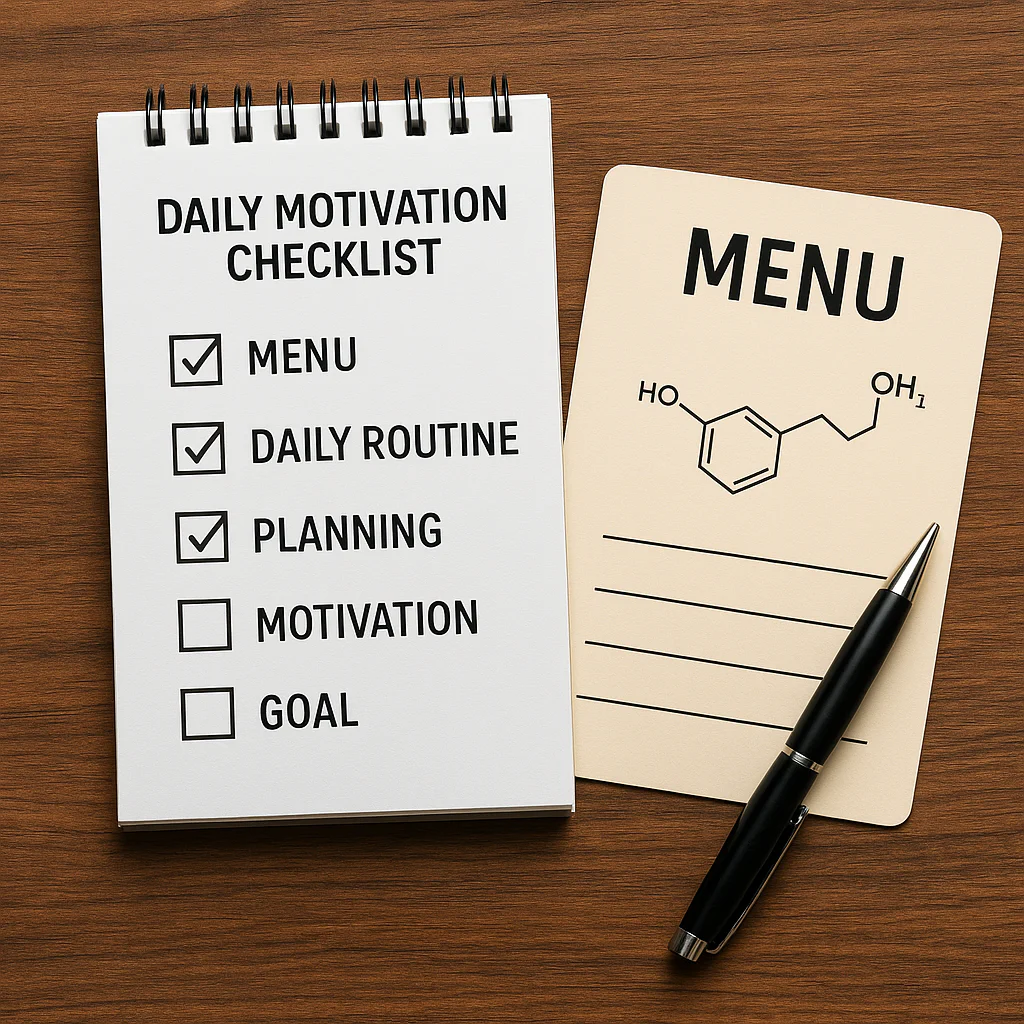
A dopamine menu for daily motivation is a personal list of enjoyable, energizing, or calming activities you can choose from when you need help getting started, taking a useful break, or making routine tasks feel less like pushing a cart with one squeaky wheel. Keep it simple: add a few quick boosts, a few longer activities, and some pleasant supports you can pair with chores or focused work.
The menu isn’t a way to measure or “hack” your dopamine. It’s a practical planning tool: when motivation is low, you don’t have to invent a perfect reset—you can choose one that’s worked for you before. A favorite song, a short walk, or a friend’s company may be enough to get the next small step moving.
🔑 Key Takeaways
- A dopamine menu is a personal list of rewarding or supportive activities, not a medical treatment or a dopamine-level tracker.
- Include options for different amounts of time and energy, from a one-song break to a longer hobby session.
- Pair pleasant activities with routine tasks when they won’t distract from safety or concentration.
- Use a checklist to make the next step clear, and treat breaks as choices—not prizes you must earn.
- Keep what genuinely helps, adjust what doesn’t, and seek professional support if persistent symptoms interfere with daily life.
Table of Contents
- ⚡️ Quick Tips and Facts
- 🧠 Dopamine, Motivation, and the Brain’s Reward System
- What dopamine does—and what it doesn’t do
- The neuroscience of motivation, anticipation, and reward
- Dopamine menus versus “cheap dopamine”
- 📖 The Origin and Rise of the Dopamine Menu
- 🍽️ What Is a Dopamine Menu?
- The appetizer, entrée, side dish, and dessert metaphor
- Dopamine menu, dopamine detox, and reward menu: key differences
- 🔬 What the Science Says About Dopamine Menus
- Evidence, benefits, and limits of the concept
- How habits, rewards, and behavioral activation fit in
- 👥 Who Can Benefit from a Dopamine Menu?
- Dopamine menus for ADHD and executive dysfunction
- Using a dopamine menu with low mood, stress, or burnout
- When a dopamine menu may not be enough
- 📝 How to Make a Dopamine Menu for Daily Motivation
- Step 1: Notice what genuinely energizes you
- Step 2: Choose activities for each menu category
- Step 3: Match activities to your time, energy, and budget
- Step 4: Make the menu visible and easy to use
- Step 5: Review, adjust, and keep what works
- 💡 30 Dopamine Menu Ideas for Focus, Energy, and Enjoyment
- Appetizers: quick motivation boosts
- Entrées: satisfying activities that take more time
- Sides: small supports to pair with a task
- Desserts: special treats and meaningful rewards
- Daily specials: novelty, connection, and spontaneous fun
- ⏰ How to Use a Dopamine Menu Throughout the Day
- A morning menu for getting started
- A midday menu for focus and energy
- An evening menu for recovery and enjoyment
- A low-energy or difficult-day menu
- 🎯 Dopamine Stacking for Productivity and Task Initiation
- Pairing a task with a pleasant activity
- Body doubling, timers, and other practical supports
- Avoiding distractions disguised as rewards
- ✅ Dopamine Menu Tips That Make It Sustainable
- Keep choices realistic, varied, and accessible
- Balance quick pleasures with restorative activities
- Adapt your menu for sensory needs, disability, and changing energy
- ⚠️ Common Dopamine Menu Mistakes to Avoid
- ❓ Frequently Asked Questions
- How do I make a dopamine menu that I’ll actually use?
- What is a dopamine menu for ADHD?
- How do you maintain motivation throughout the day?
- How do I use a dopamine menu effectively?
- What is the difference between quick pleasure and a lasting reward?
- Can dopamine stacking help with productivity?
- Does a dopamine menu increase dopamine levels?
- How often should I update my dopamine menu?
- 🔑 Key Takeaways
- Conclusion
- 🔗 Recommended Links
- 📚 Reference Links
⚡️ Quick Tips and Facts
If a checklist is the map, a dopamine menu is the snack bag for the hike. It gives you a few personally rewarding activities to choose from when motivation is dragging, without pretending that every task will suddenly become exciting. We at Daily Checklist™ use the same principle in our daily checklist guide: make the next useful action easy to see, easy to start, and realistic for the day you’re actually having.
| Quick fact | What it means for your day |
|---|---|
| A dopamine menu is a personal list of enjoyable or energizing activities organized into categories. | Choose an activity intentionally instead of waiting for motivation to magically appear. |
| The restaurant-menu metaphor is often associated with Jessica McCabe of How to ADHD. | The format is a practical planning tool, not a clinical treatment or a literal way to measure dopamine. |
| Dopamine is involved in motivation, learning, movement, and reward-related processes. | A fun activity can help you get started, but “dopamine” isn’t a simple happiness meter. |
| The best menu is personal, accessible, and balanced. | Your walk, playlist, tea, or chat with a friend may work better than someone else’s elaborate routine. |
| Short activities can be useful between tasks. | Decide in advance how you’ll return to the task, especially if your break involves a screen. |
| A dopamine menu is not a substitute for clinical care. | Persistent low mood, severe fatigue, or major difficulty functioning deserves professional support. |
Our quick-start recipe: choose one tiny activity that helps you begin, one enjoyable activity that can accompany a necessary task, and one more substantial activity to look forward to. Write them somewhere visible. Then try one today and notice what happens.
For practical ideas on making small routines stick, browse our habit formation guides and life hacks. But first, one helpful correction: dopamine menus aren’t about “hacking” a chemical. They’re about giving yourself a menu of reliable, rewarding choices.
🧠 Dopamine, Motivation, and the Brain’s Reward System
Dopamine gets described as the “pleasure chemical,” but that shorthand can make the brain sound like a vending machine: press button, receive happiness. The real picture is more nuanced. Dopamine participates in several brain functions, including learning, movement, motivation, and reward-related behavior, as described by the National Institute on Drug Abuse.
For everyday planning, the practical takeaway is simple: you don’t need to diagnose your dopamine to make a task easier to start. You can adjust the task, its surroundings, or the reward attached to it.
What dopamine does—and what it doesn’t do
Dopamine helps the brain process information about what may be worth pursuing and what has happened after an action. It is not a direct score for how happy you are, and no checklist or playlist can confirm your dopamine level.
| Popular claim | More careful interpretation |
|---|---|
| “Dopamine is the pleasure chemical.” | Dopamine is involved in reward and motivation, but pleasure and mood depend on broader brain systems. |
| “This activity gives you dopamine.” | Many experiences engage reward-related systems, but the effect is not easily reduced to a measurable personal boost. |
| “I need more dopamine to be productive.” | Motivation can be influenced by sleep, stress, environment, task design, health, and many other factors. |
| “A dopamine menu treats ADHD or depression.” | It may be a useful planning aid, but it is not a diagnosis or treatment. |
If this article’s first video is embedded above, it offers a broader perspective on the daily foundations of motivation, including sleep, movement, sunlight, nutrition, and non-sleep deep rest. Its speaker describes these as part of supporting a healthy baseline; treat individual numerical claims as the speaker’s account, not a guaranteed outcome for everyone. For independent reading, see the CDC’s guidance on sleep and physical activity.
The neuroscience of motivation, anticipation, and reward
A task can be hard to start even when you care about the result. That’s because “I want this done” and “I feel ready to begin” aren’t always the same thing. A task may feel vague, effortful, or unrewarding right now, while its benefits are far away.
A dopamine menu can help by making an immediate choice available:
- Name the next action. “Open the document” is easier to approach than “finish the project.”
- Add a supportive cue. Make tea, put on a familiar instrumental playlist, or ask a friend to work alongside you.
- Choose a stopping point. Decide whether you’ll work for five minutes, one small section, or one timer round.
- Notice the result. Did the support help you begin, continue, or recover? Keep what works.
That’s not a neuroscience experiment. It’s a practical way to test which conditions make your next action more doable.
Dopamine menus versus “cheap dopamine”
“Cheap dopamine” is a popular phrase, not a formal clinical category. It often refers to quick, highly engaging rewards—such as endless scrolling—that can crowd out activities you find more satisfying over time. But a short video, a sweet snack, or a game isn’t automatically bad. Context and consequences matter.
| Choice | Possible upside | Possible drawback | A useful guardrail |
|---|---|---|---|
| One favorite song | Quick mood or energy shift | You may lose momentum if the playlist keeps going | Pick one track, then start the task |
| Social media check | Connection or amusement | Feds can make stopping difficult | Use a timer or check during a planned break |
| Walk outside | Movement and a change of scene | Weather or access may be a barrier | Keep an indoor alternative |
| A hobby session | Enjoyment, skill, and absorption | May be hard to fit into a packed day | Schedule it as a real activity, not a “maybe” |
| A snack or drink | Comfort and a pleasant pause | Food rules can turn a reward into pressure | Choose freely; don’t use food as a moral scorecard |
A useful distinction is not “good dopamine versus bad dopamine,” but does this choice support the life and focus you want, and can you return from it? For screen habits and intentional breaks, see our digital detox resources.
📖 The Origin and Rise of the Dopamine Menu
The dopamine menu format became widely known through Jessica McCabe, creator of How to ADHD, who presented it as a way to choose rewarding activities intentionally. The metaphor makes planning feel less like a punishment chart and more like ordering something you might actually enjoy.
The idea has spread beyond ADHD communities because many people find it useful to keep a ready-made list of low-effort mood supports, pleasant breaks, or ways to make chores less dull. That doesn’t mean the tool has been established as a medical intervention. It means the menu format is easy to adapt.
We like it for the same reason a checklist works: when your brain is tired, you don’t have to invent a plan from scratch. You can scan a short list and pick the option that fits your time and energy. The question is not “Which activity is scientifically guaranteed to motivate me?” It’s “Which one has helped me feel a little more ready before?”
🍽️ What Is a Dopamine Menu?
A dopamine menu is a personal list of activities you find enjoyable, calming, energizing, or satisfying, arranged so you can choose one when you need a lift or a manageable break. It can be handwritten, in your phone, or taped beside your regular task list.
It is not a prescription to chase stimulation all day. Nor does it prove that a particular activity will raise dopamine in a measurable way. Think of it as a curated list of options for supporting motivation and making daily routines more humane.
The appetizer, entrée, side dish, and dessert metaphor
Menu categories help you pick an activity based on what the moment calls for. The labels are flexible; change them if they feel silly or confusing.
| Menu category | What it’s for | Examples |
|---|---|---|
| Appetizers | Quick, low-effort ways to get moving | Stretch, step outdoors, play one song, drink water |
| Entrées | More involved activities with a satisfying payoff | Make something, exercise, meet a friend, work on a hobby |
| Sides | Pleasant supports that pair with a necessary task | Podcast during laundry, tea while planning, body doubling |
| Desserts | Treats or high-interest activities to enjoy intentionally | A favorite show, a game, a social app, a special snack |
| Daily specials | Novel, social, or seasonal options | Visit a new walking route, try a class, call someone you miss |
A menu does not need every category. If “dessert” makes you feel judged, call it “quick pleasures.” If you don’t like background audio, leave it off your sides. The menu is yours, not a nutrition label for your personality.
Dopamine menu, dopamine detox, and reward menu: key differences
| Approach | Main idea | Practical caution |
|---|---|---|
| Dopamine menu | Keep a list of activities to choose from for enjoyment, energy, or support | Don’t treat it as a chemical prescription |
| Dopamine detox | Often means reducing highly stimulating habits or screen use | The name can imply an inaccurate idea of “cleansing” dopamine |
| Reward menu | Choose enjoyable activities as rewards or task supports | Rewards should feel inviting, not coercive |
| Behavioral activation | Plan meaningful or enjoyable activities, often used in structured mental-health care | A self-help list is not equivalent to therapy |
If an app or habit is getting in the way of sleep, work, or relationships, you might choose boundaries around it. That’s different from believing dopamine itself needs to be detoxed. For a thoughtful look at the format’s broader mood-boosting appeal, see The Everygirl’s dopamine menu guide.
🔬 What the Science Says About Dopamine Menus
The exact term “dopamine menu” is a practical metaphor, not a standardized treatment protocol. Reliable research supports the broader ideas that planning activities, shaping cues, building habits, and pairing effort with meaningful reinforcement can help people follow through. That does not establish that a particular menu will change dopamine levels or work equally well for everyone.
A product blog from Mind Lab Pro recommends choosing uplifting “starters,” useful “sides,” and more fulfilling “mains,” then transitioning smoothly back to work. That is a reasonable practical suggestion. Its supplement marketing and simplified descriptions of neurotransmiters are a separate matter and should not be taken as independent proof of a dopamine-menu effect.
Evidence, benefits, and limits of the concept
The best-supported way to think about a dopamine menu is as a planning and choice aid:
- It reduces the effort of deciding what to do when you’re tired.
- It can help you remember activities that reliably feel restorative or enjoyable.
- It lets you make a task more pleasant without waiting to feel motivated first.
- It can support a planned routine, but it cannot guarantee productivity or a particular brain-chemical response.
The National Institute of Mental Health’s overview of depression also makes clear that persistent low mood and loss of interest can be symptoms requiring professional assessment. A menu may offer supportive structure, but it should not become a reason to delay care.
How habits, rewards, and behavioral activation fit in
A menu can work alongside practical habit strategies:
- Attach a cue: “After I make coffee, I’ll open my task list.”
- Make the action smaller: “Write one sentence,” rather than “finish the report.”
- Put the reward nearby: Keep the chosen playlist or art materials ready.
- Notice what happened: Record whether the activity helped with starting, continuing, or recovering.
This is compatible with the wider study of habits and behavior change, but outcomes vary. A reward that feels helpful today may feel irritating next week; a plan that works at home may not fit at work. We recommend treating the menu as a living experiment rather than a rulebook.
👥 Who Can Benefit from a Dopamine Menu?
A dopamine menu may suit anyone who gets stuck choosing a break, struggles to begin an unappealing task, or wants more enjoyable activities in their routine. It can be especially helpful when decisions feel burdensome: rather than asking “What should I do?” you can select from a list you made when you had more bandwidth.
That said, the menu should accommodate real needs. A person with chronic pain may want rest options, not a “push through” list. Someone with limited privacy at work may need quiet, discreet breaks. A parent may need activities that fit into a ten-minute window. A useful menu reflects your circumstances, not an idealized productivity routine.
Dopamine menus for ADHD and executive dysfunction
People with ADHD may find an external list helpful for remembering options, reducing decision fatigue, and making task transitions more concrete. Jessica McCabe’s How to ADHD popularized the format in that community, but a dopamine menu is not an ADHD assessment or treatment.
For an ADHD-friendly version:
- Keep options short and easy to scan.
- Include activities with different time and energy demands.
- Write the next step beside a reward: “Put shoes on → take a five-minute walk.”
- Use alarms, visual timers, or body doubling if those support you.
- Avoid making a missed activity feel like failure.
If ADHD symptoms are affecting work, relationships, or daily functioning, consult a qualified clinician. The CDC’s ADHD information provides an overview of symptoms and support.
Using a dopamine menu with low mood, stress, or burnout
Low motivation can accompany many things: a hard week, inadequate rest, stress, illness, grief, or a mental-health condition. A menu might help you choose a gentle, manageable action, but don’t turn it into another standard you must meet.
Try a “low-demand” menu with options such as:
- Sit near a window or step outside briefly.
- Send one message to someone supportive.
- Listen to a familiar song lying down.
- Eat something accessible or refill a drink.
- Choose one task to postpone, delegate, or simplify.
For ongoing symptoms or difficulty functioning, talk with a healthcare professional. The NHS guidance on depression describes common signs and routes to support.
When a dopamine menu may not be enough
Get professional advice if persistent low mood, loss of interest, anxiety, exhaustion, sleep changes, or difficulty functioning is interfering with daily life. Seek urgent local help if you may harm yourself or someone else. A menu can accompany care, but it is not a replacement for diagnosis, therapy, medication, or other treatment when needed.
📝 How to Make a Dopamine Menu for Daily Motivation
A good menu is not a Pinterest performance. It is a short, usable list of activities that fit your actual schedule, body, budget, and environment. Start small; you can add options after you learn what helps.
Step 1: Notice what genuinely energizes you
For three to five days, jot down moments when you felt a little more engaged, calmer, or ready to continue. Keep the observation simple:
- What were you doing?
- How long did it take?
- Did it help you start, focus, or recover?
- Was it easy to repeat?
Examples might include stretching, talking to a friend, making a playlist, finishing a tiny task, sitting outside, or enjoying a favorite drink. Don’t choose activities just because they appear on someone else’s “self-care” list. Your menu should be based on your experience.
Step 2: Choose activities for each menu category
Aim for variety rather than volume. Three choices per category are plenty to begin.
| Category | Write options that are… | Example |
|---|---|---|
| Appetizers | Quick and low-friction | Put one song and stretch |
| Entrées | Meaningful or absorbing | Draw, cook, garden, or call a friend |
| Sides | Compatible with a task | Listen to a podcast while folding laundry |
| Desserts | Treat-like and time-bounded | Watch one episode or play a short game |
| Daily specials | New or social | Try a new route or invite someone for a walk |
Step 3: Match activities to your time, energy, and budget
Make sure your options work for more than one kind of day. We suggest a simple filter:
| Available capacity | Ask yourself | Possible choice |
|---|---|---|
| One minute | What can I do without changing clothes or leaving the room? | Stretch, open a window, play a song |
| Ten minutes | What can help me reset without swallowing the afternoon? | Walk, tidy one surface, message a friend |
| Thirty minutes or more | What feels nourishing or absorbing? | Cook, exercise, make art, meet someone |
| Very low energy | What is comforting and accessible? | Rest, listen, sit outside, ask for help |
| Need to focus | What can support a task without pulling me away? | Instrumental music, water, quiet company |
Include free options and options that work at home, outdoors, and in public. An expensive or complicated activity is not automatically more rewarding than a favorite song.
Step 4: Make the menu visible and easy to use
Put the menu where you make decisions: next to a paper planner, in a notes app, on a desk card, or on a fridge. Keep it short enough to scan. If you use a checklist, add an optional prompt such as “Choose one support” rather than turning every pleasure into an obligation.
You might try a simple format:
When I need a quick reset:
- Stretch for two minutes
- Play one favorite song
- Step outside

When I need help starting:
- Set a five-minute timer
- Ask someone to body double
- Pair the task with a podcast

When I need a proper break:
- Make something
- Call a friend
- Go for a walk
``

### Step 5: Review, adjust, and keep what works

After a week, mark each option as **helpful**, **neutral**, or **not for me**. Keep the activity if it fits your life, not because it sounds virtuous. Add new options when routines, seasons, health, or work conditions change.

If you are tracking tasks, track the useful outcome too: “Did I return to the task?” is often more informative than “Did I feel motivated?” For simple habit tracking, explore our [habit formation resources](https://www.dailychecklist.org/category/habit-formation/).

## 💡 30 Dopamine Menu Ideas for Focus, Energy, and Enjoyment

These ideas are starting points, not a prescription. Pick the ones that feel genuinely pleasant or useful to you. If an activity creates stress, costs too much, or is inaccessible, it doesn’t belong on your menu.

### Appetizers: quick motivation boosts

1. Play one favorite song.
2. Stretch your shoulders or legs.
3. Step outside for fresh air.
4. Take a few slow breaths.
5. Refill your water or make tea.
6. Clear one small surface.
7. Do a short lap around the room.
8. Open a window or change the lighting.
9. Send a friendly text.
10. Start a five-minute timer and do only the first step.

### Entrées: satisfying activities that take more time

11. Go for a walk or roll outdoors.
12. Cook or assemble a meal you enjoy.
13. Work on a creative hobby.
14. Exercise in a way that suits your ability and health.
15. Read something for pleasure.
16. Spend unhuried time with a friend.
17. Tend plants or garden.
18. Make something with your hands.
19. Visit a library, park, or other calming place.
20. Learn or practice a skill you care about.

### Sides: small supports to pair with a task

21. Listen to a podcast while doing laundry.
22. Put on instrumental music for paperwork.
23. Enjoy a warm drink while planning.
24. Work alongside another person.
25. Use a comfortable chair or tidy workspace.
26. Break a chore into rounds with a short reset between them.

### Desserts: special treats and meaningful rewards

27. Watch one planned episode.
28. Play a favorite game for a set break.
29. Enjoy a favorite snack without turning it into a reward you must “earn.”
30. Take time for a hobby, book, or show after a task.

### Daily specials: novelty, connection, and spontaneous fun

Novelty can be a welcome change, but you don’t need to keep adding activities. Try a different walking route, swap playlists with a friend, visit a new community space, or make a familiar task feel fresh by changing its order.

A note about social media: some people enjoy a deliberate check-in; others find feeds hard to leave. If that’s you, choose a screen-free option or use an app timer. Our [digital detox category](https://www.dailychecklist.org/category/digital-detox/) has more ideas for making screen breaks intentional rather than accidental.

## ⏰ How to Use a Dopamine Menu Throughout the Day

You don’t have to schedule a reward after every task. The menu is most useful when it meets a particular need: getting started, staying with a task, or recovering after effort. Try one choice, then adjust.

### A morning menu for getting started

A gentle morning routine might look like this:

1. Check your task list and identify **one essential next action**.
2. Choose a short appetizer: stretch, step outside, or listen to a song.
3. Pair it with a cue, such as putting on shoes or opening your work file.
4. Begin with a tiny first step.
5. Decide on a break before you get depleted.

Sleep and daylight are relevant to daily alertness and routine, but no single morning habit guarantees motivation. For general recommendations, consult the [CDC’s sleep guidance](https://www.cdc.gov/sleep/about/index.html) and the [National Institute for Occupational Safety and Health’s information on light and work](https://www.cdc.gov/niosh/).

### A midday menu for focus and energy

Miday is a good time to check what is actually getting in the way. Do you need movement, food, a quieter environment, a break, or a clearer task?

- If you feel restless, try a movement break.
- If the task is dull, pair it with suitable audio or body doubling.
- If you’re overwhelmed, reduce the task to one visible step.
- If you’re hungry or thirsty, address that basic need rather than trying to out-motivate it.

The speaker in the [featured video](#featured-video), if included above, emphasizes sleep, non-sleep deep rest, nutrition, morning light, and exercise as daily foundations. Those are useful areas to consider, but the video’s reported numerical claim about a dopamine increase from non-sleep deep rest should not be treated as a guaranteed personal result. General exercise guidance is available from the [CDC](https://www.cdc.gov/physical-activity-basics/guidelines/index.html).

### An evening menu for recovery and enjoyment

Evening is not merely a runway for tomorrow’s productivity. Include activities you enjoy because they matter to you, not just because they make you more efficient.

- Put a relaxing activity on the calendar.
- Create a short transition from work to home.
- Choose a screen boundary if screens interfere with sleep or rest.
- Prepare one small thing for tomorrow if it reduces morning friction.
- Leave room for unscheduled time.

A checklist can help you remember essentials, but it should not turn every evening into a second shift. For screen-boundary ideas, see our [digital detox guides](https://www.dailychecklist.org/category/digital-detox/).

### A low-energy or difficult-day menu

On hard days, make the menu smaller and kinder. Choose the easiest useful action, not the most impressive one.

| If you feel… | Try… |
|---|---|
| Stuck | Open the task, gather materials, or do one minute |
| Overwhelmed | Write down what can wait; ask for help with one thing |
| Restless | Change position, stretch, or move briefly if comfortable |
| Drained | Choose rest, hydration, food, or a quieter setting |
| Lonely | Send a low-pressure message or arrange a later call |
| Screen-foged | Look away from the device, step outside, or switch to paper |

Rest is not a failure of motivation. Sometimes the best choice on the menu is to stop.

## 🎯 Dopamine Stacking for Productivity and Task Initiation

“Dopamine stacking” is an informal term for pairing an effortful activity with something enjoyable or supportive. You might listen to a podcast while folding laundry, work beside a friend, or make a warm drink before tackling paperwork.

The goal is not to force every task to be entertaining. It is to reduce friction **without making the support more distracting than the task**.

### Pairing a task with a pleasant activity

Try this simple pairing:

| Task | Possible support |
|---|---|
| Fold laundry | Podcast, audiobook, or favorite show in the background |
| Sort paperwork | Timer, comfortable lighting, and a drink |
| Walk or commute | Music or an engaging audio program |
| Meal prep | A playlist and a clear counter |
| Start a report | Body doubling, a quiet room, or a two-minute warm-up |

Some tasks need full attention. Don’t pair a demanding activity with a show or conversation if it makes errors more likely. Match the support to the task’s safety and concentration needs.

### Body doubling, timers, and other practical supports

**Body doubling** means doing a task while another person is present, in person or virtually. Some people find this helps them get started; others prefer privacy. A timer can provide a clear beginning and endpoint, while a written next step can reduce the “where do I even start?” problem.

Experiment with:

- A five- or ten-minute timer.
- A shared quiet work session.
- One task card placed beside your workstation.
- Music without lyrics for concentration-heavy work.
- A planned movement break between work rounds.

For task routines and making habits easier to repeat, see [Daily Checklist’s habit formation articles](https://www.dailychecklist.org/category/habit-formation/).

### Avoiding distractions disguised as rewards

A reward is less useful if it derails the activity you meant to support. Before taking a break, decide:

- **What am I choosing?**
- **How long do I want to spend?**
- **What will tell me it’s time to return?**

A feed can be enjoyable, but an open-ended scroll may not feel like a real break. If you often lose track of time, choose an option with a natural stopping point: one song, one walk around the block, one cup of tea, or one chapter.

## ✅ Dopamine Menu Tips That Make It Sustainable

A menu should make the day feel more supportive, not more surveilled. We recommend a few practical rules:

- **Use activities you actually like.** “Healthy” is not the same as enjoyable.
- **Keep a range of effort levels.** Your energy changes; your options should too.
- **Make breaks genuine.** A break can be rest, social connection, play, or quiet.
- **Plan transitions.** Decide how you’ll return before starting a break that tends to run long.
- **Make room for accessibility.** Offer seated, low-sensory, indoor, and low-cost choices.
- **Skip the guilt accounting.** A menu is not a reward chart for being “good.”

### Keep choices realistic, varied, and accessible

A list full of activities that need perfect weather, a free afternoon, or a particular body will be hard to use. Make alternatives: indoor walk or outdoor walk; voice note or visit; seated stretch or standing stretch. If you’re working in a shared space, include discreet choices such as water, a breathing pause, or a quick stretch.

### Balance quick pleasures with restorative activities

Quick pleasures have a place. So do longer, meaningful activities. You don’t have to rank them morally. Ask instead: **What do I need right now, and will this choice leave me feeling better, unchanged, or more stuck?**

A Mind Lab Pro article describes this as favoring “mains” and useful “sides” over relying only on “desserts.” That’s a helpful metaphor for variety, not a rule that screen-based entertainment or snacks are inherently bad. The strongest menu is the one you can use without shame.

### Adapt your menu for sensory needs, disability, and changing energy

If noise is overstimulating, “music break” may be a poor fit. If movement is painful or inaccessible, don’t make exercise the price of a reset. Consider quiet, seated, sensory-friendly, social, or restorative options. For health-related constraints, follow your clinician’s advice and choose alternatives that fit your needs.

## ⚠️ Common Dopamine Menu Mistakes to Avoid

| Mistake | Why it can backfire | Better approach |
|---|---|---|
| Treating dopamine as a simple happiness gauge | It oversimplifies a complex system | Use the menu to support behavior, not measure brain chemistry |
| Making a huge list | Too many choices can add decision friction | Start with a handful of options |
| Filling it with activities you “should” enjoy | It may feel like another assignment | Choose what you genuinely find useful or pleasant |
| Using rewards as punishment or leverage | It can create pressure and shame | Offer supportive choices without requiring perfection |
| Taking an open-ended screen break | It may be difficult to return from | Use a timer or choose a natural stopping point |
| Expecting the menu to treat a mental-health condition | It may delay appropriate care | Seek professional support when symptoms persist |
| Making every break productive | It turns recovery into another job | Allow leisure and rest to be worthwhile in themselves |

The menu is a tool, not a test. If it isn’t helping, change it—or set it aside. That flexibility is a feature.

## 🔗 Featured Video: Daily Foundations for Motivation

The featured video takes a broad, habit-based view of motivation, emphasizing quality sleep, non-sleep deep rest, nutrition, morning light, and movement. It argues that motivation is easier to support when daily foundations are in place, rather than relying only on quick rewards.

One claim in the video says non-sleep deep rest can increase dopamine by up to 65%. That figure should be read as **the speaker’s stated claim**, not as a guaranteed effect or a finding established for every person and practice. The [National Center for Complementary and Integrative Health](https://www.nccih.nih.gov/health/meditation-in-depth) provides general information on meditation practices; it does not validate every specific claim made in a video.

The useful takeaway is less dramatic and more actionable: **sleep, movement, food, light, stress, and environment can all matter to how your day feels**. A dopamine menu can sit alongside those foundations; it cannot replace them.

## ❓ Frequently Asked Questions

### What are dopamine menu ideas for staying motivated throughout the workday?

Choose ideas that fit the kind of reset you need. A one-song break, stretching, a short walk, a warm drink, body doubling, or a planned call can all work for some people. For task pairing, try a podcast during a repetitive chore, but use distraction-free conditions for work requiring careful attention.

The best option is not the most exciting one. It is the one that helps you return to your priorities feeling more capable—or at least less depleted.

### How do I build rewarding breaks into a daily checklist without losing focus?

Write a break beside a task, but keep it optional and time-appropriate. For example: “Finish one section → take a five-minute walk.” Before the break, decide how you’ll resume, such as leaving the document open at the next step.

If a particular activity regularly makes it hard to return, choose a break with a clearer endpoint. A song or a short loop outside often has a more natural stopping point than an open-ended feed.

### Can a dopamine menu help with procrastination and low motivation?

It may help by reducing the decision-making and effort involved in getting started. Pair a small action with a pleasant cue, such as opening the file while listening to one song. A menu won’t resolve every cause of procrastination, which may involve overload, unclear expectations, stress, health, or attention difficulties.

If low motivation is persistent or affecting your ability to function, consider talking with a healthcare professional rather than relying on a planning tool alone.

### How can I use a dopamine menu to complete tasks on my daily checklist?

Choose one item from the menu based on what is blocking the task:

1. If you can’t start, pick a quick appetizer.
2. If the task is repetitive, add a suitable side.
3. If you’re running out of energy, take a genuine break.
4. If the work is done, enjoy a planned treat or meaningful activity.
5. Notice whether you returned to the task and adjust next time.

Keep the checklist focused on actions you can actually do. “Clear the kitchen” may be too broad; “put away clean dishes” is easier to begin.

### What quick activities can I add to a dopamine menu to stay motivated?

Try stretching, stepping outside, listening to one song, opening a window, making tea, sending a kind message, or clearing one small surface. Add options that are accessible where you work or live. A quick activity should be a choice—not a mandatory warm-up before you’re “allowed” to begin.

### How do I create a dopamine menu for daily motivation?

List activities that genuinely help you feel more energized, connected, calm, or engaged. Sort them into quick options, longer activities, task supports, and treats if those labels help. Keep the menu visible, test it for a week, and remove options that don’t suit your life.

Think of it as a personal planning aid, not a way to control dopamine or guarantee a good mood.

### What is a dopamine menu, and how can it make daily checklists easier to follow?

A dopamine menu is a list of enjoyable or supportive activities you can choose from when you need a reset, a reward, or help getting started. It can make a checklist easier to use by adding a specific support to an unappealing task: music while folding laundry, a short walk after paperwork, or a timer to begin one small step.

The list works best when it leaves room for choice. If it becomes another set of tasks you can fail, simplify it.

### Can a daily checklist paired with a dopamine menu help prevent procrastination?

It can support task initiation by making the first step and a possible reward visible. For example, “Open the bill, set a five-minute timer, then take a short break” is more actionable than “deal with finances.”

It cannot prevent every episode of procrastination. When a task feels impossible, ask whether it needs to be clarified, divided, rescheduled, delegated, or discussed with someone who can help.

### How can you use a dopamine menu without relying on social media or screens?

Include offline options such as a brief walk, stretching, reading, making tea, listening to a radio or downloaded audio, tending plants, drawing, or contacting someone by voice. If screens are the source of the distraction, keep a paper menu nearby and move the phone out of reach during work.

There’s no need to avoid all screens; choose boundaries based on how they affect your focus and rest. Our [digital detox guides](https://www.dailychecklist.org/category/digital-detox/) offer more practical screen-break ideas.

### What should you include in a dopamine menu for work and household chores?

For work, consider music where appropriate, a drink, body doubling, a timer, a change of workspace, or a short walk between focus periods. For household tasks, pair repetitive chores with audio, divide the job into small zones, or invite someone to work alongside you.

Include options for low-energy days and activities that don’t require spending money. The menu should make routine life easier, not create extra shopping or planning.

### How can a dopamine menu make daily tasks feel more rewarding?

It can add anticipation, choice, and a sense of completion. A task may feel less monotonous when paired with a pleasant support or followed by an activity you’re looking forward to. The reward doesn’t have to be large; finishing a small step and noticing that progress can be satisfying.

Try different combinations and pay attention to what genuinely helps. A reward that feels forced or distracting is not the right reward for you.

### How can I make sure a break doesn’t turn into avoidance?

Choose the break before you begin, use a timer if helpful, and leave a clear next action waiting. If you find that an activity repeatedly makes it hard to return, swap it for something shorter or more naturally bounded. Also check whether you’re avoiding the task because it is unclear, too large, or emotionally difficult; the solution may be to change the task, not the break.

### Are dopamine menus evidence-based treatment for ADHD or depression?

No. A dopamine menu is a popular self-management format, not an established standalone treatment. It may help with planning, task support, or choosing pleasant activities, but it should not replace a clinical assessment or prescribed care.

For ADHD information, see the [CDC’s overview](https://www.cdc.gov/adhd/about/index.html). For depression symptoms and treatment information, see the [National Institute of Mental Health](https://www.nimh.nih.gov/health/topics/depression).

## 🔑 Key Takeaways

- **A dopamine menu is a personal list of rewarding or supportive activities**, not a way to measure or directly control dopamine.
- Use categories—quick activities, longer activities, task supports, and treats—only if they make your choices easier.
- Match the activity to your **time, energy, environment, and access needs**.
- Pairing a pleasant activity with a task can help some people begin, but some tasks need quiet and full attention.
- Use checklists to make the next step visible, not to turn every break into a productivity test.
- If low mood, fatigue, or attention difficulties persist or interfere with daily life, seek professional support.
- The best menu is the one that helps you start, recover, or enjoy your day—with less pressure and more choice.