Support our educational content for free when you purchase through links on our site. Learn more

Daily Ritual for Creative Flow: 12 Ways to Begin 🎨
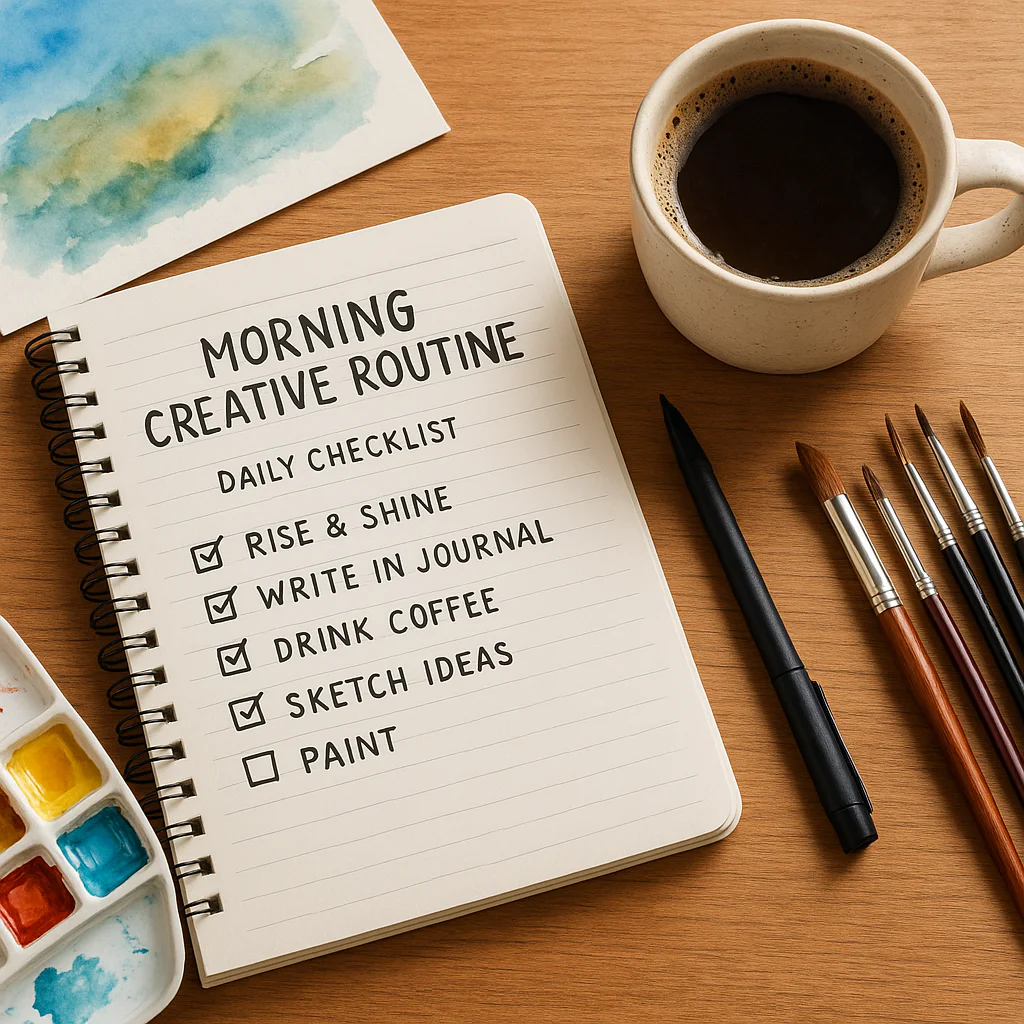
A daily ritual for creative flow works best when it’s simple: choose a repeatable cue, set one clear creative goal, and protect a manageable block of attention. You can’t force inspiration to arrive on schedule, but you can make starting easier—and that’s often where the good stuff begins.
At Daily Checklist™, we’ve seen how “I’ll work on it later” can quietly become “Where did the week go?” One small checklist—open the project, silence notifications, write the next step—turns an intimidating blank page into a few doable actions.
Flow isn’t the only sign of a productive creative session. A rough draft, a practice sketch, or ten focused minutes still count, even if your inner muse is currently stuck in traffic.
Key Takeaways
- Keep your ritual short and repeatable. A familiar cue and a prepared workspace can make it easier to begin.
- Set one specific session goal. “Sketch three ideas” beats “be creative.”
- Make flow more likely, not mandatory. Match the challenge to your skill and reduce interruptions, but don’t judge a session by whether you lose track of time.
- Protect rest and flexibility. A useful creative routine should fit your real life, not punish you for having one.
- End with a breadcrumb. Write down the next step so tomorrow’s restart feels less like staring into the creative abyss.
Table of Contents
- ⚡ Quick Tips and Facts
- 🎨 What a Daily Ritual for Creative Flow Really Is
- 🧠 The Science and History of Creative Flow
- What Happens in Your Brain During Flow?
- Flow, Focus, and Creativity: What’s the Difference?
- ✨ Can You Trigger a Creative Flow State?
- The Conditions That Make Flow More Likely
- Why Flow Can’t Be Forced
- 🧭 How to Build a Daily Creative Ritual
- Choose a Consistent Time and Place
- Create a Clear Start and Finish Cue
- Set a Small, Specific Creative Goal
- Prepare Your Tools and Workspace
- 🚀 12 Ways to Get Into Creative Flow
- 1. Begin with a Two-Minute Warm-Up
- 2. Make the First Step Ridiculously Easy
- 3. Match the Challenge to Your Skill
- 4. Work in Focused, Protected Sessions
- 5. Silence Notifications and Reduce Distractions
- 6. Use Music, Ambient Sound, or Quiet Intentionally
- 7. Keep a Capture List for Wandering Thoughts
- 8. Take Short Breaks Before Your Focus Runs Dry
- 9. Add Gentle Movement or a Change of Scene
- 10. Track Progress Without Judging the Work
- 11. Stop with a Clear Next Step
- 12. Review and Refine Your Ritual Weekly
- ⏰ Sample Daily Creative Routines for Different Schedules
- A 15-Minute Ritual for Busy Days
- A 30-Minute Morning Creativity Routine
- A 90-Minute Deep Work Session
- An Evening Ritual for Writers, Artists, and Makers
- 🌿 Rest, Breaks, and the Creative Payoff
- Why Time Off Can Improve Creative Work
- How Sleep, Exercise, and Downtime Support Flow
- 🎯 Rethinking Productivity and Creative Success
- A More Useful Definition of Creative Success
- Why Consistency Beats Waiting for Inspiration
- Common Myths That Undervalue Creative Practice
- 🧱 Common Creative Flow Problems and How to Fix Them
- “I’m Not Feeling Inspired”
- Perfectionism and Fear of Bad Work
- Interruptions, Noise, and Digital Distraction
- Burnout, Low Energy, and Creative Blocks
- 📓 How to Track Your Creative Ritual and Progress
- A Simple Creative Flow Journal
- What to Measure Besides Output
- 🔄 Adapting Your Ritual to Your Life
- Creative Rituals for Parents and Caregivers
- Rituals for Remote Workers and Shared Spaces
- How to Restart After Missing a Day
- ✅ Conclusion
- 🔗 Recommended Links
- ❓ FAQ
- How long should a daily creative ritual be?
- What is the best time of day for creative flow?
- Can a routine make creativity feel forced?
- How do I get into flow when I feel stuck?
- Is creative flow the same as deep work?
- Do I need a special workspace or tools?
- How many days does it take to build a creative habit?
- 📚 Reference Links
⚡ Quick Tips and Facts
A daily creative ritual isn’t a magic spell for instant inspiration. It’s a repeatable cue that helps you begin, protect your attention, and make room for creative work before the day fills up with everyone else’s priorities. At Daily Checklist™, we’ve found that a small checklist can make the difference between “I should work on that” and actually opening the notebook. Our guide to daily checklists offers a practical starting point.
| Quick fact | What it means for your ritual |
|---|---|
| Flow is usually easier when the challenge fits your current skill level. | Choose a task that stretches you without feeling impossible. |
| A ritual can be very short. | A playlist, a glass of water, and one written goal may be enough. |
| You don’t need an extreme wake-up time. | A useful routine is one you can repeat, not one that looks impressive online. |
| Creative practice doesn’t require every session to feel brilliant. | Showing up counts, even if today’s draft needs a future haircut. |
| Rest supports attention and creative thinking. | Use breaks as part of the process, not as a reward you must earn. |
Try this 5-step start:
- Put your phone out of reach or switch on Focus mode.
- Take a few slow breaths and open your work-in-progress.
- Write one specific goal, such as “sketch three shapes” or “draft 150 words.”
- Work for a manageable block of time.
- Before stopping, leave a note naming your next step.
That last step may sound almost too simple. Keep it in your pocket; it will come in handy when tomorrow’s blank page starts acting mysterious.
🎨 What a Daily Ritual for Creative Flow Really Is
A daily ritual for creative flow is a short sequence of intentional actions that marks the transition into creative work. It might be making tea, clearing a corner of your desk, putting on headphones, and writing down one target. The point isn’t ceremony for ceremony’s sake. It’s to reduce friction and tell your brain, “We’re doing this now.”
A ritual differs from a rigid routine in how it feels. A routine is often the practical order of events; a ritual adds meaning, attention, or a deliberate transition. In practice, the two work well together: the routine gets you there, and the ritual helps you arrive.
| Element | Example | Why it helps |
|---|---|---|
| Cue | Same playlist or chair | Signals a shift into work |
| Preparation | Open the project and gather tools | Removes small barriers |
| Intention | “Edit one scene” | Gives attention a target |
| Focus block | 20–60 minutes of work | Creates a protected stretch |
| Closing cue | Write the next step and tidy up | Makes it easier to resume |
The Daily Checklist™ planner perspective is simple: don’t checklist every breath. Track only the actions that make beginning and finishing easier. A checklist can support habit formation without turning creativity into a compliance exercise. ✅
🧠 The Science and History of Creative Flow

What Happens in Your Brain During Flow?
Psychologist Mihaly Csikszentmihalyi popularized the concept of flow: deep absorption in an activity, often accompanied by a sense of control, focused attention, and reduced awareness of time. It’s not a guaranteed productivity mode, and researchers continue to examine how flow works across different tasks and people.
A widely cited condition is a balance between challenge and skill. If a task feels far beyond your ability, anxiety may take over. If it’s too easy, boredom can creep in. The Flow Research Collective’s overview of flow explains the state and its common characteristics; for a broader research perspective, see the American Psychological Association’s discussion of flow.
| If the task feels… | Try this adjustment |
|---|---|
| Overwhelming | Break it into a smaller, visible action |
| Too easy | Add a constraint, new technique, or slightly harder target |
| Vague | Define what “done for this session” means |
| Distracting | Remove one source of interruption before starting |
Flow isn’t something we can order like a coffee. But we can make the conditions more welcoming.
Flow, Focus, and Creativity: What’s the Difference?
Focus means directing attention toward a task. Creative work involves generating, exploring, or shaping ideas. Flow is a particular kind of intense absorption that may occur during creative work, but it isn’t the only measure of a worthwhile session.
A session can be valuable even if it feels effortful. Editing, practicing scales, gathering references, or sketching rough options may not feel like a cinematic montage—but those activities can prepare the ground for a later breakthrough.
Mason Curey’s Daily Rituals: How Great Minds Make Time, Find Inspiration, and Get to Work collects accounts of more than 160 creative people. A review of the book highlights the value of scheduling and protecting time, quoting W. H. Auden: “The surest way to discipline passion is to discipline time.” That’s a useful idea, not a demand to imitate any one person’s schedule. Curey’s examples show how varied creative lives can be.
The Science and History of Creative Flow
Creative rituals have a long history in artists’ working lives, but there’s no universal ritual recipe. Curey’s book documents radically different habits: some creators worked early; others worked later, in short bursts, or around day jobs and family life. The lesson is less “copy Hemingway” and more make a repeatable space for your own work.
The competing article “Get into flow faster, using ritual and routine” makes a similar point: small actions such as a playlist, a few breaths, or changing seats can act as signals. Its examples range from a short pre-writing sequence to performers’ warm-ups. These are useful examples, not scientific proof that any one cue causes flow.
A word of caution from history: famous creatives sometimes used unhealthy methods to sustain work. The book review notes W. H. Auden’s historical use of amphetamines. That is not advice to copy. Current health guidance should always take priority over romanticized stories of overwork.
✨ Can You Trigger a Creative Flow State?
You can’t reliably command flow, but you can build conditions that make focused work more likely. Think of a ritual as opening the door, not dragging inspiration through it by the collar.
The Conditions That Make Flow More Likely
Start with a clear task, a manageable challenge, and enough uninterrupted time to get oriented. Then give yourself a useful signal: same workspace, same notebook, the same opening song, or the same first action.
Research on attention is still evolving, but distraction has a practical cost: interruptions can require time and effort to recover from. The University of California, Irvine’s research on interrupted work found that interruptions changed how people worked and increased stress in the study context. That’s a good reason to silence notifications during a focus block when you can.
Why Flow Can’t Be Forced
Flow is not a moral achievement. You can do good work without losing track of time, and a session that feels clunky can still move a project forward. Some creative tasks require deliberate evaluation rather than unbroken immersion.
Aim for readiness, not a guaranteed feeling. If a ritual leaves you calmer, clearer, and more likely to start, it’s doing useful work—even when the session itself is ordinary. For more ways to make routines easier to repeat, explore our habit formation guides.
🧭 How to Build a Daily Creative Ritual
A good ritual should be small enough to repeat and flexible enough to survive real life. Here’s a practical build-it-yourself sequence.
Choose a Consistent Time and Place
Pick a time that fits your actual energy and responsibilities. Morning works brilliantly for some people; others get their best ideas after work or during a quiet evening. Consistency can help, but exact timing matters less than choosing a slot you can protect reasonably often.
- Look at your week and identify a realistic window.
- Choose a primary spot, even if it’s just one end of the kitchen table.
- Decide what you’ll do when that spot or time isn’t available.
- Keep the alternative simple: a notebook, a library seat, or a 15-minute mobile session.
The Creative Life article describes using a walk as a “commute” to a home studio. That’s a clever transition—not a requirement to circle your yard ten times unless you genuinely enjoy it.
Create a Clear Start and Finish Cue
Use a beginning cue you like and can repeat: fill a water bottle, put on headphones, stretch, or open a specific project file. Then create a matching stop cue, such as saving work, writing the next action, and closing the notebook.
A repeatable sequence helps separate creative time from the rest of the day. It also makes it easier to stop without mentally carrying an unfinished project into dinner.
Set a Small, Specific Creative Goal
“Work on my novel” is a project. “Write one rough paragraph showing the argument” is a session goal. A clear target reduces the number of decisions between you and the work.
Use this format:
Today I will: [visible action]
For: [manageable time or amount]
I’ll know I’m done when: [simple stopping point]
Examples:
- Draft one page without editing.
- Make five thumbnail sketches.
- Practice one difficult passage slowly.
- Sort ten reference images into a mood board.
Prepare Your Tools and Workspace
Before the session, make the tools you need easy to reach and the distractions harder to reach. That may mean laying out a sketchbook, opening the correct document, or setting your phone in another room. You don’t need a pristine studio. You need a workspace that helps the next action happen.
Feature: a short checklist prevents setup from expanding into a 45-minute desk-reorganization project.
Benefit: fewer tiny decisions at the start.
Drawback: overplanning can become creative procrastination wearing a tidy apron.
Try a setup list of no more than five items, then begin.
🚀 12 Ways to Get Into Creative Flow
1. Begin with a Two-Minute Warm-Up
Warm up with a low-pressure action that gets your hands moving: freewrite, doodle, play a scale, or collect three references. The warm-up is a doorway, not a test of talent.
2. Make the First Step Ridiculously Easy
Reduce the start to one action: open the document, sharpen a pencil, or write a deliberately bad first sentence. The NHS’s guidance on building healthy habits emphasizes making behavior practical and repeatable; the same common-sense principle applies to creative practice.
3. Match the Challenge to Your Skill
If you’re new to a medium, don’t start with the most demanding project you can imagine. If you’re experienced, add a constraint that keeps the work engaging. A songwriter might draft a verse using only a few chords; a writer might shape a scene from one character’s point of view.
4. Work in Focused, Protected Sessions
Choose a block that fits your energy: 15, 25, 45, or 60 minutes. The Pomodoro method’s popular 25-minute work interval is one option, not a law. Test different lengths and note when your attention stays steady.
| Session length | Useful when… | Watch out for… |
|---|---|---|
| 10–15 minutes | Your schedule is fragmented | A large project may need a clear micro-goal |
| 25–30 minutes | You want a focused start | A timer can interrupt you mid-flow |
| 45–60 minutes | You have a protected window | You may need a movement break afterward |
| 90 minutes | You’re already settled into deep work | It may be too long for a tiring day |
5. Silence Notifications and Reduce Distractions
Put your phone away, close unrelated tabs, and tell people nearby when you’ll be available again. If you work digitally, use tools such as Apple Focus or Microsoft Focus sessions. Pick the least complicated tool that solves your actual problem.
6. Use Music, Ambient Sound, or Quiet Intentionally
Some people work well with instrumental music; others need silence. Try one sound environment for several sessions before deciding. The Creative Life article describes using different playlists to mark different task blocks—an approach that may help if music signals a transition for you.
7. Keep a Capture List for Wandering Thoughts
When your brain remembers laundry, a reply, or an urgent search for “best fountain pen ink,” jot it on a separate list and return to the task. This is one of the simplest digital detox strategies for keeping the internet from swallowing a work session whole.
8. Take Short Breaks Before Your Focus Runs Dry
Stand, stretch, get water, or look away from the screen. A break is useful when it restores attention—not when it becomes an accidental expedition through short videos. The CDC’s physical activity guidance supports regular movement for health; brief movement breaks can also make long sitting periods less static.
9. Add Gentle Movement or a Change of Scene
A short walk, a few stretches, or moving to a different seat can mark the shift into or out of creative work. The point is not to turn every session into a wellness obstacle course. Pick movement that feels welcoming.
10. Track Progress Without Judging the Work
Record that you showed up, what you worked on, and what comes next. Avoid rating every session as “good” or “bad.” Creative work often needs rough drafts and experiments that look unimpressive until they don’t.
11. Stop with a Clear Next Step
Leave a breadcrumb for tomorrow: “Test the blue palette,” “write the reply,” or “revise the first paragraph.” Mason Curey’s review highlights Hemingway’s practice of stopping when he knew what would happen next. That anecdote can inspire a practical technique, but it shouldn’t be treated as a universal rule for every medium or schedule.
12. Review and Refine Your Ritual Weekly
Ask three questions at the end of the week:
- What made it easier to begin?
- What repeatedly got in the way?
- What one change would help next week?
Change one thing at a time. If you replace the schedule, soundtrack, workspace, app, and morning beverage all at once, you won’t know which adjustment helped.
⏰ Sample Daily Creative Routines for Different Schedules
Use these as starting points, not templates carved into granite. The best schedule is the one that fits your energy, responsibilities, and type of work.
A 15-Minute Ritual for Busy Days
| Minutes | Action |
|---|---|
| 0–2 | Clear one small workspace and open your project |
| 2–4 | Stretch, breathe, or make tea |
| 4–13 | Work one specific micro-goal |
| 13–15 | Save, note the next step, and stop |
This is especially useful for keeping a project warm when your day is crowded. It may not produce a finished chapter or painting, but it helps preserve the connection.
A 30-Minute Morning Creativity Routine
- Minutes 0–5: Make a drink, put your phone away, and set up your tools.
- Minutes 5–8: Review the project and choose one goal.
- Minutes 8–25: Create without polishing every line or mark.
- Minutes 25–30: Save your work and leave a note about what to do next.
A morning session can feel calm before messages begin arriving, but it’s not automatically superior. If mornings are already a scramble, put your creative block somewhere kinder.
A 90-Minute Deep Work Session
| Phase | Suggested time | Purpose |
|---|---|---|
| Setle in | 5 minutes | Prepare the workspace and define the goal |
| Focus block one | 35–40 minutes | Build momentum |
| Reset | 5–10 minutes | Move, hydrate, rest your eyes |
| Focus block two | 30–35 minutes | Continue or refine |
| Close | 5 minutes | Save, record progress, choose next action |
Use this longer session for work that benefits from continuity. If you regularly feel drained halfway through, shorten it; endurance is not a personality test.
An Evening Ritual for Writers, Artists, and Makers
Evening work can suit people who have daytime jobs or find their minds quieter later. Keep the start gentle and the finish clear:
- Set a realistic end time.
- Use warm lighting if it feels comfortable.
- Pick a small creative target.
- Save and write tomorrow’s first step.
- Close the laptop or put the tools away.
The Creative Life article emphasizes an end-of-work ritual as well as a start ritual. That distinction matters: creativity needs an exit ramp, too.
🌿 Rest, Breaks, and the Creative Payoff
Why Time Off Can Improve Creative Work
A rest day isn’t a failure to be creative. Breaks give you a chance to recover attention and return with fresh perspective. A large body of sleep research also links adequate sleep with cognitive functioning; the CDC’s sleep guidance for adults recommends at least seven hours for most adults, while individual needs vary.
Some ideas arrive while walking, washing dishes, or staring thoughtfully at a sandwich. That doesn’t mean rest must be “productive.” It means your brain can keep processing a project when you stop actively wrestling it.
How Sleep, Exercise, and Downtime Support Flow
Good creative practice is easier to sustain when it sits inside a life that includes sleep, movement, food, and genuine downtime. The National Institute of Mental Health’s self-care guidance recommends practical steps such as regular exercise, healthy eating, sleep, and relaxing activities to support mental health.
Benefit: energy and attention are less likely to depend on last-minute willpower.
Drawback: wellness advice can become another impossible checklist. Keep it humane. A short walk and a reasonable bedtime are more useful than an elaborate routine you resent.
🎯 Rethinking Productivity and Creative Success
A More Useful Definition of Creative Success
A successful session doesn’t have to produce a masterpiece. It might mean showing up, practicing a difficult technique, generating options, or discovering that an idea needs a different direction.
Try tracking progress in several ways:
- Time protected: Did you make space for the work?
- Practice: Did you try the skill you’re developing?
- Output: Did you complete a page, sketch, scene, or recording?
- Learning: Did you identify what to change next?
This gives you a truer picture than judging the entire creative life by one day’s output.
Why Consistency Beats Waiting for Inspiration
Consistency is not the same as working every day without exception. It means returning often enough to maintain a relationship with the work. Curey’s Daily Rituals and its review show that creators have used many schedules; what recurs is the effort to make room for the work, not a single ideal timetable.
Common Myths That Undervalue Creative Practice
| Myth | More useful perspective |
|---|---|
| “Real artists wait for inspiration.” | Starting can help ideas develop; inspiration may arrive after the first few minutes. |
| “A ritual must be elaborate.” | A simple cue is often easier to repeat. |
| “Morning routines are best.” | Your best work time depends on your life and energy. |
| “Every session should feel like flow.” | Practice, editing, and setup all matter. |
| “A checklist kills creativity.” | A short checklist can protect creative time while leaving the actual work open-ended. |
One planner’s practical rule: checklist the container, not the creativity. List when you’ll begin and the first action; don’t prescribe what every idea must become.
🧱 Common Creative Flow Problems and How to Fix Them
“I’m Not Feeling Inspired”
Choose a low-stakes warm-up and work for a short interval. You’re allowed to stop after that interval, but you may find that beginning changes how the work feels. If the task still feels impossible, make it smaller rather than scolding yourself.
Perfectionism and Fear of Bad Work
Separate making from judging. Draft first, revise later; sketch several imperfect options before choosing one. A useful phrase is “This is a draft, not a verdict.”
Interruptions, Noise, and Digital Distraction
Set a visible boundary: headphones, a closed door, a status message, or a specific work interval. For online distraction, use a blocker or keep your phone in another room. Our digital detox resources offer more ways to reduce digital noise without abandoning technology altogether.
Burnout, Low Energy, and Creative Blocks
If you’re exhausted, more discipline may not be the answer. Scale the task down, take a genuine break, or ask for support. If low mood, anxiety, or persistent fatigue is affecting daily life, consider talking with a qualified health professional. Creative routines can support well-being; they are not a substitute for care.
📓 How to Track Your Creative Ritual and Progress
A Simple Creative Flow Journal
Keep the record brief enough that it doesn’t become a second creative project. A notebook, calendar, or digital checklist can all work.
Session log:
- Date and time
- Creative task
- Start cue used
- Minutes spent
- One thing that helped
- Next step
You might use a paper notebook such as a Leuchtturm1917 notebook or a digital tool such as Notion. Choose the format you’ll actually use; the notebook with the most beautiful cover cannot write the first sentence for you.
What to Measure Besides Output
Track sessions completed, energy, interruptions, and next steps, not just pages or finished pieces. This helps you notice patterns: perhaps you focus better after a walk, or perhaps a certain time slot repeatedly gets interrupted.
| Measure | What it can reveal |
|---|---|
| Number of sessions | Whether the ritual is becoming regular |
| Energy before and after | Which times of day suit you |
| Interruptions | What boundary may need strengthening |
| Next step recorded | Whether sessions end with a useful handoff |
| Enjoyment or curiosity | Whether the practice still feels personally meaningful |
🔄 Adapting Your Ritual to Your Life
Creative Rituals for Parents and Caregivers
A quiet, uninterrupted hour may not be available. Try shorter sessions, share caregiving schedules when possible, or prepare a portable “creative kit” that can move between rooms. A five-minute sketch while dinner cooks is not lesser creativity; it’s creativity adapted to the day you have.
Rituals for Remote Workers and Shared Spaces
Use a physical or digital boundary to separate work from creative practice: a different chair, a specific playlist, a browser profile, or a short walk before you begin. If your desk doubles as a work station and art table, a quick reset can help signal which mode you’re entering.
How to Restart After Missing a Day
Don’t repay a missed session with an oversized one. Restart with the smallest useful step: open the project, work for ten minutes, and leave a next-action note. A missed day is a scheduling event, not a character assessment.
The unresolved question from the beginning—what happens when tomorrow’s page looks mysterious?—has a pleasantly unglamorous answer: leave yourself a breadcrumb today. A specific next step, a prepared workspace, and a ritual small enough to repeat make starting easier. And if flow doesn’t show up? You still made room for the work.