Support our educational content for free when you purchase through links on our site. Learn more

⚡ Daily Energy Peak Task Alignment: Work With Your Rhythm
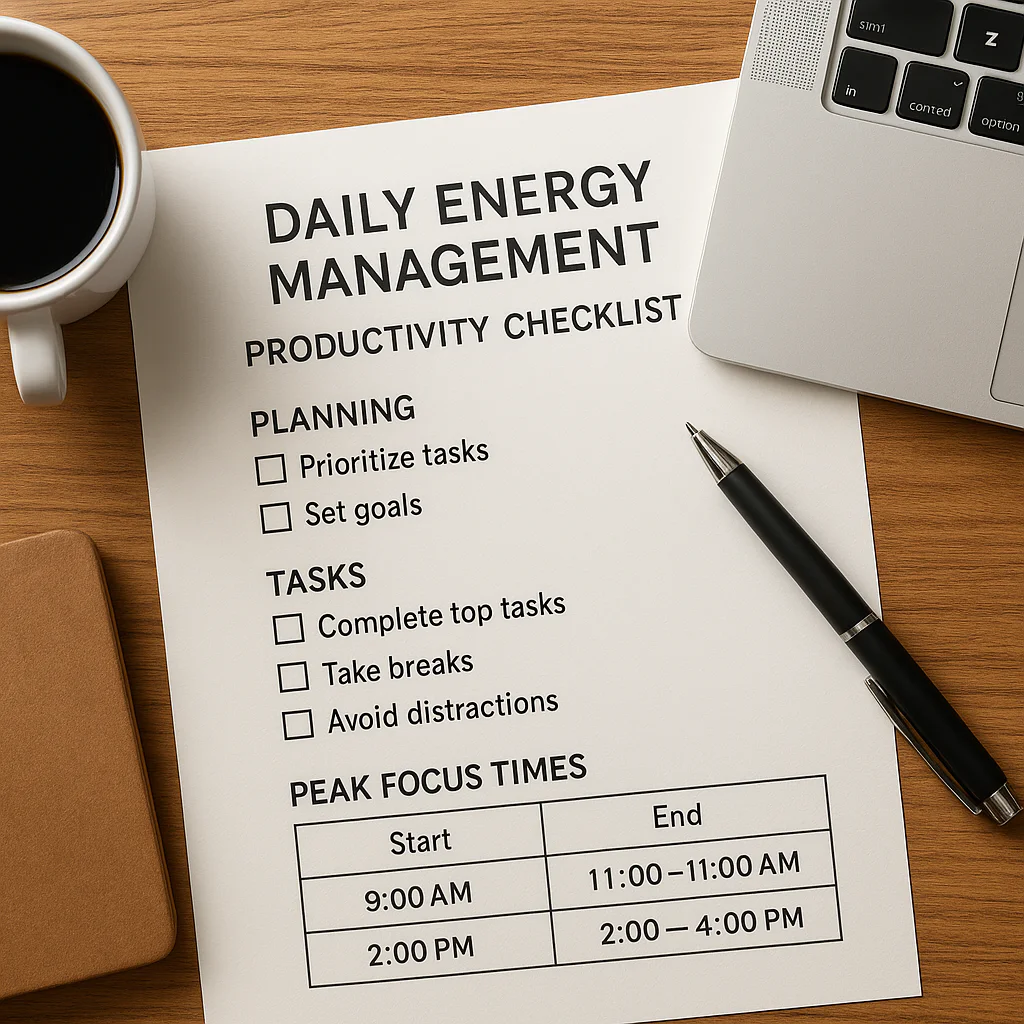
Daily energy peak task alignment means scheduling demanding work when you’re most alert, and saving routine tasks for lower-energy periods. Track your energy and focus for a week, then use the pattern to shape your checklist instead of forcing every task into the same kind of hour.
We’ve all had a day when a simple email feels like advanced mathematics—and another when a tricky plan practically writes itself. Your energy isn’t perfectly predictable, but noticing those patterns can help you spend your best focus on work that benefits from it.
You don’t need a wearable or a heroic 5 a.m. routine to get started. A few quick check-ins can reveal whether your clearest thinking tends to show up in the morning, afternoon, or somewhere between the second coffee and the meeting that could have been an email.
Key Takeaways
- Track energy and focus separately at a few points each day to spot patterns that repeat.
- Schedule complex, high-stakes tasks during your strongest focus window when your workday allows it.
- Use lower-energy periods for suitable routine tasks, but remember that some meetings and admin work can also be mentally demanding.
- Plan breaks and leave room for schedule changes; energy alignment is a flexible guide, not a rigid timetable.
- Protect sleep, movement, and recovery. A checklist can help organize work, but it can’t replace rest or medical advice for persistent fatigue.
Table of Contents
- ⚡️ Quick Tips and Facts
- 🧠 What Is Daily Energy Peak Task Alignment?
- 📚 The Science Behind Energy Rhythms and Task Timing
- Circadian Rhythms, Chronotypes, and Your Body Clock
- Ultradian Rhythms, Sleep Pressure, and Focus
- Why Energy Patterns Differ from Person to Person
- 🔎 How to Identify Your Daily Energy Peaks and Slumps
- Track Energy, Focus, and Mood
- Spot Your Chronotype Without Overcomplicating It
- Separate Natural Energy Dips from Fixable Fatigue
- 🎯 Match Tasks to Your Energy and Attention
- Deep Work and High-Cognitive-Load Tasks
- Creative Work, Meetings, and Collaborative Tasks
- Administrative Tasks and Low-Energy Work
- 🗓️ Build an Energy-Aligned Daily Schedule
- Plan Around Peak Focus, Not Just Open Calendar Slots
- Use Time Blocking with Room for Flexibility
- Schedule Breaks and Recovery Before You Need Them
- ✅ 12 Practical Strategies for Aligning Tasks with Daily Energy
- 1. Protect Your Best Focus Window
- 2. Put Your Most Demanding Task First in a Peak Period
- 3. Batch Similar Tasks Together
- 4. Match Meeting Times to the Work They Require
- 5. Use Short Breaks to Reset Attention
- 6. Take Advantage of Natural Light and Movement
- 7. Plan a Lighter Workload for Predictable Slumps
- 8. Choose a Task by Energy, Not by Convenience
- 9. Make Your Schedule Fit Your Chronotype
- 10. Protect Sleep as Part of Your Productivity Plan
- 11. Review and Adjust Your Energy Map Weekly
- 12. Create a Backup Plan for Low-Energy Days
- 🍽️ Daily Habits That Support Steady Energy
- Sleep, Consistent Wake Times, and Evening Routines
- Food, Hydration, and Caffeine Timing
- Exercise, Daylight, and Movement Breaks
- 💼 Energy-Aware Task Alignment at Work
- Designing Team Schedules Around Focus and Collaboration
- Managing Meetings, Interruptions, and Availability
- Energy Alignment for Remote and Hybrid Work
- 📱 Tools and Templates for Tracking Energy and Tasks
- A Simple Daily Energy Log
- Calendar, Time-Tracking, and Habit-Tracking Tools
- How to Review Patterns Without Obsessing Over Data
- ⚠️ Common Energy-Planning Mistakes to Avoid
- 🩺 When Persistent Fatigue May Need Professional Attention
- 🏁 Conclusion
- 🔗 Recommended Links
- ❓ FAQ
- What is the best time of day for demanding work?
- How long should I track my energy before changing my schedule?
- Can I change my natural energy peak?
- How do I align tasks with energy when my schedule is fixed?
- Why do I feel tired even when I schedule tasks around my peak?
- 📖 Reference Links
⚡️ Quick Tips and Facts
Daily energy peak task alignment means matching the kind of work you do to the times you tend to have the attention and energy for it. It’s less “wake up at 5 a.m. and become a productivity legend” and more “stop scheduling your hardest thinking for the hour your brain would prefer to become a houseplant.”
If you’re already using daily checklists to simplify your day, add an energy cue beside each task: high, medium, or low demand. That small detail can make a to-do list feel less like a pile of bricks and more like a workable plan.
| Quick fact | Useful takeaway |
|---|---|
| Your best work window is individual | Track your own patterns instead of copying a famous CEO’s morning routine. |
| Energy shifts across the day | Circadian rhythms influence sleepiness and alertness, but sleep, light, work demands, and routine also matter. CDC: About sleep |
| Task demand matters | Reserve strong-focus periods for complex writing, analysis, planning, and decisions; use lower-energy periods for routine admin. |
| A short log can reveal patterns | Rate energy and focus a few times each day for at least a week; keep tracking longer if your schedule or sleep varies. |
| Breaks are part of the plan | A break can help you reset, but there’s no universally proven work-to-break ratio that suits everyone. |
| Chronotype is a clue, not a command | “Morning person” and “night owl” labels can guide experiments, but they don’t replace your lived data. |
| A checklist should flex | If you slept poorly or your day changes, adjust the task—not your self-worth. |
Start here: for four workdays, note your energy from 1 to 10 at natural breaks such as breakfast, lunch, and mid-afternoon. Add what you were doing and whether you’d slept well. A tiny data set is better than an elaborate tracker abandoned by Tuesday.
🧠 What Is Daily Energy Peak Task Alignment?
Daily energy peak task alignment is a practical way to answer “When should I do this?”, not just “How do I fit it in?” You identify when you’re usually alert and focused, estimate the mental demand of your tasks, and schedule the two together.
For example, a difficult proposal might need your clearest thinking. Sorting receipts probably doesn’t. If both land in your strongest focus window, the receipts may quietly steal time from the proposal—and your best thinking may get spent deciding whether a coffee receipt needs a folder.
| Energy level | Typical signs | Good task matches |
|---|---|---|
| High | Alert, mentally clear, able to stay with a complex problem | Writing, coding, strategy, detailed analysis, important decisions |
| Moderate | Functional, but focus may come and go | Meetings, editing, collaboration, planned calls, review |
| Low | Slower to start, more distractible, mentally tired | Routine email, filing, scheduling, simple data entry, familiar chores |
These are planning categories, not medical measurements. The same task can also change category depending on the day: responding to routine messages may be easy, while handling a sensitive client complaint could demand significant emotional and cognitive energy.
At Daily Checklist™, we recommend beginning with a simple daily checklist and adding a demand label beside each item. That connects priorities with your available energy without asking you to rebuild your entire life around a spreadsheet. For more practical planning ideas, browse our Life Hacks and Habit Formation guides.
📚 The Science Behind Energy Rhythms and Task Timing
Energy is not a neat battery icon that drops by 10% every hour. Alertness and focus are shaped by overlapping factors: your body clock, sleep, time awake, light exposure, food, stress, movement, and the demands of the task itself.
That helps explain why two people can sit through the same 2 p.m. meeting with different experiences. One is ready to solve the budget; the other is trying to remember whether they already replied to the same email twice.
Circadian Rhythms, Chronotypes, and Your Body Clock
Your circadian system helps coordinate roughly 24-hour patterns in sleep and other bodily functions. Light is a major cue for the body clock, and people vary in the timing of their natural sleep preferences. The National Institute of General Medical Sciences explains how circadian rhythms influence daily cycles, while the Sleep Foundation’s chronotype overview describes common differences in preferred timing.
Chronotype is useful context, not a productivity horoscope. Knowing you tend toward later hours might explain why an early meeting feels rough, but your actual peak can also shift with work schedules, sleep habits, and responsibilities.
Ultradian Rhythms, Sleep Pressure, and Focus
Focus often changes within a workday. People sometimes use work cycles of around 60–120 minutes as a starting point, followed by a break, but there is no single scientifically guaranteed interval that makes every person productive. The common claim that work should precisely follow a sleep-cycle length is not a settled rule for waking work.
The practical test is simpler: notice when you begin rereading the same paragraph or making avoidable mistakes. That may be a useful moment to stand, stretch, get water, or switch to a less demanding task.
Why Energy Patterns Differ from Person to Person
A person’s pattern can vary with sleep quality, stress, workload, caregiving, medication, health, and environment. A regular afternoon dip, for instance, might reflect a combination of body-clock timing and a long stretch without a break. It isn’t proof that you’re “bad at afternoons.”
| Influence | What it may change | A useful response |
|---|---|---|
| Sleep quality | Alertness, attention, patience | Lower the day’s cognitive load after poor sleep |
| Light and environment | Sleep timing and alertness cues | Seek daylight when practical; reduce avoidable evening light |
| Stress | Working memory, flexibility, emotional energy | Break large tasks into smaller steps |
| Meetings and interruptions | Time available for sustained focus | Protect a realistic focus block |
| Food and hydration | Comfort, steadiness, and concentration | Notice your own responses; avoid assuming one meal pattern suits everyone |
| Movement | Feeling of sluggishness after long sitting | Add a short walk or stretch if it helps you reset |
What the “Energy Wave” Analogy Gets Right—and What It Doesn’t
The UNC Executive Development article on leading with energy compares daily energy to a sine wave and advises: “The best time to tackle a difficult, energy-intensive task is when the wave peaks.” That’s a memorable reminder to place demanding work in a stronger window.
But real energy is not a tidy curve that repeats identically every day. We recommend treating the wave as a planning sketch, then checking it against your actual log. A peak is a pattern to test, not a promise that your 10 a.m. brain will perform on command.
🔎 How to Identify Your Daily Energy Peaks and Slumps
You don’t need a wearable, a lab coat, or a ceremonial spreadsheet. You need a few consistent observations. The goal is to spot a repeatable window, not to score every minute of your day.
One planning guide suggests looking for recurring windows of stronger focus and tracking for two weeks or more. That’s sensible if your schedule varies; it’s not a reason to wait two weeks before trying a small adjustment. We suggest collecting a week of notes, testing one change, and extending the log if the picture remains muddy.
Track Energy, Focus, and Mood
Use a simple 1–10 scale, where 1 means “I can barely start” and 10 means “I feel unusually alert and focused.” Rate energy and focus separately if you can: feeling physically lively doesn’t always mean you’re ready for complex work.
A simple tracking routine
- Choose three to five check-in times. Tie them to natural breaks: after starting work, before lunch, mid-afternoon, and near the end of your workday.
- Record energy and focus. Keep the scale consistent rather than debating whether a 6 is really a 6.5.
- Note context. Add sleep quality, task type, movement, or a major interruption when relevant.
- Look for repeats. A single rough Tuesday is a story; several similar Tuesdays may be a pattern.
- Make one schedule change. Move one high-demand task into a better window and see what happens.
| Time | Energy (1–10) | Focus (1–10) | What I was doing | Useful context |
|---|---|---|---|---|
| 9:00 a.m. | 7 | 8 | Drafting report | Slept well |
| 12:30 p.m. | 6 | 5 | Email and lunch | Back-to-back calls |
| 3:30 p.m. | 4 | 4 | Routine admin | Walked outside |
| 5:00 p.m. | 6 | 6 | Planning tomorrow | Fewer interruptions |
These sample ratings are illustrative, not research findings. Your log could look completely different—and that is the point.
Spot Your Chronotype Without Overcomplicating It
A questionnaire such as the Morningness-Eveningness Questionnaire may offer a structured clue about preferred timing. Treat the result as a hypothesis, not a verdict. A wearable like Fitbit or Oura can provide sleep-related estimates, but neither can directly tell you whether you write your best first draft at 9:15 a.m.
Your own task-and-energy notes are the decision tool. Devices can add context; they cannot know whether the meeting that drained you was long, tense, boring, or all three.
Separate Natural Energy Dips from Fixable Fatigue
Before planning around a slump, ask what might be contributing to it:
- Did you sleep less than usual?
- Have you been sitting or concentrating without a break?
- Has stress or a difficult conversation consumed attention?
- Have meetings fractured your focus?
- Does the dip happen at a similar time on many days?
If a dip is predictable, try assigning lower-demand work there. If fatigue is new, persistent, severe, or interfering with everyday activities, don’t assume scheduling alone will fix it; consider discussing it with a healthcare professional.
🎯 Match Tasks to Your Energy and Attention
A good task-energy match makes a to-do list more realistic. It doesn’t mean you only work when conditions are perfect. It means you stop asking your most depleted hour to perform your most demanding work whenever you have another option.
Deep Work and High-Cognitive-Load Tasks
High-demand tasks usually involve sustained attention, complex decisions, or the cost of getting something wrong. Examples include:
- Writing a major report or proposal
- Coding or debugging difficult problems
- Strategic planning
- Budget analysis and forecasting
- Preparing for a high-stakes presentation
- Learning unfamiliar material
- Making decisions that require weighing several trade-offs
Mark these tasks H on your checklist. If your peak window is short, start with a clear next action rather than a broad label like “work on strategy.” “Draft the three options for the launch plan” is easier to begin.
Creative Work, Meetings, and Collaborative Tasks
Creative work and collaboration don’t always peak at the same time. The first video’s perspective, which you can revisit at #featured-video, distinguishes “creation mode”—for writing, planning, and strategic thinking—from “interaction mode” for coaching, meetings, and networking. Its advice, “It’s about doing the right tasks at the right time,” is a useful framing, though your own experience should determine which hours suit each mode.
| Task type | Typical energy demand | Possible schedule fit |
|---|---|---|
| Brainstorming alone | High or moderate | A strong independent-thinking window |
| Coaching or a one-one | Moderate, sometimes high socially | A period when you can listen attentively |
| Team status meeting | Low to moderate | A lower-focus window if participation remains effective |
| Sensitive feedback conversation | High emotional demand | A time when you’re alert and unhuried |
| Editing a familiar document | Moderate | A steady, less demanding period |
| Routine networking follow-up | Low to moderate | A transition period or admin batch |
Meetings are not automatically “easy work.” A routine stand-up may be low demand; a conflict-resolution meeting may consume more energy than a complicated spreadsheet. Label the actual work, not the calendar category.
Administrative Tasks and Low-Energy Work
Routine tasks can be ideal for lower-energy periods if they are genuinely simple and safe to defer. Examples include inbox sorting, scheduling, filing, data entry, and familiar follow-ups.
Don’t put every unpleasant task in the low-energy bucket. A difficult email, performance review, or financial approval may require judgment, even if it looks like “admin.” Use a medium or high label when the task needs care.
🗓️ Build an Energy-Aligned Daily Schedule
An energy-aligned schedule is a framework, not a tightly choreographed ballet. It gives demanding work a better chance of fitting your strongest hours while leaving room for real life: urgent requests, childcare pickup, the meeting that mysteriously reproduces overnight.
Plan Around Peak Focus, Not Just Open Calendar Slots
Start with your immovable commitments, then protect at least one realistic focus window if your role allows it. If you cannot control the clock, protect the task type: reserve a quieter stretch for diagnosis and decision-making, then handle routine follow-up around other demands.
Try this planning sequence:
- List your fixed commitments.
- Mark the focus windows your log suggests are strongest.
- Add one high-demand task to a suitable window.
- Place lower-demand tasks in predictable dips or transition periods.
- Leave some buffer for interruptions and overruns.
- Check at day’s end: did the schedule match your real energy?
Use Time Blocking with Room for Flexibility
A calendar block is useful when it communicates intent, not when it becomes a tiny prison. Label it clearly—“Draft proposal” is more actionable than “Focus”—and make the block long enough to start and make progress.
| Example pattern | Possible plan |
|---|---|
| Strong morning focus | Deep work before routine inbox processing |
| Miday social energy | Calls, collaboration, and meetings |
| Afternoon slump | Admin, simple follow-ups, a walk, or a lighter review |
| Evening second wind | Personal planning or optional creative work—if it doesn’t compromise sleep |
This is an example, not a universal daily template. An evening peak is not a free pass to work late every night. Your best schedule must also protect recovery.
Schedule Breaks and Recovery Before You Need Them
The UNC article recommends a 10-minute break every 90 minutes as one possible approach. Other guides suggest longer focused blocks, such as 90–120 minutes, followed by recovery. These are starting points, not laws of biology; evidence doesn’t establish one perfect ratio for every kind of job.
Try a shorter cycle if you’re new to focused blocks, or a longer one if your work requires uninterrupted setup. During the break:
- Stand and move.
- Look away from the screen.
- Get water or step outside.
- Avoid replacing one demanding screen task with another.
- Return with a specific next action.
For more ideas on making routines stick, see our Habit Formation resources.
✅ 12 Practical Strategies for Aligning Tasks with Daily Energy
These strategies work best as small experiments. Pick one or two, test them for a week, and keep the ones that genuinely improve your work or wellbeing.
1. Protect Your Best Focus Window
Put a recurring focus hold on your calendar if you can. Turn off nonessential notifications, close distracting tabs, and tell colleagues when you’re available afterward. If a recurring meeting is in the way, propose a different time or use the meeting for discussion after doing the thinking beforehand.
2. Put Your Most Demanding Task First in a Peak Period
Write down the next physical action. “Finish report” is a project; “outline the report’s three recommendations” is a starting point. This makes it easier to use your strongest window before it disappears into inbox whack-a-mole.
3. Batch Similar Tasks Together
Group email replies, approvals, calls, or errands to reduce repeated switching. Batching is not a magic spell: keep exceptions for genuinely urgent messages and tasks that need a different level of attention.
4. Match Meeting Times to the Work They Require
Try to cluster routine meetings into a limited window when your role permits it. Save your clearest stretch for deep work, but avoid pushing emotionally demanding conversations into your lowest-energy period simply because that slot was open.
5. Use Short Breaks to Reset Attention
A pause helps when it lets you disengage briefly and return with more focus. Experiment with a few minutes away from your screen or a longer walk after a sustained work block. The best break is one you can actually take, not an elaborate ritual requiring a silent forest.
6. Take Advantage of Natural Light and Movement
Daylight and physical activity can support healthy sleep-wake routines. The CDC’s sleep guidance recommends habits such as maintaining a regular sleep schedule; a short walk can also be a practical reset between tasks. If outdoor time isn’t feasible, stand, stretch, or move around indoors.
7. Plan a Lighter Workload for Predictable Slumps
If your notes repeatedly show a low-focus window, use it for routine work, a break, or tasks that require less sustained concentration. Don’t fill every dip with chores; some low-energy time may be a cue to recover.
8. Choose a Task by Energy, Not by Convenience
When you finish something, ask: “What can I do well with the energy I have right now?” A small, suitable task can be more useful than forcing a major decision during a mental trough.
9. Make Your Schedule Fit Your Chronotype
If mornings are reliably slow and later hours are stronger, test a schedule shift where possible. If the workday is fixed, use the earliest hours for preparation and routine tasks, then protect a better window later for demanding work.
10. Protect Sleep as Part of Your Productivity Plan
Adults generally need at least seven hours of sleep regularly, according to the CDC. A schedule that gets more work done by borrowing from sleep may create a worse trade the next day. Productivity advice that ends with “simply sleep less” belongs in the bin.
11. Review and Adjust Your Energy Map Weekly
Once a week, look at your log and ask:
- Which tasks felt easier at particular times?
- Which blocks were repeatedly interrupted?
- Did sleep or stress explain a rough stretch?
- What one scheduling change is worth testing next week?
A weekly review keeps energy planning responsive rather than rigid.
12. Create a Backup Plan for Low-Energy Days
Make a short “low-energy list” of safe, manageable tasks: file a document, confirm an appointment, prepare tomorrow’s materials, or send a straightforward update. Keep the most demanding work movable when deadlines allow.
The purpose is not to lower expectations forever. It’s to avoid turning one difficult day into an entire week of guilt and avoidable mistakes.
🍽️ Daily Habits That Support Steady Energy
Task alignment helps you spend energy wisely. Daily habits help support the energy you have available. Neither guarantees a perfect day, but together they can make work feel less like dragging a shopping cart with one wobbly wheel.
Sleep, Consistent Wake Times, and Evening Routines
A consistent sleep schedule can support a stable routine, while insufficient sleep can affect alertness and concentration. The CDC’s sleep recommendations include keeping a regular bedtime and wake time and making the bedroom quiet and relaxing.
Try a brief evening shutdown:
- Write tomorrow’s top one to three tasks.
- Mark the task that needs your best focus.
- Decide what can wait.
- Set out anything you’ll need to start.
- Stop planning when the list is good enough.
A checklist can be a useful boundary between work and rest. For more habit-building ideas, visit Habit Formation.
Food, Hydration, and Caffeine Timing
There is no single meal plan that creates an ideal focus curve for everyone. Notice how meal timing, food choices, hydration, and caffeine affect your concentration and comfort. The FDA’s caffeine information explains that caffeine affects people differently and provides safety context.
A sensible experiment might be to note caffeine timing alongside energy ratings for a week. Avoid treating a late-afternoon coffee as a substitute for sleep; if it disrupts your rest, it could make tomorrow’s energy planning more complicated.
Exercise, Daylight, and Movement Breaks
Regular physical activity supports overall health, and short movement breaks can make a long seated day feel less stagnant. The U.S. Department of Health and Human Services’ Physical Activity Guidelines provide evidence-based recommendations for activity.
Keep it realistic: a short walk, a stretch between calls, or a few minutes standing may fit more workdays than a grand fitness plan you keep postponing. If you’re trying to reduce distraction during breaks, our Digital Detox category has ideas for spending less break time inside another scroll.
💼 Energy-Aware Task Alignment at Work
Energy-aware planning can help individuals, but workplace schedules involve more than personal preference. Customer needs, shift coverage, team time zones, and collaborative work all matter. The goal is to improve task fit without pretending everyone can move every meeting.
Designing Team Schedules Around Focus and Collaboration
Teams can make room for both independent focus and collaboration:
- Agree on a few shared collaboration windows.
- Avoid scattering meetings across the whole day where possible.
- Make meeting purpose and preparation clear.
- Protect focus time without treating “busy” as a refusal to help.
- Consider time zones and caregiving responsibilities when choosing shared hours.
The UNC article emphasizes that a leader’s energy can affect the team and uses the oxygen-mask analogy: care for your own energy so you can support others. That doesn’t mean leaders get special treatment; it means depleted people have limited capacity to listen, think creatively, and respond well.
Managing Meetings, Interruptions, and Availability
A focus block works best when colleagues know what it means. Try language that connects availability to the work:
“I’m protecting the first hour for concentrated analysis. I’ll be available for quick questions afterward, and I can join the project discussion this afternoon.”
When urgent work is part of the role, protect a type of work, not necessarily a fixed hour. For example, reserve peak attention for triage and decisions, then use lower-energy windows for documentation and follow-up.
Energy Alignment for Remote and Hybrid Work
Remote work can reduce commuting and make focus blocks easier, but it can also blur work and home boundaries. Hybrid schedules add travel and meeting constraints. Helpful practices include:
- Put focus blocks on your calendar and set a clear status.
- Cluster video calls to reduce context switching.
- Schedule a transition after a demanding meeting.
- Keep a written handoff when teammates work in different time zones.
- Use a shutdown checklist so the workday has an ending.
For guidance on cutting avoidable screen distraction, explore our Digital Detox articles.
📱 Tools and Templates for Tracking Energy and Tasks
The best tool is the one you’ll use consistently. A paper notebook, spreadsheet, or notes app can be enough; a new subscription cannot rescue a tracking habit that feels like doing taxes for your feelings.
A Simple Daily Energy Log
Copy this template into a notes app, planner, or spreadsheet:
| Check-in | Energy (1–10) | Focus (1–10) | Task or context | Next adjustment |
|---|---|---|---|---|
| Start of day | ||||
| Before lunch | ||||
| Mid-afternoon | ||||
| End of day |
Add sleep quality or movement only if it helps answer a question you actually have. Tracking everything can turn a useful experiment into a part-time analytics job.
Calendar, Time-Tracking, and Habit-Tracking Tools
You can use tools you already have:
- Google Calendar or Microsoft Outlook for focus blocks and meeting clusters.
- Apple Notes, Google Sheets, or a paper planner for energy ratings.
- Daylio for mood and activity journaling.
- Fitbit or Oura for sleep-related estimates and trends.
Brand features and data policies can change, so review each service’s official information before relying on it. Wearable sleep estimates are not a substitute for clinical assessment, and a device won’t measure whether a particular work task felt mentally draining.
How to Review Patterns Without Obsessing Over Data
At the end of the week, look for broad patterns rather than perfect precision:
- Are there recurring windows where demanding work feels easier?
- Do specific meetings or tasks drain you?
- Does a low-energy period improve after a walk or a break?
- Did sleep or workload change the pattern?
- What is one practical schedule adjustment to test?
If your ratings are uneven, that is still information. You may need a flexible schedule, smaller focus blocks, or a backup plan—not a more sophisticated graph.
⚠️ Common Energy-Planning Mistakes to Avoid
| Mistake | Why it backfires | Better move |
|---|---|---|
| Copying a “5 a.m. club” routine | Other people’s chronotypes and responsibilities differ | Track your own alertness |
| Assuming energy is identical every day | Sleep, stress, and workload change | Use flexible focus windows |
| Filling the peak with email | Easy tasks can crowd out high-impact work | Choose a demanding task before opening the inbox |
| Calling every meeting low-energy | Some conversations require judgment and emotional effort | Rate the actual demand |
| Treating breaks as a reward | You may wait until focus is already gone | Plan short recovery pauses |
| Tracking too many details | The system becomes a chore | Track only what helps you choose better |
| Forcing work through persistent fatigue | Scheduling cannot fix every cause of fatigue | Seek professional advice if symptoms persist |
One more trap: believing that a schedule must be perfectly optimized before it counts. It doesn’t. If moving one demanding task out of a predictable slump helps, that is useful alignment—even if your calendar still contains three meetings and an inconvenient dentist appointment.
🩺 When Persistent Fatigue May Need Professional Attention
Energy planning is a productivity tool, not a diagnosis or treatment. If tiredness is ongoing, unusually severe, getting worse, or affecting daily life despite reasonable rest, speak with a healthcare professional. The NHS overview of tiredness and fatigue outlines common considerations and advises seeking medical help when fatigue is persistent or unexplained.
Consider getting professional guidance if you experience:
- Persistent fatigue that does not improve with rest
- Daytime sleepiness that makes work, driving, or daily tasks unsafe
- A major change in sleep or energy
- Fatigue alongside other new or concerning symptoms
- Sleep problems that continue to interfere with daily life
Don’t respond to a serious or unexplained change by simply adding more caffeine, tightening your schedule, or blaming your checklist. A clinician can help assess possible causes and appropriate next steps.