Support our educational content for free when you purchase through links on our site. Learn more

Remote Boundaries
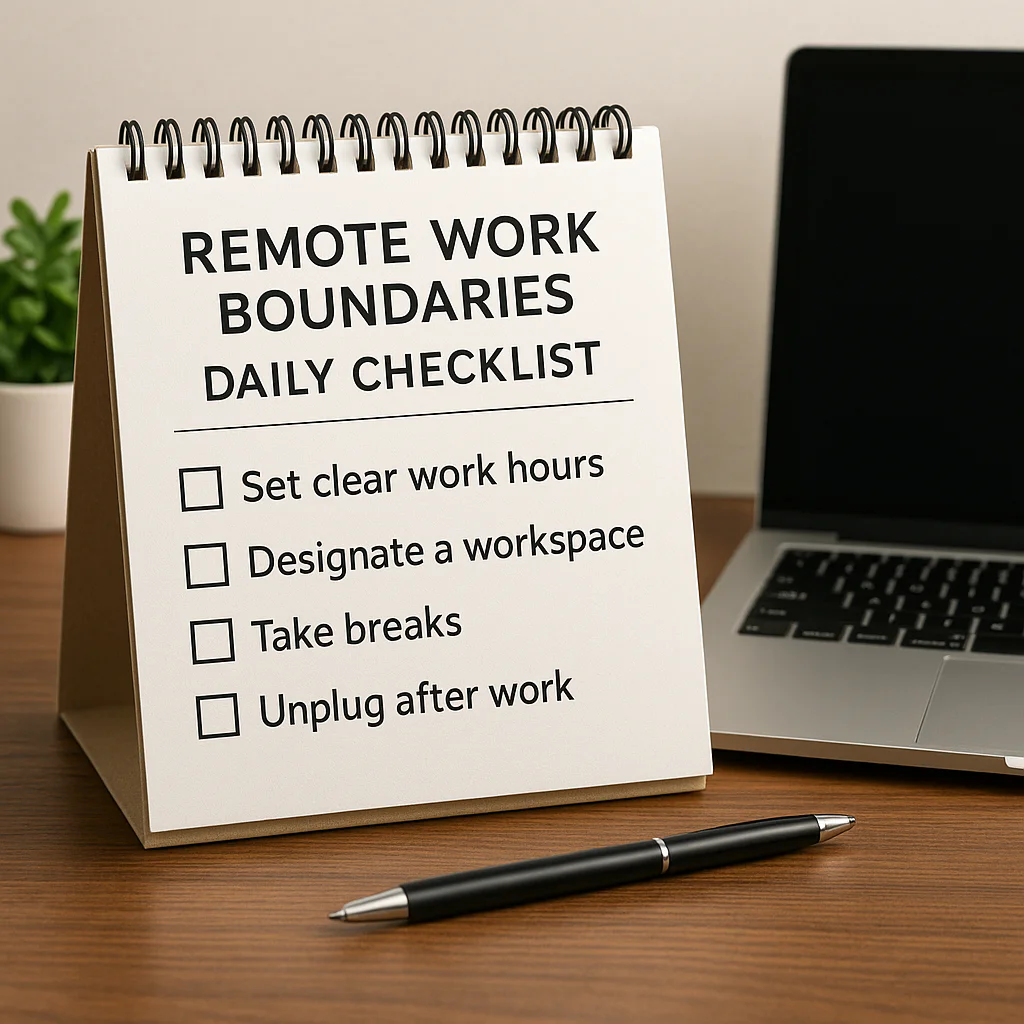

: Your Daily Checklist! ✅
Tired of work-life blur? The
secret to reclaiming your sanity and boosting productivity in the remote world lies in one powerful tool: a daily checklist for remote work boundaries. We’ve all been there – the late-night pings, the weekend email checks, the feeling
that your home has become an inescapable office. It’s a fast track to burnout, and frankly, it’s unsustainable. Our expert planners at Daily Checklist™ have seen firsthand how a structured approach can transform chaotic remote work into a harmonious
blend of professional achievement and personal well-being.
One of our team members, David, vividly remembers the early days of remote work. “My laptop was always open, always on,” he confessed. “I’d finish dinner, see
a new email, and suddenly it was 10 PM and I was still ‘just checking one more thing.’ My family started calling my desk ‘the black hole’ because I’d disappear into it.” This constant “always-on”
mentality isn’t just anecdotal; a recent study revealed that 49% of remote workers struggle to switch off after work, leading to increased stress and decreased job satisfaction. But David, armed with a new daily checklist for remote work boundaries,
turned things around. He started scheduling his “digital shutdown” and found his evenings, and his family life, dramatically improved.
This isn’t about being rigid; it’s about being intentional. It’s about empowering yourself to create
a sustainable work rhythm that respects your time, energy, and personal life. Ready to build your own fortress of focus and freedom?
Key Takeaways
- Define your non-negotiables: Identify sacred personal times and activities that work
should never infringe upon. - Time block everything: Schedule work, breaks, and personal time in your calendar to create clear visual boundaries.
- Master the digital disconnect: Strategically mute notifications, disconnect work apps, and create
digital separation. - Communicate effectively: Clearly articulate your boundaries to colleagues and managers to manage expectations.
- Embrace the power of “No”: Prioritize your workload and learn to politely decline requests that over
extend you. - Implement post-work rituals: Create routines to signal the end of the workday and transition into personal time.
- Leverage technology: Use “Do Not Disturb” modes, notification settings, and time
-tracking apps to enforce boundaries. - Protect your weekends: Treat downtime as sacred, setting strong boundaries to fully recharge.
Table of Contents
-
The Evolution of Work-Life Balance: A Brief History of Remote Boundaries
-
Why Boundaries Aren’t Just Nice-to-Haves: The Hidden Costs of “Always On” 🤯
-
Crafting Your Personal Remote Work Boundary Blueprint: A Daily Checklist™ Guide 📝
-
1. Define Your “Non-Negotiables”: What’s Sacred in Your Remote Day? 🚫
-
2. Schedule Your Day (and Your Life!): Time Blocking for Sanity 🗓️
-
3. Master the Art of the Digital Disconnect: Unplugging for Real 📵
-
4. Create a Dedicated Workspace: Your Sanctuary, Your Rules 🏡
-
5. Communicate, Communicate, Communicate: Setting Expectations with Grace 🗣️
-
7. Post-Work Rituals: Transitioning from “Work Mode” to “Life Mode” 🛀
-
8. Leverage Technology to Your Advantage: Tools for Taming the Digital Beast ⚙️
-
9. The Weekend Warrior: Protecting Your Downtime and Recharge Days 🛡️
-
10. Regular Review and Adjustment: Your Boundaries Aren’t Set in Stone! 🔄
-
Building a Harmonious Hybrid/Remote Team: Collective Boundary Setting Strategies 🤝
-
Understanding Team Workflows: Classifying Priorities and Focus Areas 🎯
-
Identifying Peak Productivity: When Team Members Work Best 🚀
-
Synchronous vs. Asynchronous: Defining Availability for Real-Time Collaboration ⏱️
-
Crafting a Team Boundaries Agreement: The Remote Work Social Contract 📜
-
Overcoming Common Boundary Blunders: Troubleshooting Your Remote Work Life 🚧
-
Your Daily Checklist™ Ultimate Boundary Blueprint: Take Action for a Better Work-Life Blend! ✅
-
Conclusion: Reclaiming Your Time and Sanity in the Remote Era
-
FAQ: Your Burning Questions About Remote Work Boundaries Answered
<
a id=”quick-tips-and-facts-for-remote-work-boundaries”>
⚡️ Quick Tips and Facts for Remote Work Boundaries
Let’s face it, the lines between work and life have blurred into
a watercolor painting since remote work became the norm. We’ve all been there: answering emails at midnight, taking calls during dinner, or feeling the constant hum of Slack notifications even when we’re trying to relax. But what if we told you there
‘s a secret weapon to reclaim your personal time and boost your productivity? It’s all about setting crystal-clear remote work boundaries, and we, the planners at Daily Checklist™, are here to help you master it.
Did
you know that a staggering 92% of younger workers report experiencing burnout? That’s not just a statistic; it’s a siren call for change! Effective boundaries aren’t just a nice-to
-have; they’re essential for your mental health, well-being, and long-term career sustainability. Think of your daily checklist for remote work boundaries as your personal force field against the “always-on” culture. It’
s about intentionality, communication, and a little bit of digital discipline. Ready to draw your line in the sand (or, you know, your home office)? Let’s dive in!
The Evolution of Work-Life Balance: A Brief History of Remote Boundaries

Once upon a time, work-life balance was a relatively straightforward
concept. You went to the office, you did your work, and then you left. The physical act of commuting often served as a natural boundary, a transition from “work mode” to “life mode.” Ah, simpler times! But
with the advent of the internet, smartphones, and the global shift towards remote and hybrid work models, those clear lines began to smudge.
Suddenly, our homes became our offices, our dining tables doubled as desks, and the commute was reduced
to a few steps from the bedroom to the living room. While this offered incredible flexibility and freedom, it also introduced a new challenge: how do you truly “leave” work when work is always right there? This is where the concept of
remote work boundaries truly blossomed, evolving from a niche concern to a critical component of modern professional well-being. It’s no longer just about managing your time; it’s about managing your space, your attention, and your *
energy* in a world that constantly demands more.
Why Boundaries Aren’t
Just Nice-to-Haves: The Hidden Costs of “Always On” 🤯
Ever felt like you’re constantly juggling flaming chainsaws, trying to keep your professional and personal lives from colliding in a fiery mess? Welcome to the “always
-on” culture, a pervasive side effect of remote work without proper boundaries. We’ve seen it firsthand, and trust us, the costs are far more significant than just a few missed episodes of your favorite show.
The relentless pressure to be
constantly available, to respond to every ping and email immediately, leads to a vicious cycle of stress, exhaustion, and ultimately, burnout. This isn’t just anecdotal; studies confirm that blurred boundaries significantly increase cybersecurity risks due to distraction, fatigue
, and role conflict. Think about it: when you’re mentally drained from work bleeding into your personal time, are you really at your sharpest to spot a phishing email or remember that crucial security protocol? Probably
not.
Beyond security, the “always-on” mentality erodes your personal relationships, diminishes your capacity for leisure, and can even impact your physical health. It’s a thief of joy, a drain on your energy, and a silent
killer of productivity. So, if you’re wondering why you feel perpetually tired, even after a full night’s sleep, or why your weekends feel less like a break and more like an extension of the workweek, the answer might just
be lurking in your lack of boundaries. But don’t despair! We’re about to equip you with the tools to fight back.
The Psychology of “The Line”: Why Setting Remote Work Boundaries Feels So Hard (and Why It’s Essential!) 🧠
So
, you know boundaries are important, but actually setting them? That’s a whole other ball game, isn’t it? It often feels like an uphill battle against invisible forces. Why is it so darn difficult to draw that
line in the sand, especially when working remotely?
Part of the challenge lies in our innate desire to be helpful and to please. We fear saying “no” might make us seem uncommitted or uncooperative. There’s also the
insidious fear of missing out (FOMO) – what if an important decision is made, or a crucial conversation happens, and we’re not there? This internal struggle often leads to what experts call “blurred boundaries,” where the
distinction between work and personal life becomes so indistinct that it’s hard to tell where one ends and the other begins. This blurring isn’t just inconvenient; it creates greater cognitive demands and inconsistent behavior, especially when it comes to
routine tasks like cybersecurity.
But here’s the kicker: while setting boundaries might feel uncomfortable at first, it’s an act of self-preservation and ultimately, a boost to your professional effectiveness. When you intentionally
separate your roles and activities, your secure behaviors become more stable and consistent. It’s about protecting your mental energy, fostering focus, and ensuring you have the capacity to bring your best self to both your work and your
life. It’s a marathon, not a sprint, and your boundaries are the hydration stations along the way.
## Crafting Your Personal Remote Work Boundary Blueprint: A Daily Checklist™ Guide 📝
Alright, enough talk about the “why” – let’s get to the “how”! Building effective remote work boundaries isn’t a
one-time fix; it’s an ongoing practice, a daily commitment to yourself and your well-being. Think of this as your Daily Checklist™ blueprint for a more balanced, productive, and frankly, happier remote work life. We’
ve distilled years of experience and consumer insights into these actionable steps. Ready to simplify your day with daily checklists? Check out our guide to Daily Checklists here!
<
a id=”1-define-your-non-negotiables-whats-sacred-in-your-remote-day”>
1. Define Your “Non-Negotiables”: What’s Sacred in Your Remote
Day? 🚫
Before you can build a fence, you need to know what you’re protecting. What are the absolute, non-negotiable elements of your personal life that you refuse to let work infringe upon? Is it your morning workout
? Family dinner? Your child’s bedtime story? A quiet hour with a book?
For us, it’s always been about protecting that sacred morning routine. A quick walk with the dog, a cup of coffee, and a few minutes
of journaling before the workday officially begins. This “me time” sets the tone for the entire day. Identifying these “non-negotiables” is the first, crucial step. Once you know what’s truly important, you can then
strategically carve out time for it. This also includes identifying your deep work periods – those times when you’re most focused and productive – and safeguarding them fiercely. These are the moments when you tackle your most important
tasks, free from distractions.
2. Schedule Your Day (and Your Life!):
Time Blocking for Sanity 🗓️
This is where your calendar becomes your best friend. We’re not just talking about scheduling meetings; we’re talking about time blocking your entire day, including your personal time. This means
putting everything on your calendar: your start time, your break times, your end time, and yes, even your lunch!
One of our planners, Sarah, swears by this. “I used to just
let my day happen to me,” she recounts, “but once I started blocking out my lunch break in Google Calendar, I actually took it! It sounds simple, but it was a game-changer for my energy levels.” The
first YouTube video we’ve all been watching also echoes this sentiment, recommending setting clear working hours and recurring lunch blocks in your calendar (like Google Calendar or Teams Calendar) so others know your availability.
Here
’s how to do it:
- Define your work hours: Be realistic. If you know you’re a morning person, front-load your deep work. If you hit your stride in the afternoon, plan accordingly.
Block out breaks: Schedule a lunch break, short stretching breaks, or even a “coffee run” block. Treat these as non-negotiable appointments.
- Schedule personal time: Seriously, put your gym time, family time,
or hobby time on your calendar. This visually reinforces your commitment to these activities. - Use your calendar’s features: Most digital calendars (Google Calendar, Outlook Calendar, Microsoft Teams Calendar) allow you to set “working hours” and ”
out of office” notifications. Use them!
By making your boundaries visible, you not only remind yourself but also help colleagues understand your availability. This proactive approach is a cornerstone of effective Life Hacks.
3. Master
the Art of the Digital Disconnect: Unplugging for Real 📵
This is often the trickiest part, isn’t it? Our devices are designed to keep us connected, but that constant connection can be a major boundary b
uster. The key here is intentional segmentation – clearly separating your work and personal digital lives.
Remember that YouTube video we mentioned? It offers some golden nuggets here:
- Silence message notification sounds
for communication apps like Slack and Teams on your laptop to minimize distractions. Trust us, the world won’t end if you don’t respond to every ping instantly. - Audit and mute unnecessary Slack or Teams
channels/threads to reduce interruptions. Be ruthless! If it’s not directly relevant to your core tasks, mute it. - Disconnect work email from your personal phone for a week to assess its necessity. You might be surprised how little you actually need it.
- Turn off push notifications for work-related messaging apps on your phone. Let’s be honest,
those notifications are rarely truly urgent. - Consider using an old phone as a dedicated “work phone” to manage work communications separately. This is the ultimate segmentation move!
We’ve found that using
separate browsers or user profiles for work and personal use can also be incredibly effective. For example, using Chrome for work and Firefox for personal browsing. This simple act creates a mental and digital barrier. This intentional approach to Digital Detox is crucial for maintaining sanity.
4. Create a Dedicated Workspace: Your Sanctuary, Your Rules 🏡
Even if it’s just a corner of a room, having a designated workspace is a powerful physical boundary. When you step into that space, your brain
registers “work time.” When you step out, it’s “personal time.” This physical separation is a cornerstone of the segmentation strategy for boundary management.
One of our team members, Mark, lives
in a small apartment. For a long time, his “office” was his kitchen table. “I felt like I was always at work, even when I was eating dinner,” he recalls. “Then I invested in a small, foldable desk and set
it up in a corner of my living room. It made a huge difference. Just the act of folding it up at the end of the day signaled ‘work is over.'”
Consider these tips for your workspace:
- Dedicated
space: Even if it’s a small desk, make it your work zone. - Separate devices/accounts: Where possible, use separate devices, accounts, or even browsers for work and personal activities.
This minimizes the risk of accidental exposure of work information and reduces role conflict. - Ergonomics matter: Invest in a comfortable chair and a good monitor. Your body will thank you.
- Personalize it: Make your
workspace a place you enjoy being, but keep personal distractions to a minimum during work hours.
5. Communicate,
Communicate, Communicate: Setting Expectations with Grace 🗣️
This is perhaps the most critical, yet often overlooked, step. Your boundaries are only as effective as your ability to communicate them clearly and consistently to your colleagues and managers. As Workplac
eless wisely points out, “How can a colleague or manager support, respect, and not infringe on your boundaries if they aren’t aware of them?” They can’t!
Here’s how to communicate
effectively:
- Share your calendar: Make your time blocks, breaks, and unavailable periods visible to relevant colleagues. This is a simple yet powerful way to manage expectations.
- Discuss with your manager: Have
an open conversation with your manager about your boundaries and how they support your productivity and well-being. Align on expectations before communicating more broadly. - Set expectations in team chats: Use your status messages on Slack or
Teams to indicate when you’re in deep work, on a break, or offline. - Encourage others: Be a role model and encourage your teammates to share their own boundaries. A culture of mutual respect for boundaries benefits
everyone.
Remember, clear communication isn’t about being rigid; it’s about fostering understanding and respect. It’s about saying, “I’m committed to my work, and I’m also committed to my well-being,
which ultimately makes me a better employee.”
6. The Power of the “No”: Saying
It Without Guilt 💪
Ah, the dreaded “no.” For many of us, it feels like a dirty word, especially in a professional setting. We’re conditioned to be team players, to say “yes” to every request
, to take on every new project. But as Workplaceless reminds us, “It’s nearly impossible to do it all, so it requires intention in learning to say ‘no’ even though you might want to always say ‘yes.’”
Learning to say “no” isn’t about being unhelpful; it’s about prioritizing your capacity and your existing commitments. It’s about protecting your deep work time and ensuring you can
deliver high-quality work on the tasks that truly matter.
Tips for saying “no” gracefully:
- Be polite but firm: “Thank you for thinking of me, but I’m currently focused on [X project] and
won’t be able to take that on right now.” - Offer alternatives: “I can’t do it, but perhaps [colleague’s name] might be able to help, or I could look at it next
week.” - Explain your reasoning (briefly): “To ensure I can deliver my best work on [current priority], I need to decline this request.”
- Use an objective rubric: Workplaceless uses
this approach for their CEO’s virtual speaking opportunities. You can adapt this for your own workload, evaluating requests based on alignment with strategic priorities and required time/resources.
Remember, every “yes” to a low
-priority item is a “no” to a high-priority item, or worse, a “no” to your personal time and well-being. This is a crucial Habit Formation skill to cultivate.
7. Post-
Work Rituals: Transitioning from “Work Mode” to “Life Mode” 🛀
When your commute is just a few steps, how do you signal to your brain that the workday is officially over? This is where end
-of-day boundary reset rituals come into play. These are intentional actions that help you transition from your professional persona to your personal self, reducing after-hours role conflict.
For us, it’s often a
simple act: closing the laptop, putting it away in a drawer, and then taking a short walk around the block. It’s a symbolic closing of the “office door.”
Consider these rituals:
- A “digital shutdown
“: Sign out of work systems, close all work applications, and turn off notifications. - A physical change: Change out of your “work clothes” (even if they’re just comfy sweats) into something else.
- A sensory shift: Listen to a specific playlist, light a candle, or make a cup of herbal tea.
- A short activity: Take a walk, do a quick workout, or spend
15 minutes on a hobby.
The goal is to create a clear psychological break, allowing you to fully disengage from work and embrace your personal time. This helps prevent work thoughts from creeping into your evenings and weekends.
8. Leverage Technology to Your Advantage: Tools for Taming the Digital Beast ⚙️
While technology can be a boundary-blurring culprit, it can also be your greatest ally in enforcing them. Think of your devices and apps as your personal boundary bouncers!
- “Do Not Disturb” modes: Most phones
and computers have robust “Do Not Disturb” features. Schedule them to activate automatically during your non-work hours. - Notification management: Go deep into the settings of Slack, Microsoft Teams, Outlook, and Gmail. Customize notifications
to only alert you for truly urgent messages, or mute them entirely outside of work hours. - Website blockers: If you find yourself drifting to distracting websites during work hours, consider using browser extensions like StayFocusd (Chrome) or LeechBlock NG (Firefox) to block them during specific times.
- Time tracking apps: Tools like Toggl Track or Clockify can help you accurately track your work hours
, making it easier to see if you’re consistently overworking and where you might need to adjust your boundaries. - Device features for time limits: Use your phone’s built-in features (like Apple’s Screen Time or Android’s Digital Wellbeing) to set app time limits for work-related apps after hours.
👉 Shop Productivity Tools on:
- Toggl Track: Official Website
- Clockify: Official Website
- StayFocusd (Chrome Extension): Chrome Web Store
- LeechBlock NG (Firefox Add-on): Firefox Add-ons
9. The Weekend Warrior: Protecting Your Downtime and Recharge Days 🛡️
Boundaries aren’t just for weekdays; they’re equally, if not more, important for your weekends and vacation time
. These are your crucial recharge days, the periods when you truly step away and replenish your energy reserves. Without them, you’re heading straight for burnout.
We’ve all been guilty of “just checking emails” on a Saturday morning
, only to find ourselves sucked into a work vortex for an hour. This is precisely what we need to avoid.
Become a weekend warrior for your downtime:
- The Friday shutdown: Make your end-of-day
ritual on Friday even more pronounced. Close everything, put away your work phone (if you have one), and commit to not opening work apps until Monday morning. - Out-of-office replies: For longer breaks or vacations, set
a clear out-of-office reply that states when you’ll return and who to contact for urgent matters. Resist the urge to check in. - Plan non-work activities: Fill your weekends with activities that bring you joy and help
you disconnect. Hobbies, time with loved ones, nature walks – whatever recharges your battery. - Communicate your unavailability: If you’re taking a vacation, communicate your dates well in advance to your team and clients
.
Remember, true rest isn’t just the absence of work; it’s the presence of restorative activities.
10. Regular Review and Adjustment: Your Boundaries Aren’t Set in Stone! 🔄
Here’s the honest truth: your boundaries aren’t a set-it-and-forget-it
kind of deal. Life changes, work demands shift, and your personal needs evolve. What worked perfectly last month might feel restrictive or insufficient this month. That’s why regular review and adjustment are crucial.
Think of your boundary
blueprint as a living document. Periodically, perhaps once a quarter or whenever you feel things getting a bit fuzzy, sit down and assess:
- Are my boundaries still serving me?
- Am I consistently upholding
them? - Are my colleagues respecting them?
- Are there new challenges I need to address?
As Workplaceless notes, “If boundaries appear flexible, others may continue treating them as flexible.”
So, if you’ve been letting things slide, it’s time to tighten them up again. Don’t be afraid to tweak your schedule, refine your communication, or even add new rituals. This iterative process ensures
your boundaries remain effective and continue to support your well-being in the ever-changing landscape of remote work.
Building a Harmonious Hybrid/Remote Team: Collective Boundary Setting Strategies 🤝
While individual boundaries are paramount, true remote work harmony blossoms when teams also embrace collective boundary setting. It’s like a symphony: each instrument plays its part, but
they all need to be in tune for beautiful music. Leaders play a crucial role here, as managers who ignore their own boundaries can create a negative ripple effect across the team. A remote-team culture based on trust
is essential for expressing, respecting, and supporting boundaries.
Understanding Team Workflows: Class
ifying Priorities and Focus Areas 🎯
For a team to thrive remotely, everyone needs to be on the same page about what truly matters. This means clarifying strategic priorities and communicating the organization’s key objectives. When
team members understand the big picture, they have a framework for evaluating incoming requests and managing their workload.
- Define core objectives: What are the 2-3 most important goals for the team this quarter?
- Establish
evaluation criteria: How do you assess new opportunities or requests? Workplaceless suggests evaluating based on alignment with strategic priorities and required time/resources. - Prioritization frameworks: Consider using frameworks like the Eisenhower Matrix (Urgent/Important) or MoSCoW (Must have, Should have, Could have, Won’t have) to help the team classify tasks.
This clarity empowers individuals to say “no” to lower-priority requests without guilt
, knowing they are contributing to the team’s overall success.
Identifying Peak Productivity: When Team Members Work Best 🚀
Not everyone is a morning lark, and not everyone is a night owl. Remote work offers the flexibility to leverage individual peak productivity times. A smart team acknowledges this and designs its workflow accordingly.
- Survey your team: Ask team
members when they feel most focused and productive. - Reserve “deep work” blocks: Encourage and protect periods of the day or week for autonomous, uninterrupted work and asynchronous collaboration. This is when complex problems
are solved and creative ideas flourish. - Minimize distractions: During these protected times, discourage non-urgent interruptions and meetings. Uninterrupted independent work is essential to high remote productivity.
By understanding and respecting individual
work rhythms, teams can optimize collective output and reduce frustration.
Synchronous vs. Asynchronous: Defining Availability for
Real-Time Collaboration ⏱️
One of the biggest challenges in remote and hybrid teams is managing communication across different schedules and time zones. The key is to be intentional about when and how you communicate.
-
Prefer asynchronous communication: For
most updates, information sharing, and non-urgent discussions, lean into tools like Slack, Microsoft Teams channels, or project management software (e.g., Asana, Trello, Jira) that allow team members to respond on their own time. -
Streamline meetings: Are all those synchronous meetings truly necessary? Challenge the default to meet. Can an update be an email? Can a discussion be a thread?
-
Establish meeting windows: For essential synchronous discussions, collaboration, and relationship building, define specific “meeting windows” that work for the majority of the team and don’t interrupt normal workflows.
Time zone considerations:** For global teams, identify workable overlap periods for meetings. Consider designating specific meeting days to consolidate real-time interactions.
👉 Shop Project Management Tools on:
- Asana: Official Website
- Trello: Official Website
- Jira: Official Website
Crafting a Team Boundaries Agreement: The Remote Work Social Contract 📜
The ultimate tool for collective
boundary setting is a team boundaries agreement. This isn’t a top-down mandate; it’s a collaboratively developed “social contract” that outlines how the team will work together effectively and respectfully.
What
to include in your team boundaries agreement:
-
Work-prioritization frameworks: How will the team decide what’s urgent and what can wait?
-
Cross-team collaboration practices: How will different teams interact and share information?
-
Schedules supporting asynchronous work: Clearly define periods for focused, uninterrupted work.
-
Effective meeting guidelines: When are meetings held? What’s the expected duration? What’s the agenda protocol?
Definition of “urgent”: What truly qualifies as an urgent issue, and what’s the protocol for responding to it (who, how, when)?
- Guidance for when boundaries are stretched:
What happens during busy seasons or unexpected crises? How does the team support each other? - Communication norms: Which channels are for what type of communication? What are response time expectations?
Review and revise periodically: Team size,
workflows, and challenges evolve. Schedule recurring check-ins to confirm whether the agreement is being followed or needs revision. Workplaceless even offers a DIY Team Boundaries Agreement template in its Hybrid Team Toolkit. This proactive approach to policy clarity and leadership expectations is vital for secure remote boundaries.
## Overcoming Common Boundary Blunders: Troubleshooting Your Remote Work Life 🚧
Even with the best intentions and a meticulously crafted daily checklist, you’ll inevitably encounter boundary blunders. It’s part of the remote work journey! The
key is to recognize them and have strategies to get back on track.
1. The “Just One More Email” Trap: We’ve all fallen into it. You’ve officially “signed off,” but then you see that one un
read email… and suddenly, you’re back in the work vortex.
- Solution: Implement a strict “digital shutdown” ritual (see Section 7). Close your email client completely. Better yet, use a separate
work profile or device that you physically put away. ✅
2. The Guilt Trip: Feeling guilty for not being constantly available or for saying “no” to a request. This often leads to “blurred boundaries” and inconsistent security behavior.
- Solution: Remind yourself that setting boundaries is an act of self-care that ultimately makes you a more effective and sustainable employee. Revisit Section 6 on the power of “no.” Your well
-being is not selfish; it’s essential. ✅
3. The “Flexible Boundary” Fallacy: You set boundaries, but then you constantly make exceptions, sending a signal that your boundaries are, in fact, flexible.
- Solution: Treat your boundaries as firm unless a clearly defined exception applies (e.g., a pre-communicated busy season). After an exception, return to your
sustainable schedule immediately to avoid burnout. Consistency is key! ✅
4. The “Always On” Team Culture: Your team or manager implicitly (or explicitly) expects constant availability, making it hard to enforce your boundaries.
- Solution: This requires a collective effort. Share your calendar, communicate your boundaries clearly, and encourage your leadership to model healthy boundary practices. Advocate for a team boundaries agreement (see Section 14). 🤝
5. The Physical Space Invasion: Your “dedicated workspace” starts bleeding into your personal living areas, making it hard to mentally disconnect.
- Solution: Be diligent about your end-of-day
rituals. Pack away work items, close your laptop, and physically leave your workspace, even if it’s just moving to another chair. If possible, create a visual barrier. ❌
6. The Notification Overload: Despite
your best efforts, your phone or computer is still buzzing with work-related pings after hours.
- Solution: Go deeper into your notification settings. Mute channels, turn off push notifications for work apps on your personal phone, and
leverage “Do Not Disturb” modes. Consider a dedicated work phone. ✅
Troubleshooting these blunders is an ongoing process, but by being aware of them and having strategies in place, you can quickly course-correct and get
back to a healthier, more balanced remote work life.
Your
Daily Checklist™ Ultimate Boundary Blueprint: Take Action for a Better Work-Life Blend! ✅
You’ve got the knowledge, you’ve got the tools, and now it’s time to take action! This isn’t just about
reading; it’s about doing. Your journey to a healthier, more productive remote work life starts today, with your very own Daily Checklist™ for remote work boundaries.
We’ve walked you through defining your non-negotiables, mastering
time blocking, digitally disconnecting, creating sacred workspaces, communicating with grace, and even saying “no” without guilt. We’ve explored the power of post-work rituals, leveraging technology, protecting your weekends, and the importance of regular review. And we
haven’t forgotten the crucial role of collective team boundaries in fostering a harmonious remote environment.
Remember, the goal isn’t perfection; it’s progress. Start small, pick one or two areas from this blueprint, and commit to implementing them consistently
. Maybe it’s just blocking out your lunch break, or perhaps it’s finally muting those incessant Slack notifications after 5 PM. Every small step is a victory!
Your well-being, your focus, and your long
-term success in the remote work world depend on these boundaries. So, what are you waiting for? Grab your calendar, open your notification settings, and start building your ultimate boundary blueprint today! For more insights on how to simplify your day and thrive
, explore our comprehensive guide to Daily Checklists.
Subscribe to Daily Checklist™: Get Weekly Microlessons to Thrive in the Age of Workplace Flexibility! 🚀
Loved what you read? Want more actionable
insights, expert tips, and personal anecdotes to help you navigate the modern work landscape? Join the Daily Checklist™ community! We deliver weekly microlessons directly to your inbox, packed with strategies for habit formation, life hacks, digital detox,
and, of course, mastering your daily checklists for ultimate productivity and well-being. Don’t just survive the age of workplace flexibility—thrive in it!